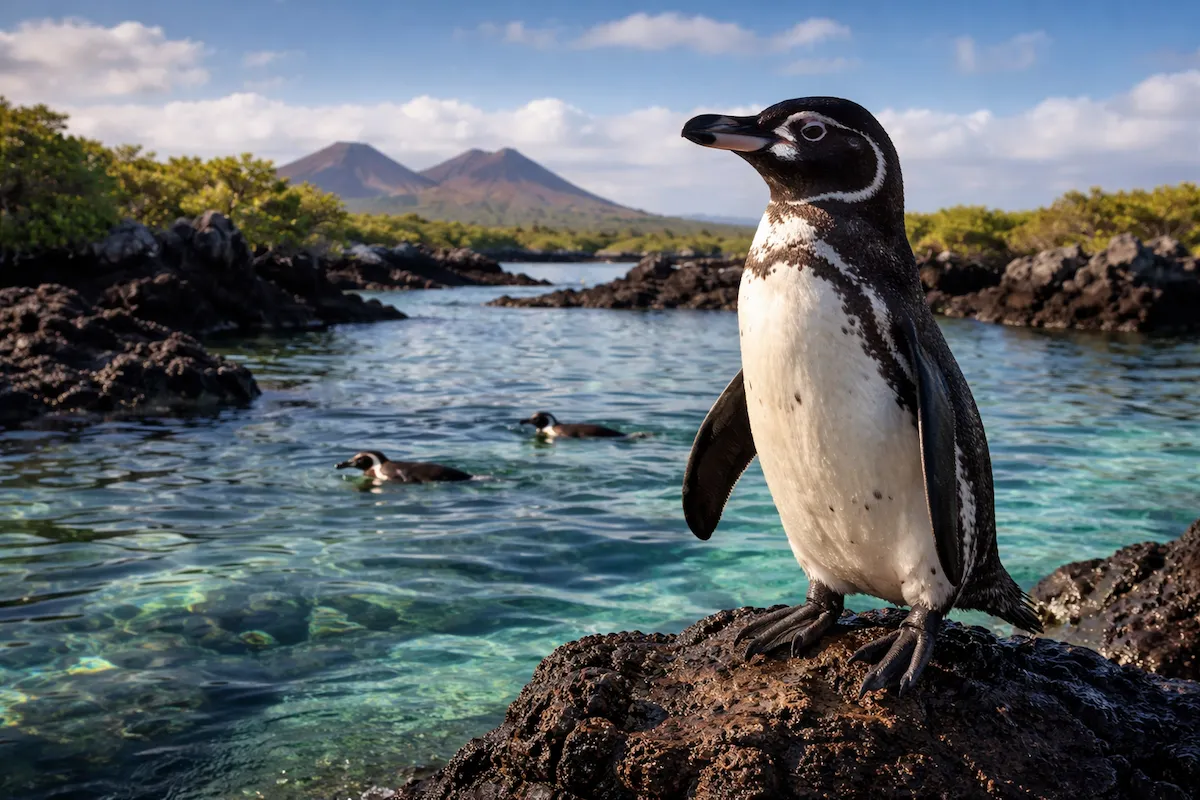
galapagos penguin
Short definition: The word galapagos penguin refers to the only penguin species living near the equator, native to the Galápagos Islands, known for adapting to warm climates and relying on cool ocean currents for survival.
Looking for a clear and natural explanation of the term galapagos penguin? This penguin often appears in wildlife guides and documentaries about the Galápagos Islands. A galapagos penguin is especially interesting because it lives closer to the equator than any other penguin species. Instead of ice and snow, it survives in a warm volcanic environment by relying on cool ocean currents. Below, each meaning is explained in a calm and natural way, with long definitions and realistic examples.
Forms: galapagos penguin (singular), galapagos penguins (plural)
Related: penguin n., seabird n., coastal wildlife n.
Syllable: ga-la-pa-gos pen-guin
-
(Noun) A small penguin species native to the Galápagos Islands, adapted to warm climates near the equator.
A galapagos penguin is a penguin that lives on and around the Galápagos Islands, making it the only penguin species found naturally so close to the equator. It has a black back, white belly, and thin black bands across the chest and face. Instead of ice, this penguin depends on cool ocean currents that bring nutrient-rich water and plenty of fish. Its body and behavior are adapted to balance heat on land and cold water at sea.
Seeing a galapagos penguin resting on dark volcanic rocks felt strange because the sun was strong and the air was warm.The guide explained that the galapagos penguin survives the heat by staying close to the water and shaded areas.We watched a galapagos penguin dive quickly into the ocean, where the water was much cooler than the land.Synonyms: Galápagos penguin species, equatorial penguin, island penguin, coastal penguin, Pacific penguin, seabird penguin, marine penguin, diving penguin, warm-climate penguin, shore-dwelling penguin, fish-eating penguin, tropical-region penguin
Antonyms: ice-dwelling penguin, emperor penguin, polar penguin, flying bird, songbird, inland bird, forest bird, desert bird, freshwater bird, airborne bird, land mammal, non-coastal species -
(Noun) A penguin species that relies on cool ocean currents rather than cold air to survive.
The galapagos penguin depends heavily on cold ocean currents that flow past the islands. These currents lower sea temperatures and support large numbers of fish, which are essential for survival. When the currents weaken, food becomes scarce and breeding success drops. In this sense, the penguin’s survival is closely tied to ocean conditions rather than land climate.
Scientists monitor ocean currents closely because the galapagos penguin depends on them for food.A warm year can be difficult for the galapagos penguin if cold water does not reach the islands.The health of the galapagos penguin population often reflects changes in the surrounding ocean.Synonyms: current-dependent penguin, ocean-reliant penguin, marine indicator species, cold-current penguin, climate-sensitive penguin, food-chain indicator, ecosystem marker, marine-dependent seabird, sensitive penguin, monitored species, ocean-linked wildlife, biodiversity indicator
Antonyms: climate-independent species, land-adapted animal, generalist species, adaptable wildlife, inland bird, freshwater bird, forest species, desert animal, urban-tolerant species, widespread species, hardy species, non-marine animal -
(Noun) A penguin species known for using shade, caves, and crevices to avoid overheating.
To cope with strong sun and high temperatures, the galapagos penguin often rests in shaded areas. It may hide in lava tunnels, rock crevices, or shaded coastal spots during the hottest parts of the day. This behavior helps regulate body temperature and conserve energy. In this sense, the penguin is an example of behavioral adaptation to a warm environment.
The galapagos penguin retreated into a shaded lava crevice as the midday sun became intense.We rarely saw a galapagos penguin standing in direct sunlight for long.Shade and cool rocks are essential for a galapagos penguin on hot days.Synonyms: heat-avoiding penguin, shade-seeking penguin, cave-using penguin, lava-crevice penguin, warm-climate seabird, behaviorally adapted penguin, shelter-using penguin, sun-avoiding species, coastal shade nester, adaptive seabird, environment-sensitive penguin, habitat-specialist penguin
Antonyms: cold-adapted penguin, ice-nesting penguin, snow-dwelling species, exposed sun-tolerant animal, desert bird, inland wildlife, forest songbird, flying seabird, airborne bird, land mammal, non-coastal species, ice-shelf species -
(Noun) A penguin species often highlighted in conservation due to its small population and limited range.
The galapagos penguin is frequently mentioned in conservation efforts because it has a small population and lives in a very limited area. Environmental changes, climate events, and human activity can quickly affect its survival. Because of this, it is closely monitored and protected. In this sense, the penguin represents the vulnerability of island wildlife.
Conservation programs focus on protecting the galapagos penguin and its feeding areas.Learning about the galapagos penguin helped visitors understand why island ecosystems are fragile.Saving the galapagos penguin also helps protect many other species in the Galápagos.Synonyms: conservation species, vulnerable penguin, endemic penguin, island-restricted species, protected seabird, monitored wildlife, biodiversity emblem, sensitive species, at-risk penguin, conservation icon, rare seabird, wildlife indicator
Antonyms: widespread species, common animal, adaptable wildlife, generalist species, inland bird, freshwater species, forest animal, urban-tolerant wildlife, resilient species, dominant species, non-endemic animal, hardy species