Definition of jupiter

Short definition: The word Jupiter refers to the largest planet in the solar system, famous for its massive size, colorful cloud bands, and powerful storms, often mentioned when people talk about space, planets, or the scale of the universe.

Looking for a clear and natural explanation of the word Jupiter? The word Jupiter is most commonly used in astronomy, science education, and space discussion. It refers to the largest planet in our solar system, known for its massive size, strong gravity, and famous Great Red Spot. Beyond science, the name Jupiter also appears in mythology and symbolic language. You will hear it in textbooks, documentaries, news about space exploration, and cultural references. Below, each meaning is explained in a calm and natural way, with enough detail to feel clear, human, and informative.

Jupiter n. /ˈdʒuːpɪtər/

Forms: Jupiter
Related: planet n., gas giant n., solar system n.
Syllable: Ju-pi-ter

  1. (Noun) The largest planet in the solar system a gas giant known for its size storms and strong gravity.

    Jupiter is the fifth planet from the sun and the largest in the solar system, made mostly of gas, famous for its massive size, powerful magnetic field, many moons, and the Great Red Spot, a huge storm that has existed for centuries.

    Jupiter dominates the night sky with its bright appearance and can often be seen even without a telescope on clear evenings.
    Scientists study Jupiter to understand gas giants and how large planets influence the structure of the solar system.
    The spacecraft sent back detailed images of Jupiter’s clouds storms and many orbiting moons.

    Synonyms: gas giant, largest planet, giant planet, solar system giant, Jovian planet, massive planet, outer planet, giant world, planetary giant, gas planet, Jovian body, solar giant
    Antonyms: small planet, dwarf planet, asteroid, moon, minor body, rocky planet, inner planet, terrestrial planet, small world, tiny object, space rock, minor planet

  2. (Noun) The Roman god associated with power authority and the sky.

    In mythology, Jupiter is the chief god of ancient Rome, ruler of the gods and the sky, often associated with thunder, authority, protection, and supreme power.

    In Roman mythology, Jupiter ruled over the gods and controlled thunder and lightning.
    Many planets were named after Roman gods, with Jupiter representing strength and leadership.
    Ancient stories describe Jupiter as a powerful figure who maintained order among gods and humans.

    Synonyms: Roman sky god, king of the gods, thunder god, supreme deity, ruling god, chief god, mythological ruler, divine authority, celestial god, Roman Zeus, sky ruler, god of power
    Antonyms: mortal, human figure, minor deity, servant god, lesser god, ordinary person, earthly being, non divine figure, powerless figure, subordinate deity, human ruler, common being
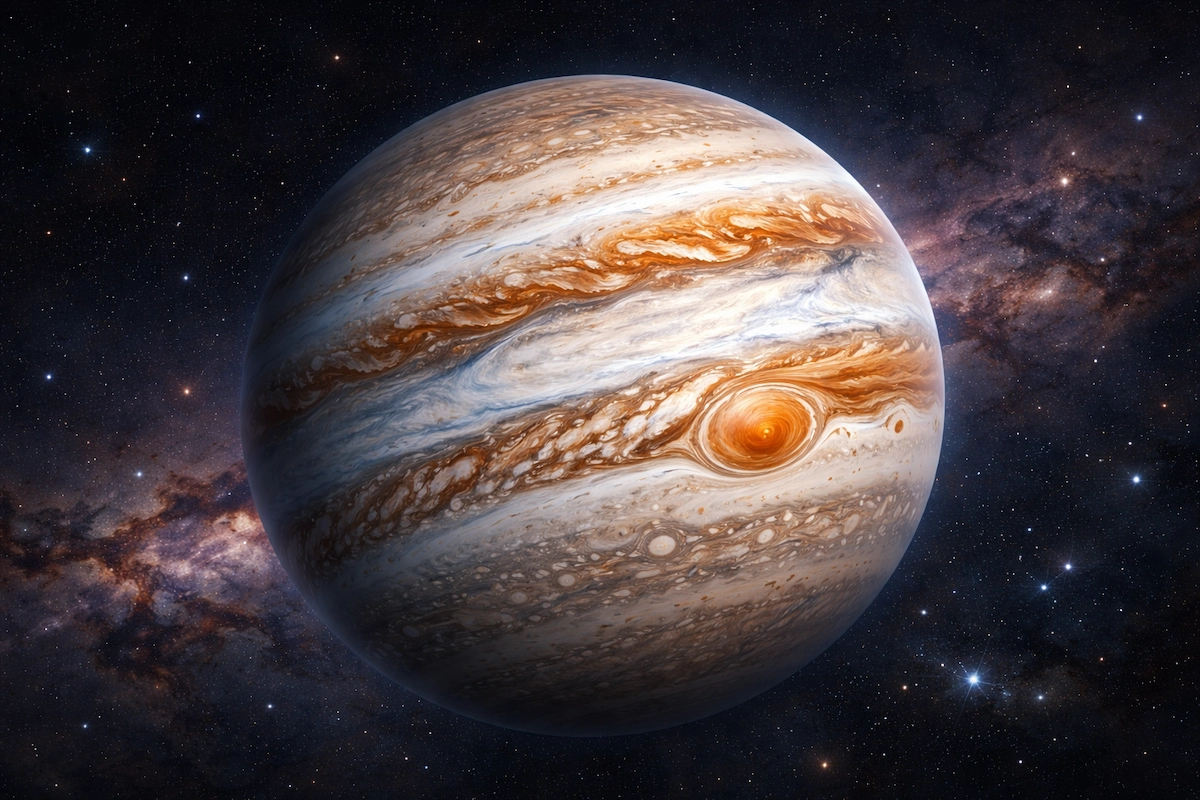
An Explanation of the Word "jupiter" in an Image

Landscape illustration of the planet Jupiter showing its colorful cloud bands, massive Great Red Spot storm, and surrounding stars in deep space.
A detailed landscape illustration of Jupiter, the largest gas giant in our solar system, highlighting its swirling cloud bands and the iconic Great Red Spot against a star-filled cosmic background.

Conversation Using the Word Jupiter

The following conversation takes place between two friends during a stargazing night. It shows how the word Jupiter is used naturally when talking about planets, curiosity, and simple observations of the sky.

The exchange reflects casual conversation sparked by seeing bright objects in space and wondering about their size and importance.

Leo: Do you see that bright point in the sky?

Ava: Yeah, that’s Jupiter, it’s really clear tonight.

Leo: It looks brighter than most stars.

Ava: That’s because Jupiter is huge and reflects a lot of sunlight.

Leo: It’s hard to imagine how big it actually is.

Ava: I know, thinking about Jupiter always puts things into perspective.

Leo: Makes Earth feel pretty small.

Ava: Exactly, space has a way of doing that.

Phrases Containing the Word Jupiter

The phrases below show how the word Jupiter is commonly used when talking about astronomy, planets, size, and space exploration.

Planet Jupiter

The gas giant itself.

Planet Jupiter is so large that all the other planets could fit inside it with room to spare.

Jupiter atmosphere

The planet’s thick gas layers.

The Jupiter atmosphere is made mostly of hydrogen and helium, with dramatic cloud patterns.

Jupiter storm

Powerful weather system.

A Jupiter storm can last for years and grow larger than the Earth itself.

Jupiter moons

Natural satellites.

Jupiter moons include dozens of objects, some of which may contain underground oceans.

Jupiter gravity

Strong gravitational force.

Jupiter gravity is strong enough to influence objects far across the solar system.

Jupiter orbit

The path around the sun.

Jupiter orbit takes nearly twelve Earth years to complete one full cycle.

Jupiter size

The planet’s vast scale.

Jupiter size is difficult to imagine without comparing it to Earth.

Jupiter rings

Faint ring system.

Jupiter rings are thin and hard to see compared to Saturn’s.

Jupiter clouds

Colorful gas layers.

Jupiter clouds form swirling bands that circle the planet.

Jupiter exploration

Scientific study missions.

Jupiter exploration has revealed complex weather and magnetic fields.

Jupiter magnetosphere

Magnetic field area.

The Jupiter magnetosphere is the largest structure in the solar system.

Jupiter formation

How the planet formed.

Studying Jupiter formation helps scientists understand early solar system history.

Jupiter distance

How far it is from the sun.

Jupiter distance from Earth changes as both planets move in their orbits.

Jupiter mission

A space probe project.

The Jupiter mission collected valuable data about its atmosphere and moons.

Jupiter view

Seeing the planet.

Through a small telescope, the Jupiter view reveals bright bands and nearby moons.

Jupiter night sky

The planet as seen from Earth.

Jupiter night sky appearances often make it one of the brightest objects after the moon.

Jupiter discovery

Early observation.

Jupiter discovery dates back to ancient civilizations who tracked its movement.

Jupiter influence

Effect on other objects.

Jupiter influence helps protect inner planets by attracting asteroids.

Jupiter science

Research about the planet.

Jupiter science combines astronomy, physics, and planetary studies.

Jupiter comparison

Size and scale contrast.

Any Jupiter comparison with Earth highlights just how massive it really is.

POS: Noun  Category: Celestial Bodies