yellow-eyed penguin
Short definition: The word yellow-eyed penguin means a rare penguin species native to New Zealand, recognized by its pale yellow eyes and head band, known for solitary nesting habits and preference for forested coastal areas.
Looking for a clear and natural explanation of the term yellow-eyed penguin? This penguin often appears in wildlife guides and conservation discussions, especially those focused on New Zealand. A yellow-eyed penguin is well known for its pale yellow eyes and the yellow band that runs across the back of its head. Unlike many penguins that gather in huge, noisy colonies, this species is more private and cautious. Below, each meaning is explained in a calm and natural way, with long definitions and realistic examples.
Forms: yellow-eyed penguin (singular), yellow-eyed penguins (plural)
Related: penguin n., seabird n., wildlife n.
Syllable: yel-low-eyed pen-guin
-
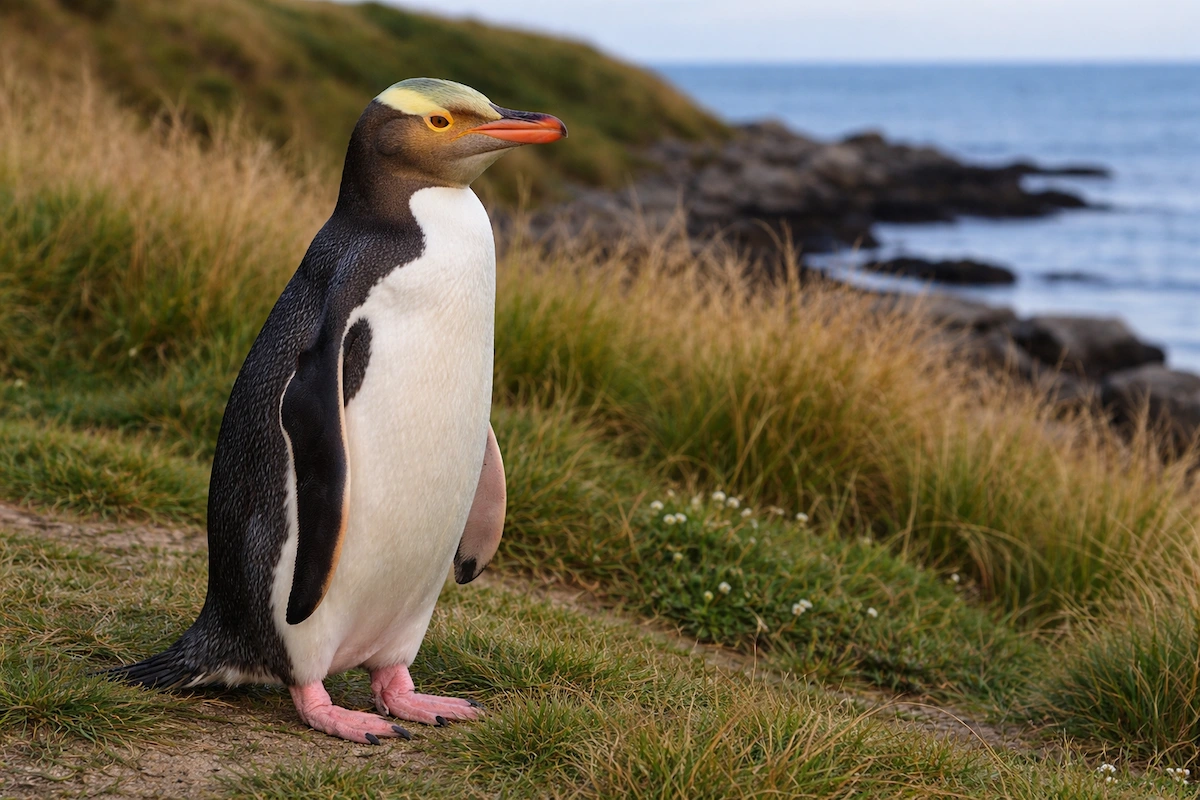
(Noun) A rare penguin species with pale yellow eyes and a yellow band across the back of the head.
A yellow-eyed penguin is a medium-sized penguin that is easy to recognize because of its light yellow eyes and the soft yellow stripe that curves from one eye to the other. Its body is mostly dark gray and white, giving it a calm and slightly serious appearance. This penguin lives mainly along the southern coast of New Zealand and on nearby islands. Because of its distinctive face and limited population, it is considered one of the most recognizable penguins in the region.
The yellow-eyed penguin stepped carefully out of the water, its pale eyes catching the light as it looked around.Once you see the eye color, it is hard to confuse a yellow-eyed penguin with any other species.We quietly watched a yellow-eyed penguin resting on the beach before it slowly made its way toward the trees.Synonyms: hoiho, New Zealand penguin, yellow-banded penguin, rare penguin, coastal penguin, island penguin, southern penguin, seabird penguin, diving penguin, marine penguin, protected penguin, wildlife penguin
Antonyms: common penguin, widespread species, flying bird, songbird, inland bird, forest bird, desert bird, freshwater bird, airborne bird, land mammal, non-coastal species, urban wildlife -
(Noun) A shy and solitary penguin that avoids large colonies and prefers hidden nesting sites.
Unlike many penguins that live in dense groups, the yellow-eyed penguin prefers space and privacy. It often nests in secluded areas such as forest edges, tall grass, or behind dunes where it is less visible. This behavior helps reduce stress and disturbance but also makes the species harder to monitor. When people describe the yellow-eyed penguin this way, they are usually highlighting its cautious and independent nature.
The ranger reminded us to keep our distance because the yellow-eyed penguin becomes stressed easily.Seeing a yellow-eyed penguin nest alone among the bushes felt very different from visiting crowded penguin colonies.The yellow-eyed penguin disappeared into the vegetation instead of staying on the open sand.Synonyms: shy penguin, solitary penguin, private nester, forest-edge penguin, reclusive seabird, disturbance-sensitive penguin, cautious penguin, low-density breeder, hidden-nest penguin, independent penguin, quiet seabird, secretive species
Antonyms: colony penguin, social penguin, group-nesting species, crowded breeder, communal penguin, beach-colony bird, noisy colony species, highly social penguin, open-nesting bird, exposed breeder, group-living wildlife, communal species -
(Noun) A penguin strongly associated with conservation efforts due to its declining population.
The yellow-eyed penguin is often mentioned in conservation contexts because its numbers have decreased over time. Threats such as habitat loss, predators, disease, and human disturbance have affected the species. As a result, it has become a focus of protection programs and public awareness campaigns. In this sense, the penguin represents the importance of protecting vulnerable wildlife.
The conservation project focused on improving nesting areas for the yellow-eyed penguin.Learning about the yellow-eyed penguin helped visitors understand why coastal protection matters.Saving the yellow-eyed penguin also helps protect many other species that share its habitat.Synonyms: conservation species, protected penguin, vulnerable species, threatened penguin, monitored wildlife, endangered seabird, rare wildlife, biodiversity indicator, sensitive species, conservation icon, at-risk penguin, protected species
Antonyms: invasive species, overabundant species, pest species, resilient generalist, adaptable wildlife, common animal, widespread species, dominant species, human-tolerant species, opportunistic species, hardy species, unmanaged wildlife -
(Noun) (By extension) A symbol of New Zealand’s unique wildlife and natural heritage.
Outside biology, the yellow-eyed penguin is often used as a symbol of New Zealand’s natural identity. Its unusual appearance and limited range make it memorable and meaningful in education and tourism. In this sense, the penguin represents uniqueness, responsibility, and the need to protect native species. It frequently appears in logos, campaigns, and learning materials related to conservation.
The visitor center displayed a yellow-eyed penguin image to highlight local wildlife protection.Children easily remembered the yellow-eyed penguin because of its bright eyes and gentle look.Using the yellow-eyed penguin as a symbol helped promote respectful wildlife tourism.Synonyms: wildlife symbol, conservation icon, native-species emblem, New Zealand wildlife icon, heritage species symbol, nature mascot, biodiversity emblem, protected wildlife image, environmental symbol, education mascot, conservation emblem, national wildlife icon
Antonyms: generic symbol, common-species image, abstract icon, corporate logo, non-animal symbol, industrial emblem, urban icon, artificial image, text-only logo, mass-market branding, non-nature theme, commercial symbol