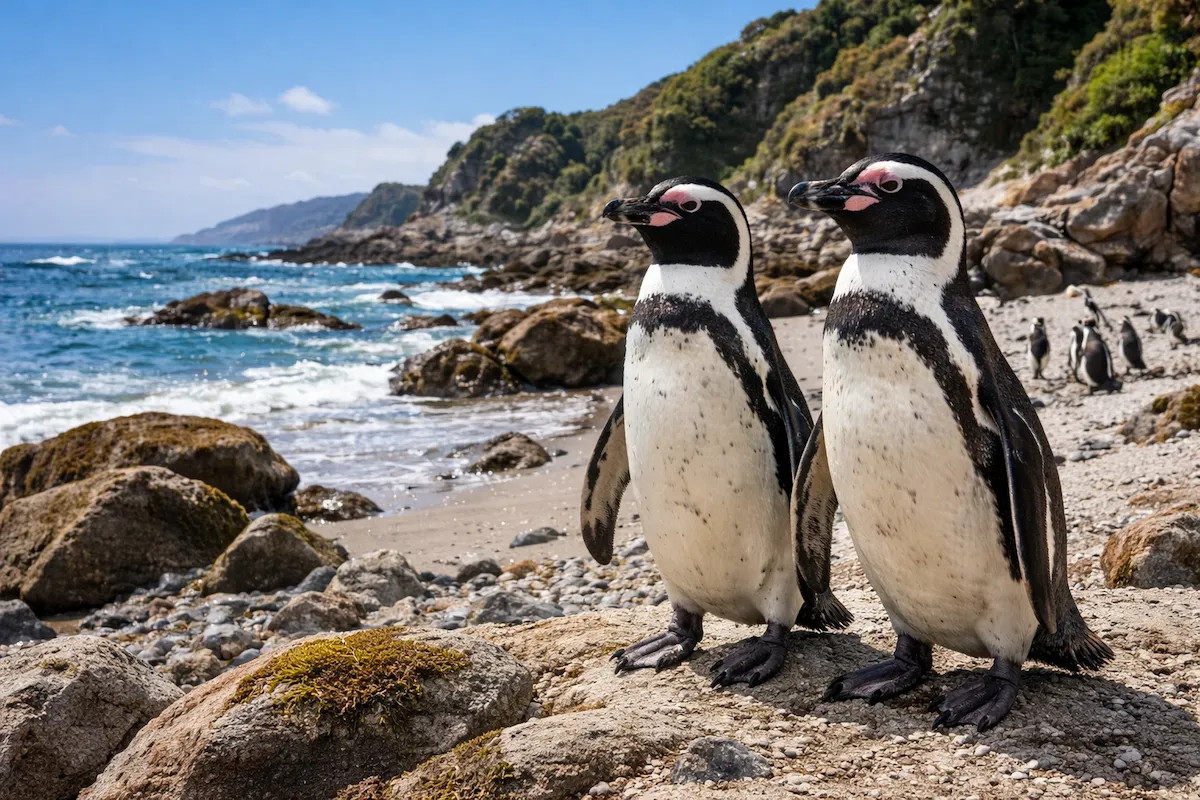
humboldt penguin
Short definition: The word humboldt penguin refers to a penguin species found along the Pacific coasts of Peru and Chile, adapted to cool ocean currents, known for nesting in burrows and feeding mainly on fish and squid.
Looking for a clear and natural explanation of the term humboldt penguin? This penguin often appears in wildlife guides, documentaries, and articles about the Pacific coast of South America. A humboldt penguin is known for its black-and-white pattern, pink facial skin, and strong link to cold ocean currents. Unlike penguins from icy regions, this species lives in a much drier, rocky coastal environment. Below, each meaning is explained in a calm and natural way, with long definitions and realistic examples.
Forms: humboldt penguin (singular), humboldt penguins (plural)
Related: penguin n., seabird n., coastal wildlife n.
Syllable: hum-boldt pen-guin
-
(Noun) A medium-sized penguin species native to the Pacific coast of South America, adapted to cool ocean currents.
A humboldt penguin is a penguin that lives along the rocky shores of Peru and Chile, where cold water from the Humboldt Current keeps the climate relatively cool. It has a black back, white belly, and a bold black band across the chest, along with patches of pink skin around the eyes and beak. These penguins spend much of their time swimming and hunting fish near the coast, returning to land mainly to rest and breed. Their appearance and lifestyle are closely tied to the ocean rather than ice or snow.
We watched a humboldt penguin swim quickly through the waves, clearly comfortable in the cold coastal water.The guide explained that the humboldt penguin relies heavily on the cold current to survive in an otherwise dry region.Seeing a humboldt penguin resting on sun-warmed rocks felt very different from seeing penguins on ice.Synonyms: Humboldt penguin species, South American penguin, coastal penguin, Pacific penguin, seabird penguin, marine penguin, diving penguin, cold-current penguin, rock-coast penguin, shore-dwelling penguin, ocean penguin, fish-eating penguin
Antonyms: ice-shelf penguin, inland bird, forest bird, flying bird, songbird, desert bird, freshwater bird, tree-dwelling bird, airborne bird, land mammal, non-coastal species, tropical land bird -
(Noun) A penguin species that nests in burrows, crevices, or caves to escape heat and predators.
Unlike penguins that nest openly on ice or beaches, the humboldt penguin often digs burrows or uses natural rock crevices. This behavior helps protect eggs and chicks from strong sunlight, predators, and temperature extremes. Nesting underground or in shaded areas is a key adaptation to living in a warmer, drier environment. When people mention humboldt penguins this way, they are usually emphasizing survival strategies rather than appearance.
The humboldt penguin disappeared into a narrow burrow carved into the rocky slope.Rangers showed us how humboldt penguins use caves to stay cool during the hottest parts of the day.A nesting humboldt penguin rarely stays in the open, preferring shaded, protected spaces.Synonyms: burrow-nesting penguin, cave-nesting penguin, shelter-seeking penguin, heat-adapted penguin, rock-nesting seabird, protected-nest penguin, crevice-nesting bird, coastal burrower, shade-nesting penguin, adaptive penguin, survival-adapted species, habitat-specialist penguin
Antonyms: open-nesting penguin, exposed breeder, ice-nesting penguin, beach-nesting bird, colony surface nester, unprotected nester, ground-nesting species, open-coast breeder, unsheltered bird, surface breeder, open-area penguin, non-burrowing species -
(Noun) A penguin often discussed in conservation due to threats from climate change and fishing activity.
The humboldt penguin is frequently mentioned in conservation efforts because its food supply depends on healthy ocean systems. Changes in sea temperature, overfishing, and human disturbance can reduce fish availability. As a result, population numbers can drop quickly when conditions change. In this sense, the penguin represents how closely marine wildlife is tied to ocean health.
Conservationists monitor humboldt penguin populations to understand changes in coastal ecosystems.A decline in humboldt penguins often signals problems with local fish stocks.Protecting the humboldt penguin also helps protect the wider marine environment.Synonyms: conservation species, vulnerable penguin, monitored seabird, threatened penguin, ecosystem indicator, marine indicator species, protected penguin, biodiversity marker, sensitive species, conservation icon, at-risk penguin, wildlife indicator
Antonyms: invasive species, overabundant species, pest species, resilient generalist, adaptable wildlife, common species, widespread animal, dominant species, human-tolerant species, opportunistic species, hardy species, unmanaged wildlife -
(Noun) (By extension) A symbol of South America’s coastal wildlife and ocean-dependent ecosystems.
Outside biology, the humboldt penguin is often used as a symbol in education and eco-tourism. Its strong link to ocean currents and fisheries makes it a powerful example of environmental balance. In this sense, the penguin represents the connection between climate, oceans, and coastal communities. It is commonly used to promote awareness of marine conservation.
The aquarium used a humboldt penguin display to teach visitors about ocean currents.Children learned about climate change through stories centered on the humboldt penguin.Seeing the humboldt penguin symbol helped explain why healthy oceans matter.Synonyms: wildlife symbol, marine conservation icon, coastal-species emblem, ocean-health symbol, biodiversity emblem, environmental mascot, marine-education icon, conservation emblem, nature symbol, coastal wildlife icon, ecosystem symbol, awareness emblem
Antonyms: generic symbol, abstract icon, corporate logo, non-animal symbol, industrial emblem, urban icon, artificial image, text-only logo, mass-market branding, non-nature theme, commercial symbol, decorative graphic