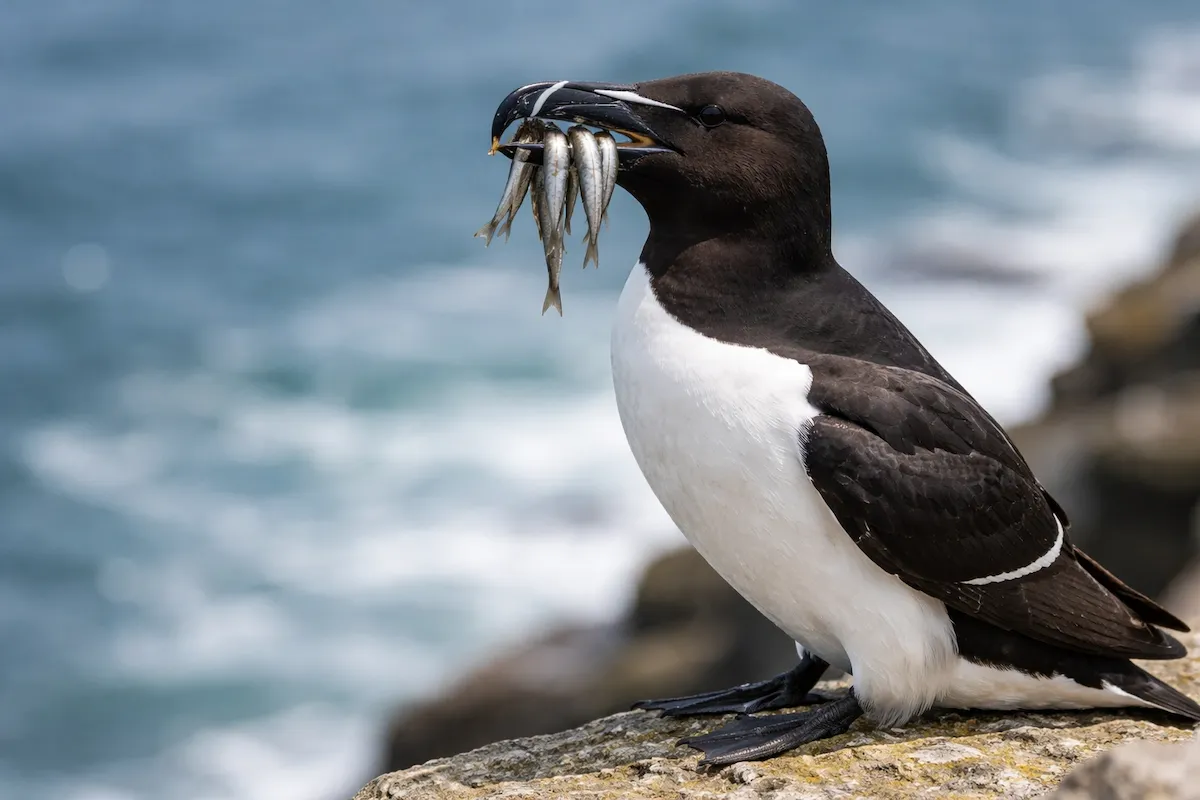
razorbill
Short definition: The word razorbill refers to a black-and-white seabird with a thick, blunt bill marked by pale lines, commonly found in the North Atlantic, known for strong diving skills and nesting on rocky coastal cliffs.
Looking for a clear and natural explanation of the word razorbill? It’s not a common “daily conversation” word unless you’re into birds, sea cliffs, or nature documentaries, but once you learn it, you’ll start noticing it in wildlife articles and coastal travel guides. A razorbill is a real seabird with a bold look—especially that thick, sharp-edged bill that gave it the name. People often confuse it with puffins or guillemots, but razorbills have their own vibe: sleek, black-and-white, and usually seen near cold northern oceans. Below are several meanings and uses explained in a calm, human way, with detailed examples that feel natural.
Forms: razorbill (singular), razorbills (plural)
Related: auk n., seabird n., alcid n.
Syllable: ra-zor-bill
-
(Noun) A black-and-white seabird with a thick, sharp-looking bill, often found around cold northern coasts and rocky sea cliffs.
A razorbill is a type of seabird that lives near the ocean—especially in cooler northern areas—and it’s easy to recognize once you know what to look for. It has a neat “tuxedo” style (dark on top, light underneath) and a chunky bill that looks a bit like a smooth, blunt blade, which is where the name comes from. People often spot razorbills standing in groups on steep cliffs or bobbing on the water near the shore, and they can dive underwater to catch fish rather than just snatching food at the surface. If you’ve ever seen a puffin and thought, “Okay, but what’s the more serious-looking cousin?”, you’re basically imagining a razorbill.
We stood quietly below the windy cliff and watched a line of razorbills shuffle along the narrow ledge, looking surprisingly calm even with waves crashing below them.On the boat tour, the guide pointed out a razorbill floating close to the rocks, and then it suddenly vanished underwater like it had dropped through a trapdoor.I thought it was a puffin at first, but the bird had a more streamlined face and that thick bill—once I saw it clearly, I realized it was a razorbill.Synonyms: auk, alcid, seabird, diving bird, sea bird, cliff-nesting bird, marine bird, coastal bird, northern seabird, pelagic bird, black-and-white seabird, fish-eating seabird
Antonyms: landbird, songbird, passerine, woodland bird, forest bird, inland bird, freshwater bird, desert bird, farm bird, tropical bird, ground bird, domestic bird -
(Noun) The specific species known as the “razorbill auk,” famous for cliff nesting and underwater hunting in the North Atlantic.
In a more exact, “field-guide” sense, razorbill often means the particular species commonly called the razorbill auk. This is the bird you’ll see mentioned in North Atlantic wildlife notes—breeding on rocky islands, raising chicks in crowded cliff colonies, and commuting between the nest and open water to bring back fish. People who like birdwatching will use razorbill this way when they’re being precise, especially when comparing it with similar birds like murres and guillemots. So if someone says, “We saw a razorbill today,” they might not mean “any seabird,” but that exact bird with the classic thick bill and clean black-and-white body pattern.
The ranger explained that the razorbill is one of the most reliable birds to spot in this area during the breeding season, because the adults keep returning to the same cliff ledges.In my notebook I wrote “one razorbill carrying fish,” because the bill shape and the crisp white line along the face were clear enough to rule out a murre.We didn’t just see “seabirds”—we saw a razorbill up close, and the guide even showed us how its bill markings differ from the nearby guillemots.Synonyms: razorbill auk, Alca torda, alcid species, auk species, North Atlantic seabird, cliff-breeding alcid, diving alcid, pelagic alcid, colonial seabird, fish-diving seabird, black-and-white alcid, offshore seabird
Antonyms: freshwater duck, garden bird, city pigeon, barn swallow, backyard bird, forest warbler, inland raptor, domestic chicken, aviary bird, cage bird, tropical parrot, desert lark -
(Noun) A coastal “marker bird” people mention when describing northern sea cliffs, offshore islands, and wildlife-rich shorelines.
Sometimes razorbill is used less like a strict biology label and more like a “scene-setting” word—one of those birds that tells you what kind of place you’re in. If a travel writer says there were razorbills on the cliffs, they’re painting a picture of cold sea air, rocky edges, and that dramatic coastline feeling where birds nest in noisy groups above the surf. In that sense, razorbill becomes a shortcut for “this coast is wild and northern,” the same way someone might mention palm trees to suggest a tropical beach. It’s still the bird, of course—but the word is doing extra work by describing the whole mood of the landscape.
The guidebook said the cliffs were “full of razorbills,” and when we finally arrived, the sound alone made it feel like the coastline was alive and busy.She described the island as raw and beautiful, with razorbills scattered along the rocks like little black-and-white punctuation marks against the grey sea.Even before we saw the lighthouse, we knew we were in the right place because the air smelled salty and there were razorbills circling and landing on the cliff shelves.Synonyms: seabird symbol, coastal wildlife sign, cliff bird, ocean bird, marine wildlife, northern coastal bird, offshore bird, colony bird, sea-cliff seabird, fish-diving bird, pelagic seabird, ocean-going bird
Antonyms: city wildlife, urban bird, street bird, backyard bird, park bird, house pet, indoor animal, aquarium fish, zoo animal, barnyard animal, farm livestock, domestic pet -
(Noun) (By extension) A razorbill-shaped or razorbill-themed design in art, logos, souvenirs, or wildlife branding—used to represent rugged coastal nature.
Outside strict nature talk, razorbill can also show up as a design reference—like when a local shop sells a “razorbill” mug, a coastal park uses a razorbill silhouette in its logo, or a tour company names itself after the bird to sound closely tied to the sea. In that kind of use, the word still points back to the bird, but it’s really about what the bird represents: wild cliffs, cold waters, and a tough little creature that belongs in that environment. People do this with animals all the time—using the name of a recognizable species to create an identity, a theme, or a “feel” for a place.
The visitor center sold a poster labeled razorbill, and it wasn’t just educational—it was meant to capture that bold, clean shape the bird makes against the horizon.Their tour brochure had a razorbill on the cover, basically saying, “This trip is about real coastal wildlife, not just pretty views.”I bought the little razorbill pin because it felt like a simple souvenir that still reminded me of the cliffs, the wind, and the whole mood of that coastline.Synonyms: wildlife emblem, coastal icon, seabird motif, marine symbol, bird silhouette, nature logo, seabird logo, coastal branding, animal emblem, conservation icon, cliff-coast symbol, marine-themed mark
Antonyms: abstract logo, generic symbol, plain pattern, non-animal design, text-only mark, geometric icon, corporate badge, urban emblem, tech icon, industrial symbol, artificial theme, non-nature branding