Definition of archaeology

Short definition: The word archaeology refers to the study of ancient human history by examining objects, structures, and sites left behind, helping people understand how earlier civilizations lived, worked, and interacted with their environment over time.

Looking for a clear and natural explanation of the word archaeology? The word archaeology is used when talking about the study of human history through physical remains. It helps us understand how people lived, worked, and thought in the past by examining objects they left behind. You will see it in history, science, education, and documentary contexts. Although it sounds academic, archaeology is deeply connected to everyday human stories. Below, each meaning is explained in a calm and natural way, with enough detail to feel clear, human, and meaningful.

archaeology n. /ˌɑːrkiˈɒlədʒi/

Forms: archaeology
Related: archaeologist n., artifact n., excavation n.
Syllable: ar-chae-ol-o-gy

  1. (Noun) The scientific study of human history and culture through physical remains left behind by past societies.

    Archaeology is the study of past human life by carefully examining objects, buildings, tools, and other material evidence found in the ground, allowing researchers to reconstruct how ancient people lived, worked, believed, and interacted with their environment.

    Archaeology helps historians understand daily life in ancient cities by analyzing homes tools and artwork uncovered during long excavations.
    She chose archaeology as a career because she wanted to uncover real evidence of how civilizations developed over time.
    Modern archaeology combines technology science and history to protect and interpret fragile sites from the past.

    Synonyms: study of ancient cultures, historical excavation, ancient history research, material history, cultural history science, past civilization study, artifact research, heritage science, ancient studies, human past research, excavation science, cultural investigation
    Antonyms: modern studies, future studies, speculation without evidence, fictional history, imagined past, unverified stories, mythology only, present focused study, forward looking research, modern sociology, future planning, contemporary analysis

  2. (Noun) The practical work of digging investigating and preserving historical sites and artifacts.

    In practice, archaeology refers to the careful fieldwork of locating excavating documenting and preserving ancient sites and objects, often involving teamwork patience and strict methods to avoid damaging valuable historical evidence.

    The archaeology project required months of careful digging recording and analysis before any conclusions could be made.
    Local archaeology revealed ruins beneath the city showing that people had lived there for thousands of years.
    Advances in archaeology now allow researchers to study sites without disturbing the ground too much.

    Synonyms: excavation work, field archaeology, site investigation, artifact recovery, historical digging, heritage excavation, cultural preservation work, ancient site research, past site exploration, field research, archaeological practice, site study
    Antonyms: site destruction, careless digging, looting, artifact theft, modern construction focus, surface only study, non scientific digging, unprotected development, damage to heritage, neglect of history, reckless excavation, uncontrolled removal
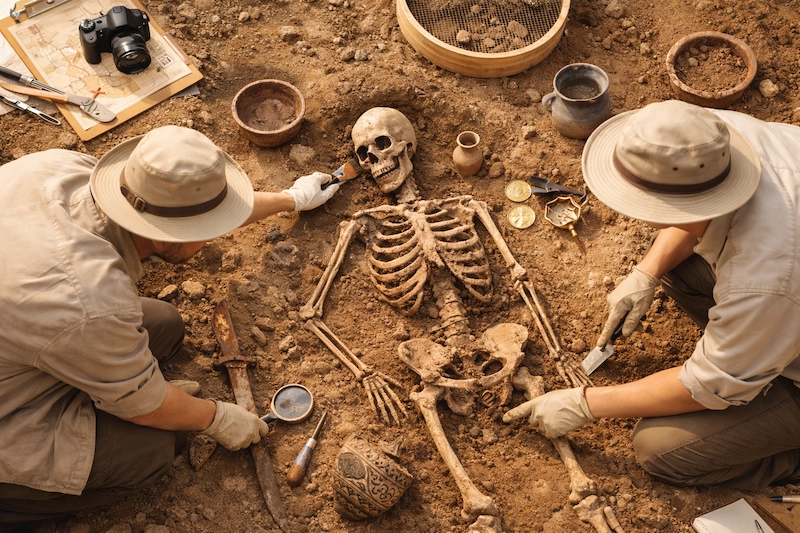
An Explanation of the Word "archaeology" in an Image

Archaeologists working at an excavation site, brushing soil from a human skeleton and surrounding artifacts during a detailed archaeology dig.
Archaeologists carefully excavating an ancient burial site, uncovering human remains and historical artifacts to study past civilizations through systematic archaeological methods.

Conversation Using the Word Archaeology

The following conversation takes place between two university students discussing their studies. It shows how the word archaeology is used naturally in academic and everyday conversation.

Emma: What are you majoring in this semester?

Lucas: Archaeology, I have always been interested in ancient civilizations.

Emma: That sounds exciting, do you actually get to visit real sites?

Lucas: Yes, archaeology involves fieldwork, and we might join an excavation next year.

Emma: I imagine it requires a lot of patience.

Lucas: Definitely, but archaeology helps you understand history in a much deeper way.

Emma: It must feel amazing to uncover something hidden for centuries.

Lucas: It really does, that sense of discovery is what makes archaeology so rewarding.

Phrases Containing the Word Archaeology

The phrases below show how the word archaeology is commonly used to talk about history, research, education, and the discovery of past civilizations.

Study archaeology

To learn archaeology as a subject.

She decided to study archaeology at university because she was fascinated by ancient cultures and forgotten cities.

Field of archaeology

The academic discipline.

The field of archaeology combines science, history, and careful observation to uncover the past.

Archaeology research

Scientific investigation of ancient remains.

Years of archaeology research helped experts better understand how early humans adapted to their environment.

Archaeology site

A place where remains are found.

The archaeology site revealed layers of history built up over thousands of years.

Archaeology discovery

An important finding.

The archaeology discovery changed what historians believed about the region.

Modern archaeology

Current archaeological practice.

Modern archaeology uses advanced technology such as drones and scanning tools.

Archaeology excavation

Careful digging work.

The archaeology excavation required patience, precision, and respect for fragile artifacts.

Archaeology findings

Results of research.

The archaeology findings provided new insight into daily life in ancient societies.

Archaeology museum

A place displaying ancient artifacts.

The archaeology museum displayed tools, pottery, and artwork from different eras.

Archaeology career

A profession in archaeology.

She chose an archaeology career knowing it required travel, dedication, and long-term research.

Archaeology methods

Techniques used in research.

New archaeology methods allow researchers to study sites without damaging them.

Archaeology evidence

Physical proof from the past.

Archaeology evidence supported theories about early trade networks.

Archaeology project

A planned research effort.

The archaeology project took several years to complete and involved experts from many countries.

Archaeology lecture

An educational talk.

The archaeology lecture attracted students curious about ancient civilizations.

Archaeology fieldwork

Practical research outside.

Archaeology fieldwork can be physically demanding but deeply rewarding.

Archaeology history

The development of the discipline.

Archaeology history shows how techniques have evolved over time.

Archaeology tools

Equipment used in excavation.

Simple archaeology tools like brushes are essential for delicate work.

Archaeology documentary

A film about discoveries.

The archaeology documentary brought ancient history to life for a wide audience.

Archaeology department

An academic division.

The university’s archaeology department is known for its international research.

Archaeology study area

A specific research focus.

The archaeology study area focused on early coastal settlements.

Words Rhyme with archaeology

biology
psychology
sociology
theology
topology
apology
technology
ideology
analogy
anthology
astrology
ecology
geology
mythology
pathology
physiology
terminology
trilogy
zoology
etymology
genealogy
chronology
criminology
dermatology
methodology
neurology
ornithology
paleontology
pharmacology
phraseology
POS: Noun  Category: Ancients