out
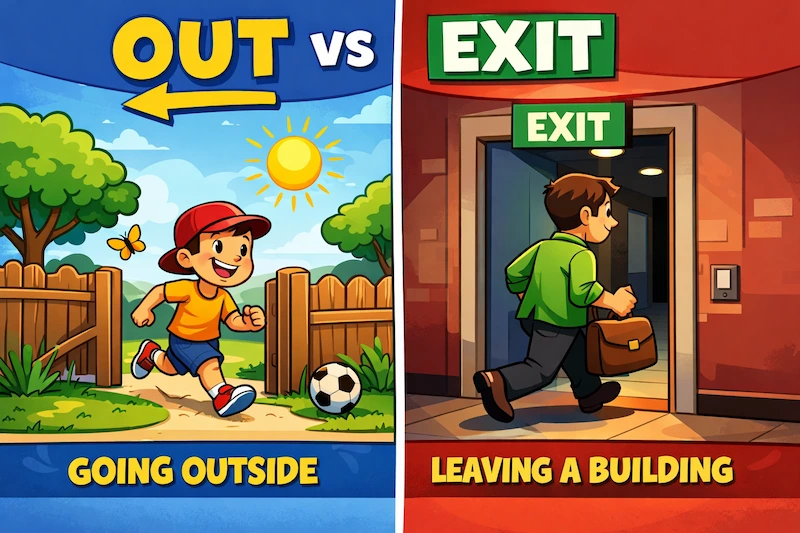
Short definition: The word out means away from the inside, not available, or finished. People use it to talk about going outside, removing something, or saying that something has ended or is no longer there.
Looking for a clear and real-life explanation of the word out? The word out appears everywhere in English—from talking about being outside, unavailable, or finished, to expressing honesty, visibility, and even emotional states. Below, each meaning is explained in a relaxed, everyday way with long examples that reflect how people truly use this small but powerful word.
Related: outing n., outdoors adv., outspoken adj.
Syllable: out
-
(Adverb) Not inside; located beyond a closed or enclosed space.
She stepped out of the office for a moment to get some fresh air, hoping the short break would help her clear her mind.The children were playing out in the yard, laughing loudly while their parents watched from the window.He looked out the window and noticed the sky turning dark, which reminded him that a storm might be coming soon.
Synonyms: outside, outdoors, beyond, externally, in the open, out of doors, on the outside, beyond the door, open-air, external, outer, outwardly
Antonyms: inside, indoors, within, internally, in, enclosed, inner, interior, inwardly, at home, inside space, in-house -
(Adverb) Not available, not functioning, or no longer active.
The power suddenly went out during the storm, leaving the entire neighborhood in darkness for several hours.This product is currently out of stock, but the store expects new shipments next week.He’s out sick today, so the meeting had to be postponed.
Synonyms: unavailable, inactive, shut down, turned off, gone, finished, depleted, exhausted, missing, discontinued, absent, offline
Antonyms: available, active, on, working, functioning, present, running, operating, stocked, supplied, enabled, online -
(Adverb) Away from one’s usual place, such as home, work, or school.
She will be out of the office this afternoon, attending a conference across town.He went out with friends after a long week, hoping to relax and forget about work for a while.The manager is out today, so urgent matters will be handled tomorrow.
Synonyms: away, absent, not in, elsewhere, off-site, gone out, out of office, unavailable locally, disengaged, away from duty, off-duty, missing
Antonyms: in, present, available, at work, at home, onsite, attending, here, reachable, on duty, around, nearby -
(Adjective) No longer fashionable, popular, or commonly accepted.
That hairstyle is completely out now, even though it was trendy just a few years ago.Printed magazines are slowly going out as more people prefer digital content.Some expressions sound out of date, especially to younger generations.
Synonyms: outdated, unfashionable, old-fashioned, obsolete, passé, behind the times, dated, no longer trendy, superseded, archaic, retired, discarded
Antonyms: fashionable, trendy, popular, current, modern, stylish, in style, up-to-date, contemporary, chic, fresh, accepted -
(Adjective) No longer included in an activity, competition,
or opportunity.
The team is officially out of the tournament, even though they played their best.After the injury, he was ruled out for the rest of the season.She felt disappointed when she realized she was out of the final round.
Synonyms: eliminated, excluded, disqualified, removed, knocked out, barred, sidelined, withdrawn, dismissed, dropped, ruled out, ejected
Antonyms: in, included, qualified, eligible, active, participating, remaining, continuing, selected, admitted, allowed, involved -
(Preposition) Away from or no longer within a particular place,
condition, or situation.
She walked out of the meeting because the discussion became too tense.He dropped out of college to start his own business.We finally ran out of time, so the presentation had to be shortened.
Synonyms: outside of, beyond, away from, lacking, without, removed from, detached from, separated from, short of, free from, beyond limits, past
Antonyms: inside of, within, in, included in, part of, supplied with, surrounded by, contained in, among, equipped with, connected to, within bounds -
(Figurative) Openly expressed or made known to others.
The truth finally came out after months of silence and speculation.He decided to speak out against the unfair policy at work.Her story is now out, and people are finally listening.
Synonyms: public, open, revealed, disclosed, exposed, announced, spoken openly, made known, uncovered, out in the open, transparent, visible
Antonyms: hidden, secret, concealed, private, covered up, undisclosed, unspoken, suppressed, confidential, kept quiet, invisible, unknown