bear in mind

Short definition: The phrase bear in mind means to remember or consider an important fact while thinking, deciding, or planning something, making sure it stays in your thoughts so it influences your understanding, judgment, or actions.

Looking for a clear and natural explanation of the phrase bear in mind? This phrase is very common in everyday English, especially when giving advice, instructions, or reminders. To bear in mind means keeping something important in your thoughts while you decide or act. You will hear it in conversations, explanations, and polite warnings. Below, each meaning is explained in a calm and natural way, with long definitions and realistic examples.

bear in mind verb phrase /beər ɪn maɪnd/

Forms: bear in mind, bears in mind, bore in mind, bearing in mind
Related: remember v., consider v., keep in mind phr.
Syllable: bear in mind

  1. (Verb Phrase) To remember or consider something important while thinking, deciding, or acting.

    To bear in mind means keeping a fact, condition, or detail in your thoughts so it influences your decision. It is often used when giving advice or explaining limits and conditions. The phrase suggests active awareness, not just memory. People usually say it before or during a decision-making process.

    You should bear in mind that prices may change during the holiday season.
    Please bear in mind the deadline when planning your schedule.
    He tried to bear in mind her feelings before responding.

    Synonyms: remember, keep in mind, consider, take into account, be aware of, not forget, hold in mind, think about, factor in, keep track of, stay aware of, give thought to
    Antonyms: forget, ignore, overlook, neglect, disregard, miss, leave out, dismiss, pay no attention to, fail to consider, lose sight of, forget about

  2. (Verb Phrase) Used as a polite reminder before giving advice, warnings, or extra information.

    Bear in mind is often used to gently introduce an important point. It softens advice and makes it sound more considerate. This usage is common in professional, educational, and polite conversation. The focus is on guidance rather than command.

    Bear in mind that the process may take longer than expected.
    Bear in mind, this offer is only available for a limited time.
    Bear in mind how sensitive this topic is before bringing it up.

    Synonyms: remember that, keep in mind that, note that, be aware that, don’t forget that, take note of, consider that, think about this, keep this in view, hold this in mind, stay mindful of, factor this in
    Antonyms: ignore the fact, forget the point, overlook the detail, dismiss the warning, pay no attention, disregard advice, miss the reminder, fail to notice, neglect the condition, ignore the warning, brush aside, tune out
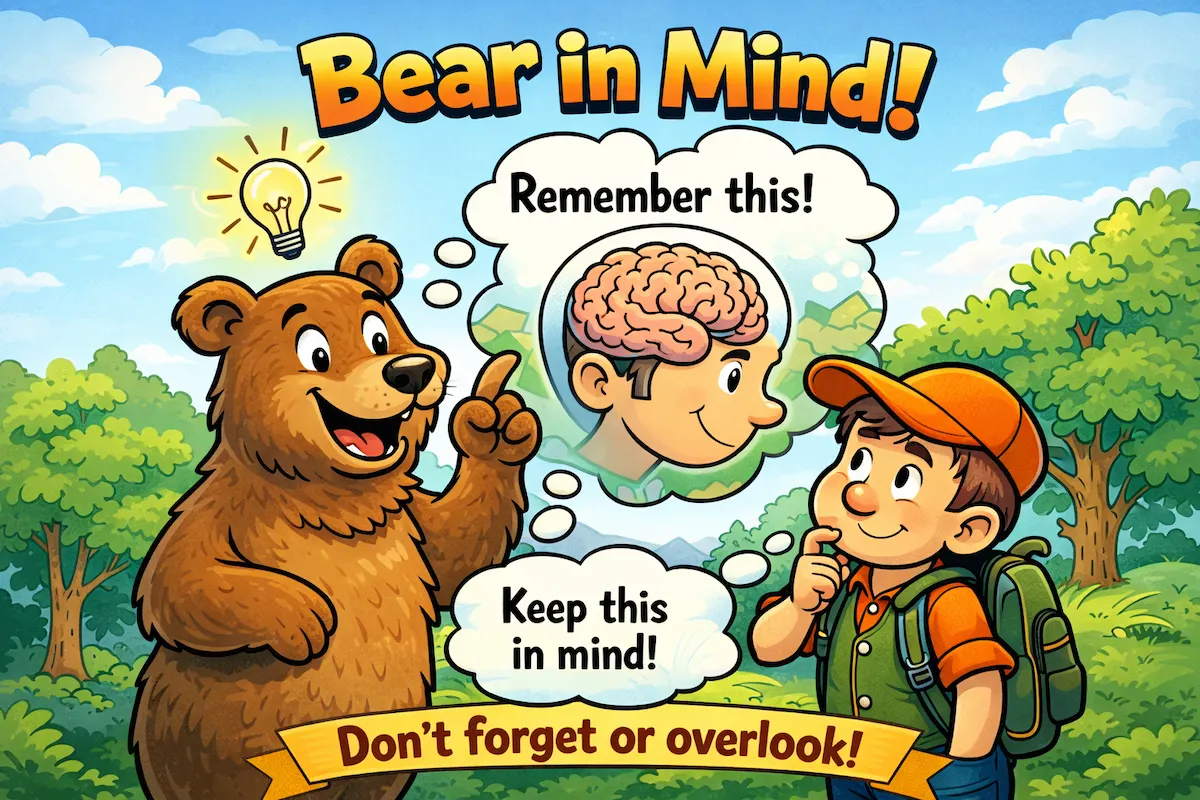
An Explanation of the Word "bear in mind" in an Image

Colorful landscape cartoon illustration of the idiom bear in mind, featuring a bear and a boy thinking together to represent remembering or considering an important point.
A friendly cartoon illustration explaining the idiom “bear in mind,” showing a smiling bear reminding a thoughtful boy to remember an important idea, symbolizing awareness, consideration, and keeping something in focus.

Conversation Using the Phrase Bear in mind

While planning a large outdoor community event, organizers Thomas and Mia discuss the logistical challenges. The dialogue explores the phrase bear in mind, which means to remember, consider, or keep a specific fact or piece of information in your thoughts when making a decision.

Thomas: When we book the park, we must bear in mind that there is no electrical outlet near the main stage area.

Mia: I’ll bear in mind the need for a generator, but we also have to bear in mind our limited budget for equipment.

Thomas: I read that planners should always bear in mind the possibility of rain and have a secondary indoor location ready.

Mia: I noticed the forecast looks clear, but I’ll bear in mind your advice and check the local community center's availability.

Thomas: Please bear in mind that the volunteers will need plenty of water and breaks if the temperature stays this high.

Mia: I’ll bear in mind the schedule for rotations so that nobody gets too tired or dehydrated during the festival.

Thomas: I saw that the town council wants us to bear in mind the local noise ordinances after ten o'clock at night.

Mia: I’ll bear in mind the volume levels; it’s important to stay on good terms with the neighbors while we celebrate.

Thomas: I’m glad we’re being thorough; if we bear in mind all these details, the event should be a huge success.

Mia: I agree; it’s much better to bear in mind the potential problems now than to deal with them as surprises later.

Phrases Containing the Expression Bear in Mind

The phrases below show how the expression bear in mind is used to remind someone to consider important facts, limitations, or context before making a decision.

Bear in mind

To remember an important point.

Bear in mind that small delays can add up over time, especially when a project depends on many people.

Bear in mind the deadline

To remember a time limit.

Please bear in mind the deadline when planning your tasks, as there will be no extensions.

Bear in mind the context

To consider surrounding circumstances.

Before judging her response, bear in mind the context in which the decision was made.

Bear in mind the consequences

To consider possible results.

You should bear in mind the consequences before sharing sensitive information online.

Bear in mind the limitations

To remember existing constraints.

When reviewing the proposal, bear in mind the limitations of the current budget.

Bear in mind the audience

To consider who is listening or reading.

Bear in mind the audience when choosing your words during a public presentation.

Bear in mind the risks

To remember possible dangers.

Investors should bear in mind the risks before committing large sums of money.

Bear in mind personal differences

To consider individual situations.

Bear in mind personal differences, as not everyone reacts the same way under pressure.

Bear in mind the long term

To think about future effects.

When making this choice, bear in mind the long-term impact rather than short-term convenience.

Bear in mind previous experience

To remember what happened before.

Bear in mind previous experience so you don’t repeat the same mistakes.

Bear in mind the bigger picture

To consider overall goals.

Bear in mind the bigger picture instead of focusing on one small detail.

Bear in mind cultural differences

To consider cultural context.

When working internationally, bear in mind cultural differences in communication styles.

Bear in mind the instructions

To remember given directions.

Bear in mind the instructions carefully, as missing one step could cause problems later.

Bear in mind changing conditions

To consider uncertainty.

Bear in mind changing conditions when planning outdoor activities.

Bear in mind the pressure

To consider stress factors.

Bear in mind the pressure she was under before criticizing her decision.

Bear in mind the schedule

To remember time planning.

Please bear in mind the schedule so the team can coordinate smoothly.

Bear in mind future changes

To consider upcoming shifts.

Bear in mind future changes in technology when choosing a long-term solution.

Bear in mind emotional impact

To consider feelings.

Bear in mind the emotional impact your words may have on others.

Bear in mind practical concerns

To consider real-world issues.

Bear in mind practical concerns such as cost and maintenance before deciding.

Bear in mind past feedback

To remember earlier responses.

Bear in mind past feedback so improvements are actually meaningful.

Words Rhyme with bear in mind

care in kind
fair in wind
dare in bind
rare in find
stare in blind
share in lined
spare in signed
wear in mind
tear in bind
glare in kind
mind
find
kind
bind
blind
hind
grind
lined
signed
wind
behind
remind
unwind
mankind
combined
aligned
refined
designed
assigned
inclined
POS: Verb Phrase