whimbrel

Short definition: The word whimbrel means a medium-sized wading bird related to curlews, recognized by its striped head and curved bill, often seen along shorelines during migration and known for long-distance coastal travel.

Looking for a clear and natural explanation of the word whimbrel? The word whimbrel is mainly used in birdwatching, wildlife studies, and coastal nature writing. It refers to a large migratory shorebird known for its long downcurved bill and striped head. You will hear it in discussions about mudflats, beaches, tundra breeding grounds, and long-distance migration. Although not common in everyday conversation, it appears often in field guides and birding reports. Below, each meaning is explained in a calm and natural way, with enough detail to feel clear, human, and informative.

whimbrel n. /ˈwɪmbrəl/

Forms: whimbrel, whimbrels
Related: curlew n., shorebird n., wader n.
Syllable: whim-brel

  1. (Noun) A large migratory shorebird with a long curved bill and bold head stripes often seen along coasts and mudflats.

    A whimbrel is a long legged wading bird recognized by its downcurved bill brown streaked body and distinctive striped crown commonly found feeding on crabs insects and marine invertebrates along shorelines wetlands and open tidal areas.

    The whimbrel probed deeply into the wet sand with its curved bill as waves rolled in and out along the quiet beach.
    Birdwatchers identified the whimbrel by its head stripes and slightly smaller size compared to a curlew.
    During migration whimbrels travel vast distances stopping at coastal mudflats to rest and refuel.

    Synonyms: shorebird, wading bird, curlew relative, coastal wader, migratory shorebird, mudflat bird, long billed wader, wetland bird, tidal flat bird, probing bird, marine feeder, coastal species
    Antonyms: forest bird, tree dwelling bird, domestic bird, flightless bird, inland land bird, raptor, seed eating bird, woodland species, urban bird, non migratory bird, ground running bird, landlocked species

  2. (Noun) A shorebird known for its clear whistling calls and alert behavior during migration.

    Whimbrels are also known for their distinctive whistling calls and watchful behavior often vocalizing while flying in groups or when disturbed on feeding grounds during migration.

    The sharp whistling calls of the whimbrel echoed over the marsh as the flock lifted into the air together.
    Its repeated calls helped birders locate the whimbrel before it came into view.
    Researchers note that whimbrels remain highly alert when resting in open coastal habitats.

    Synonyms: vocal shorebird, alert wader, warning bird, vigilant species, calling wader, migratory signal bird, watchful shorebird, group calling bird, attentive species, early warning bird, aware feeder, responsive bird
    Antonyms: silent bird, passive species, quiet shorebird, non vocal animal, indifferent bird, unalert species, calm wildlife, non defensive bird, unaware animal, quiet feeder, low response species, inactive bird
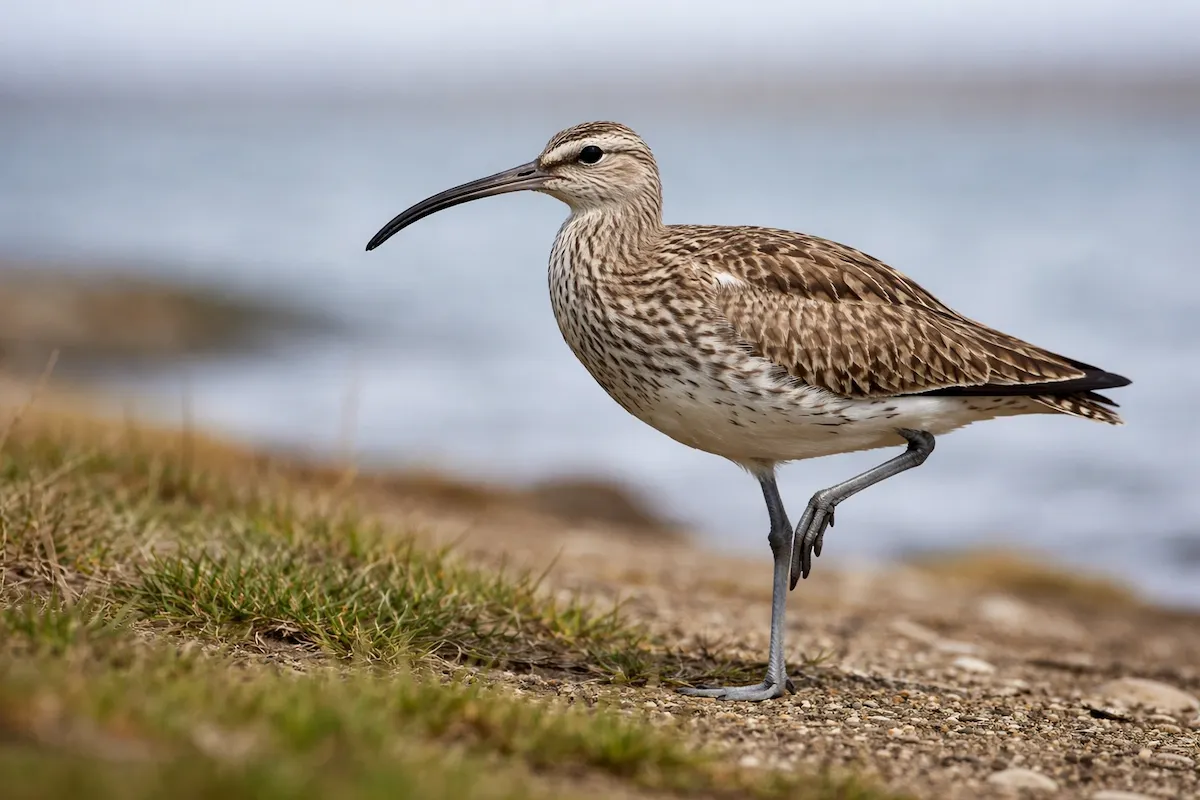
An Explanation of the Word "whimbrel" in an Image

A whimbrel bird standing on short grass near the coast, showing a long curved bill, streaked brown feathers, gray legs, and calm ocean water blurred in the distance.
A detailed wildlife photograph of a whimbrel standing along a grassy coastal edge, highlighting its long downcurved bill, streaked brown plumage, and alert posture against a soft seaside background.

Conversation Using the Word Whimbrel

This conversation takes place on a grassy headland between Chloe and Arthur. It focuses on the whimbrel's curved beak and its distinctive striped head.

Chloe: Look at that large bird over there; is that a curlew or a whimbrel feeding in the grass?

Arthur: If you look at the head through the scope, you’ll see the dark crown stripes that define it as a whimbrel.

Chloe: Ah, I see them now! The whimbrel also has a shorter beak with a more abrupt curve than a curlew.

Arthur: That’s a perfect observation; the whimbrel is like a more compact, sporty version of its larger cousin.

Chloe: It seems to be eating berries or insects from the shrubs rather than probing the mud like other waders.

Arthur: During migration, a whimbrel will often stop in coastal heathlands to fuel up on crowberries.

Chloe: I love the rippling, whistling call the whimbrel makes; it sounds like a series of seven or eight fast notes.

Arthur: That’s why some old-timers used to call the whimbrel the 'seven-whistler' bird.

Chloe: It’s amazing to think this whimbrel might fly all the way to the Arctic tundra from South America.

Arthur: They are incredible long-distance athletes; the whimbrel is built for thousands of miles of non-stop flight.

Chloe: I feel lucky to see a whimbrel today, as they usually only stay in this area for a few days at a time.

Arthur: Let’s enjoy the view of the whimbrel while we can before it continues its epic journey north.

Phrases Containing the Word Whimbrel

The phrases below show how the word whimbrel is used to describe long-billed shorebirds, their coastal movements, and their presence on mudflats and open shorelines.

Eurasian whimbrel

A well-known whimbrel species.

The Eurasian whimbrel walked slowly along the mudflat, its long curved bill probing deeply for hidden prey.

Whimbrel on tidal flats

A whimbrel feeding in exposed coastal areas.

The whimbrel on tidal flats searched patiently as the water continued to recede.

Whimbrel probing the sand

A whimbrel searching for food.

The whimbrel probing the sand moved slowly, inserting its bill far below the surface.

Whimbrel calling repeatedly

A whimbrel making its distinctive call.

The whimbrel calling repeatedly could be heard long before the bird was seen.

Whimbrel behavior

The typical actions of whimbrels.

Whimbrel behavior is cautious, deliberate, and closely tied to the movement of the tides.

Whimbrel in coastal wetlands

A whimbrel living near the sea.

A whimbrel in coastal wetlands fed along shallow channels left by the tide.

Whimbrel silhouette

The outline of a whimbrel.

The whimbrel silhouette showed a long neck and strongly curved bill.

Whimbrel in early morning

A whimbrel active at dawn.

The whimbrel in early morning light moved steadily through misty air.

Whimbrel near salt marshes

A whimbrel close to grassy wetlands.

A whimbrel near salt marshes stayed close to the water’s edge.

Whimbrel feeding alone

A solitary whimbrel.

The whimbrel feeding alone seemed completely focused on its search for food.

Whimbrel flock

A group of whimbrels together.

A whimbrel flock lifted suddenly into the air with loud calls.

Whimbrel feeding at low tide

A whimbrel hunting on exposed mud.

The whimbrel feeding at low tide took advantage of newly uncovered feeding areas.

Whimbrel resting quietly

A whimbrel pausing activity.

The whimbrel resting quietly stood on one leg near the shoreline.

Whimbrel pair

Two whimbrels together.

A whimbrel pair foraged close together, rarely straying far apart.

Whimbrel across open beaches

A whimbrel seen at a distance.

A whimbrel across open beaches moved slowly against the wind.

Whimbrel watching carefully

A whimbrel staying alert.

The whimbrel watching carefully raised its head at every movement nearby.

Whimbrel in migration

A whimbrel traveling seasonally.

The whimbrel in migration stopped briefly to rest and feed.

Whimbrel feeding quietly

A whimbrel eating calmly.

The whimbrel feeding quietly focused entirely on prey hidden below the sand.

Whimbrel near shallow pools

A whimbrel using calm water.

A whimbrel near shallow pools probed repeatedly along the edges.

Familiar whimbrel

A whimbrel often seen in the same place.

The familiar whimbrel returned each season to the same coastal flat.

Words Rhyme with whimbrel

bell
cell
fell
hell
shell
spell
tell
well
yell
dwell
swell
smell
quell
compel
expel
repel
impel
excel
hotel
motel
farewell
parallel
personnel
gazelle
bagatelle
mackerel
pickerel
doggerel
asphodel
petrel
POS: Noun  Category: Birds