curlew

Short definition: The word curlew refers to a large wading bird with a very long curved bill, commonly found in coastal marshes and open moorlands, known for its haunting calls and slow, graceful flight.

Looking for a clear and natural explanation of the word curlew? The word curlew is mainly used in birdwatching, wildlife studies, and coastal nature writing. It refers to a large shorebird famous for its very long downcurved bill and haunting calls. You will hear it in discussions about wetlands, tidal flats, moorlands, and long-distance migration. Although not common in everyday conversation, it appears often in field guides and birding reports. Below, each meaning is explained in a calm and natural way, with enough detail to feel clear, human, and informative.

curlew n. /ˈkɜːrˌluː/

Forms: curlew, curlews
Related: shorebird n., wader n., whimbrel n.
Syllable: cur-lew

  1. (Noun) A large wading bird with a very long downcurved bill and long legs often seen along coasts and open wetlands.

    A curlew is a large migratory shorebird recognized by its extremely long curved bill brown mottled plumage and long legs, commonly found feeding on worms crabs and insects in mudflats marshes grasslands and coastal wetlands.

    The curlew slowly probed the wet mud with its long curved bill pulling out small creatures as the tide moved gently across the flat.
    Birdwatchers spotted the curlew from far away thanks to its tall shape and unmistakable bill silhouette.
    During migration curlews travel vast distances stopping at estuaries and coastal wetlands to rest and feed.

    Synonyms: shorebird, wading bird, coastal wader, migratory shorebird, long billed wader, wetland bird, tidal flat bird, probing bird, marsh bird, large wader, coastal species, mudflat feeder
    Antonyms: forest bird, tree dwelling bird, domestic bird, flightless bird, inland land bird, raptor, seed eating bird, woodland species, urban bird, non migratory bird, ground running bird, landlocked species

  2. (Noun) A shorebird known for its loud haunting calls that carry over open landscapes.

    Curlews are also known for their distinctive echoing calls often described as mournful or haunting, which are commonly heard over open wetlands grasslands and coastal areas especially during breeding season.

    The haunting call of a curlew echoed across the marsh creating a quiet dramatic atmosphere at sunset.
    Many people associate the sound of curlews with wide open landscapes and untouched nature.
    Researchers note that curlew calls play an important role in communication and territory defense.

    Synonyms: vocal shorebird, calling wader, alert bird, signaling species, haunting call bird, warning bird, communicative wader, expressive shorebird, sound marker species, territorial caller, awareness bird, audible species
    Antonyms: silent bird, passive species, quiet shorebird, non vocal animal, indifferent bird, unalert species, calm wildlife, non defensive bird, unaware animal, quiet feeder, low response species, inactive bird
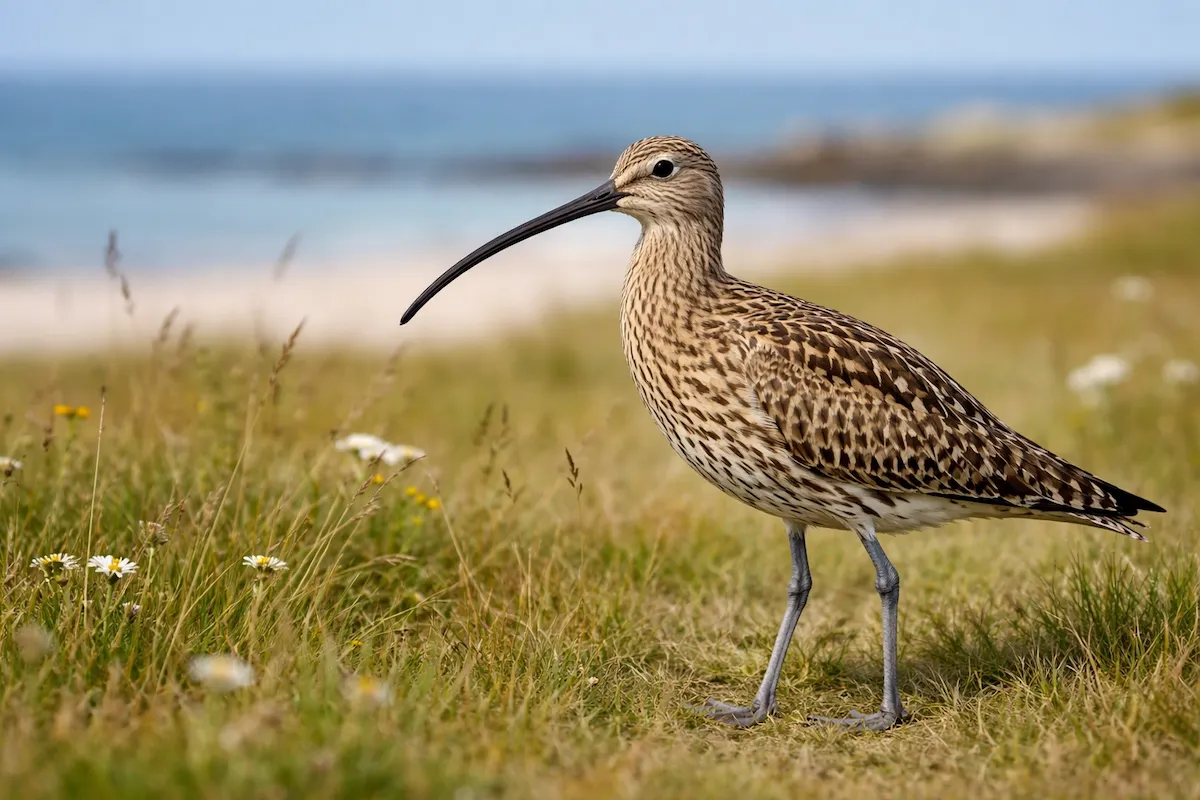
An Explanation of the Word "curlew" in an Image

A curlew bird standing on grass near the coast, showing an extremely long curved bill, mottled brown feathers, long gray legs, and a calm seaside background.
A detailed wildlife photograph of a curlew standing in a grassy coastal meadow, highlighting its very long downcurved bill, streaked brown plumage, and tall gray legs with the sea softly blurred behind.

Conversation Using the Word Curlew

This conversation takes place on a misty estuary between Sophie and Thomas. It describes the curlew's iconic long beak and its haunting, beautiful song.

Sophie: There is no sound quite as lonely and beautiful as the call of a curlew over the salt marsh.

Thomas: I agree; that bubbling "cur-lee" rise is the true soundtrack of the wild British coast.

Sophie: Look at the length of that beak! How does the curlew manage to carry such a long, curved tool around?

Thomas: It’s perfectly designed for reaching deep into lugworm burrows where other birds simply can't reach.

Sophie: I’ve noticed the curlew is much more cautious than the other birds; it flies away if we get anywhere near it.

Thomas: The curlew is a very shy bird, which is why you usually need a good pair of binoculars to see them well.

Sophie: Is it true that the curlew is currently a bird of high conservation concern due to falling numbers?

Thomas: Sadly, yes; the curlew is struggling because its grassland nesting sites are being disturbed or built upon.

Sophie: It would be a tragedy if we lost the curlew; the moors and estuaries would feel so silent without them.

Thomas: That’s why there are so many projects now dedicated to protecting the curlew and its fragile eggs.

Sophie: Look at that curlew landing on the mud—it looks so statuesque and ancient against the gray sky.

Thomas: It really is one of our most iconic birds, and I hope the curlew remains a part of this landscape forever.

Phrases Containing the Word Curlew

The phrases below show how the word curlew is used to describe large shorebirds, their long curved bills, and their presence in wetlands and open landscapes.

Eurasian curlew

A well-known curlew species.

The Eurasian curlew stood tall in the marsh, its long bill curving gracefully downward.

Curlew calling across wetlands

A curlew making its haunting call.

The curlew calling across wetlands created a lonely, echoing sound.

Curlew probing deep mud

A curlew searching for food.

The curlew probing deep mud searched for worms far below the surface.

Curlew in open grasslands

A curlew living away from the coast.

A curlew in open grasslands walked slowly between patches of tall grass.

Curlew behavior

The typical actions of curlews.

Curlew behavior is cautious, watchful, and strongly tied to seasonal changes.

Curlew silhouette

The outline of a curlew.

The curlew silhouette showed a long neck and dramatically curved bill.

Curlew in early morning

A curlew active at dawn.

The curlew in early morning mist appeared almost ghostly.

Curlew feeding slowly

A curlew eating deliberately.

The curlew feeding slowly paused between each careful probe.

Curlew near tidal flats

A curlew close to the sea.

A curlew near tidal flats followed the retreating tide.

Curlew resting quietly

A curlew pausing activity.

The curlew resting quietly stood motionless despite strong winds.

Curlew flock

A group of curlews together.

A curlew flock gathered briefly before taking flight.

Curlew in breeding season

A curlew active while nesting.

Curlew in breeding season became highly vocal and defensive.

Curlew near marsh edges

A curlew close to vegetation.

A curlew near marsh edges stayed alert for danger.

Curlew flying overhead

A curlew in flight.

The curlew flying overhead gave a long, mournful call.

Curlew across open plains

A curlew seen at a distance.

A curlew across open plains moved steadily against the wind.

Curlew watching carefully

A curlew staying alert.

The curlew watching carefully froze at sudden movement.

Curlew in migration

A curlew traveling seasonally.

The curlew in migration paused briefly to feed before continuing its journey.

Curlew feeding quietly

A curlew eating calmly.

The curlew feeding quietly focused entirely on hidden prey.

Curlew near shallow pools

A curlew using calm water.

A curlew near shallow pools searched methodically.

Familiar curlew

A curlew often seen in the same place.

The familiar curlew returned each year to the same marsh.

Words Rhyme with curlew

view
new
clue
blue
true
you
too
shoe
stew
knew
crew
flew
grew
due
few
skew
through
adieu
venue
menu
nephew
into
unto
tattoo
kazoo
bamboo
mildew
preview
review
interview
POS: Noun  Category: Birds, Animals