Definition of ostrich

Short definition: The word ostrich refers to a very large bird with long legs and a long neck that cannot fly but can run extremely fast, and it is often mentioned when talking about wildlife, speed, or unusual animal behavior.

Looking for a clear and natural explanation of the word ostrich? The word ostrich is commonly used when talking about large birds, wildlife, and well known animal behavior. It refers to the biggest living bird in the world, famous for its long legs and inability to fly. Beyond biology, the word is sometimes used figuratively to describe avoidance behavior. You will hear it in nature discussions, documentaries, and everyday expressions. Below, each meaning is explained in a calm and natural way, with enough detail to feel clear, human, and practical.

ostrich n. /ˈɒstrɪtʃ/

Forms: ostrich, ostriches
Related: bird n., flightless adj., wildlife n.
Syllable: os-trich

  1. (Noun) A very large flightless bird with long legs and a long neck native to Africa.

    An ostrich is the largest living bird, unable to fly but capable of running at very high speeds, with powerful legs, a long neck, and a strong body adapted for life on open land rather than in the air.

    The ostrich ran across the open plain with incredible speed, easily outpacing the vehicle that followed it during the wildlife tour.
    Visitors were surprised by how tall the ostrich looked when it raised its long neck above the fence.
    A documentary explained how the ostrich uses its strong legs for defense and fast escape rather than flight.

    Synonyms: large flightless bird, African bird, running bird, ground dwelling bird, giant bird, non flying bird, long legged bird, savanna bird, heavy bird species, land bird, tall bird, fast runner bird
    Antonyms: flying bird, small bird, songbird, airborne bird, light bird, winged flier, tree dwelling bird, hovering bird, flying species, aerial animal, sky bird, flight capable bird

  2. (Noun) A person who avoids reality or refuses to face an obvious problem.

    Figuratively, an ostrich describes someone who ignores clear problems or unpleasant facts, based on the false idea that ostriches hide their heads to avoid danger, meaning the person chooses denial instead of action.

    He acted like an ostrich about his financial troubles, hoping the issues would disappear if he ignored them long enough.
    The manager was criticized for being an ostrich and refusing to address obvious problems in the team.
    Pretending nothing is wrong does not help, she said, calling that kind of thinking ostrich behavior.

    Synonyms: avoider, reality denier, problem ignorer, head in the sand person, denial based thinker, avoidant person, escapist, non confronter, passive avoider, reality dodger, denial driven person, conflict avoider
    Antonyms: realist, problem solver, confrontational thinker, proactive person, truth accepter, responsible individual, decisive actor, direct thinker, face reality person, action taker, practical person, honest responder
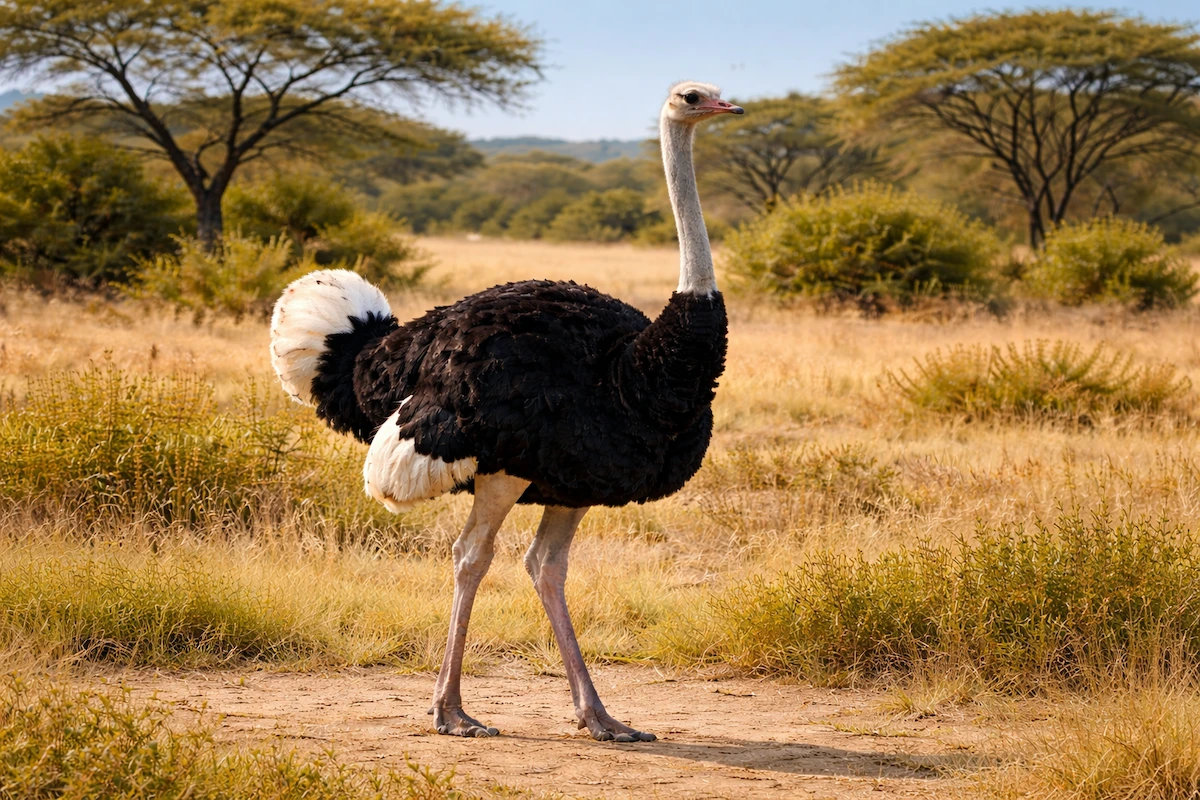
An Explanation of the Word "ostrich" in an Image

Clear landscape photo of an ostrich standing in dry grassland at midday, showing its long neck, black-and-white feathers, and tall legs in sharp focus.
A crisp landscape photo of an ostrich standing on a sandy path in open savannah under bright midday light, with acacia trees and clear sky in the background.

Conversation Using the Word Ostrich

The following conversation takes place between two travelers visiting a wildlife reserve. It shows how the word ostrich is used naturally when talking about animals, size, and surprising characteristics.

The conversation reflects how people often react with curiosity and amazement when seeing large animals up close for the first time.

Emma: I didn’t realize an ostrich was that tall.

Lucas: Same here, it’s much bigger than I imagined from photos.

Emma: Look at its legs, they look incredibly strong.

Lucas: Yeah, an ostrich can run faster than most animals around here.

Emma: I used to think they hid their heads in the sand.

Lucas: That’s just a myth, they actually rely on speed and awareness.

Emma: Seeing an ostrich this close is really impressive.

Lucas: Definitely, it makes wildlife feel very real.

Phrases Containing the Word Ostrich

The phrases below show how the word ostrich is commonly used when talking about animals, behavior, speed, and figurative meaning in everyday English.

Ostrich farm

A place where ostriches are raised.

They visited an ostrich farm to learn how these large birds are cared for and protected.

Ostrich egg

A very large egg.

An ostrich egg is so big that it can feed several people at once.

Ostrich feathers

Soft decorative feathers.

Ostrich feathers were once popular in fashion and stage costumes.

Ostrich running speed

How fast it can run.

The ostrich running speed can reach impressive levels over open ground.

Ostrich behavior

Typical actions of the bird.

Ostrich behavior includes using powerful legs to defend itself when threatened.

Ostrich habitat

The natural environment.

The ostrich habitat is usually open land where running space is available.

Ostrich neck

The long neck.

The ostrich neck helps the bird see predators from far away.

Ostrich legs

Strong running limbs.

Ostrich legs are extremely powerful and built for speed.

Ostrich kick

A defensive strike.

An ostrich kick can be dangerous due to the bird’s strength.

Ostrich in the wild

The bird in nature.

Seeing an ostrich in the wild is unforgettable because of its size.

Ostrich size

Its large body.

The ostrich size surprises people who have only seen pictures.

Ostrich wings

Non-flying wings.

Although ostrich wings cannot lift it into the air, they help with balance while running.

Ostrich feathers spread

Opening feathers.

The ostrich feathers spread slightly as it changed direction.

Ostrich diet

What it eats.

The ostrich diet includes plants, seeds, and small insects.

Ostrich myth

A common false belief.

The ostrich myth about hiding its head in the sand is not true.

Ostrich awareness

Alertness to danger.

Ostrich awareness helps it survive in open environments.

Ostrich movement

Running motion.

Ostrich movement looks smooth and powerful across flat land.

Ostrich chicks

Young ostriches.

Ostrich chicks follow adults closely for protection.

Ostrich protection

Safety behavior.

Ostrich protection relies more on speed than hiding.

Ostrich species

Types of ostriches.

There are different ostrich species adapted to various regions.

Words Rhyme with ostrich

rich
witch
switch
stitch
pitch
ditch
hitch
niche
glitch
twitch
snitch
flitch
bewitch
enrich
unhitch
backstitch
hemstitch
topstitch
fever pitch
sales pitch
quitch
shitch
kitschy
breech
leech
reach
speech
teach
beach
bleach
POS: Noun  Category: Animals, Birds