bite your tongue

Short definition: The phrase bite your tongue means to stop yourself from saying something you want to say, especially when it could be rude, hurtful, or cause conflict, choosing silence to avoid trouble.

Looking for a clear and natural explanation of the phrase bite your tongue? This idiom is very common in everyday English, especially in situations that involve self-control and emotions. To bite your tongue means stopping yourself from saying something you really want to say. You will hear it in conversations about politeness, conflict, and avoiding trouble. Below, each meaning is explained in a calm and natural way, with long definitions and realistic examples.

bite your tongue idiom /baɪt jʊr tʌŋ/

Forms: bite your tongue, bites your tongue, bit your tongue, biting your tongue
Related: restraint n., silence n., self-control n.
Syllable: bite your tongue

  1. (Idiom) To stop yourself from saying something, especially when it might be rude or cause trouble.

    To bite your tongue means holding back words that you really want to say. This usually happens when speaking honestly could lead to conflict, embarrassment, or hurt feelings. The phrase highlights self-control and awareness of consequences. It is often used in tense or emotional situations.

    She had to bite her tongue during the meeting to avoid starting an argument.
    I wanted to correct him, but I bit my tongue and stayed quiet.
    He bit his tongue when he realized the comment might sound offensive.

    Synonyms: hold back, stay silent, keep quiet, restrain yourself, keep your mouth shut, hold your words, remain quiet, stop yourself from speaking, swallow your words, stay reserved, stay polite, exercise restraint
    Antonyms: speak up, say it out loud, blurt it out, speak freely, voice your opinion, speak your mind, talk openly, express yourself, let it out, be outspoken, say what you think, speak without restraint

  2. (Idiom) Used as a warning telling someone not to say something inappropriate or offensive.

    Bite your tongue can also be said directly to someone as a warning. It tells them to stop talking before they say something they will regret. This usage often carries a strong emotional tone. It is common in arguments or heated discussions.

    You should bite your tongue before you say something you can’t take back.
    She told him to bite his tongue when the conversation got too personal.
    He was warned to bite his tongue during the sensitive discussion.

    Synonyms: stop talking, watch your words, be careful what you say, hold your tongue, keep it to yourself, stay quiet, think before speaking, restrain your speech, pause before talking, mind your language, control your mouth, stay respectful
    Antonyms: speak freely, say whatever you want, talk without thinking, speak carelessly, blurt things out, ignore warnings, talk openly, express without restraint, say it anyway, speak boldly, be reckless with words, talk too much
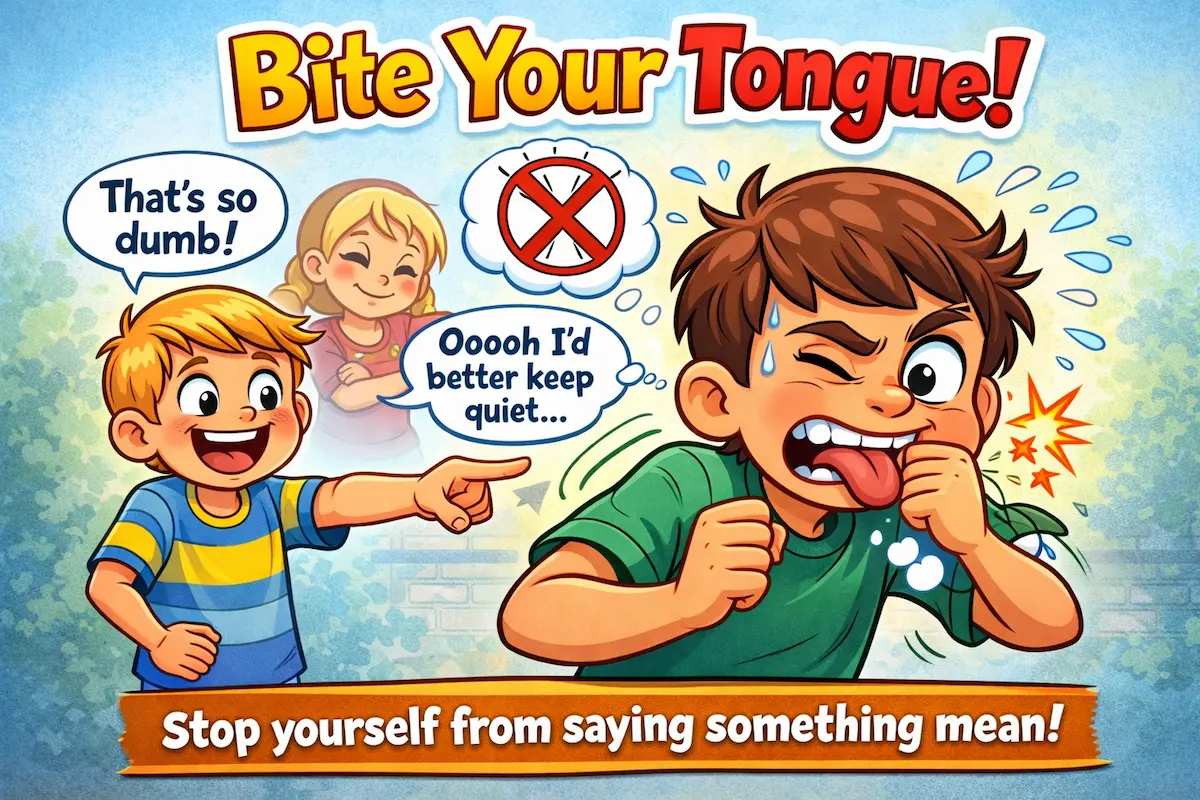
An Explanation of the Word "bite your tongue" in an Image

Landscape cartoon illustration of a boy biting his tongue while reacting to others, symbolizing the idiom bite your tongue and the act of stopping yourself from saying something.
A colorful cartoon illustration showing a boy literally biting his tongue to stop himself from speaking, clearly representing the idiom “bite your tongue” and the idea of holding back unkind or impulsive words.

Conversation Using the Idiom Bite your tongue

During a tense family dinner, siblings Arthur and Beatrice are trying to avoid a long-standing argument. The dialogue focuses on the idiom bite your tongue, which means to make a conscious effort to stop yourself from saying something that might be hurtful, rude, or inappropriate in a given situation.

Arthur: I almost told him exactly what I thought of his new car, but I had to bite my tongue to keep the peace.

Beatrice: I’m glad you did; if you didn't bite your tongue, the whole evening would have turned into a giant shouting match.

Arthur: I read that learning when to bite your tongue is one of the most important social skills you can have in a professional environment.

Beatrice: I noticed that she had to bite her tongue when the manager took credit for all of her hard work during the presentation.

Arthur: If you don't bite your tongue occasionally, you might end up saying something that you’ll regret for a very long time.

Beatrice: I saw him struggle to bite his tongue while his friend was giving him completely incorrect advice about fixing his computer.

Arthur: Sometimes it’s physically painful to bite your tongue when you know you have the perfect comeback ready to go.

Beatrice: I agree, but it’s always better to bite your tongue than to cause unnecessary drama at a wedding or a funeral.

Arthur: I’m glad we both managed to bite our tongues tonight; the dinner was actually quite pleasant for a change.

Beatrice: Me too; it shows we’ve finally learned that you don't always have to win every argument if you just bite your tongue.

Phrases Containing the Expression Bite Your Tongue

The phrases below show how the expression bite your tongue is used to describe stopping yourself from speaking, especially to avoid conflict or trouble.

Bite your tongue

To stop yourself from speaking.

He bit his tongue and stayed silent, even though he strongly disagreed.

Bite your tongue in a meeting

To stay quiet at work.

She bit her tongue in the meeting to avoid starting an argument.

Bite your tongue to keep peace

To avoid conflict.

Sometimes you have to bite your tongue to keep peace in the family.

Bite your tongue before reacting

To pause before speaking.

He bit his tongue before reacting emotionally to the criticism.

Bite your tongue in public

To avoid embarrassment.

She bit her tongue in public rather than correct him loudly.

Bite your tongue out of respect

To stay silent politely.

He bit his tongue out of respect for the senior speaker.

Bite your tongue during conflict

To prevent escalation.

Biting your tongue during conflict can sometimes stop things from getting worse.

Bite your tongue and listen

To stay quiet and pay attention.

She bit her tongue and listened carefully instead of interrupting.

Bite your tongue at work

To avoid workplace trouble.

He bit his tongue at work even when the decision felt unfair.

Bite your tongue to avoid regret

To prevent saying something hurtful.

She bit her tongue to avoid regret later.

Bite your tongue when angry

To control anger.

When angry, it’s often wise to bite your tongue.

Bite your tongue instead of arguing

To choose silence over conflict.

He bit his tongue instead of arguing over a minor issue.

Bite your tongue temporarily

To stay quiet for a short time.

She bit her tongue temporarily until the right moment to speak.

Bite your tongue during criticism

To remain calm.

He bit his tongue during criticism and reflected later.

Bite your tongue socially

To avoid social tension.

Biting your tongue socially can sometimes protect relationships.

Bite your tongue and smile

To hide disagreement.

She bit her tongue and smiled through the awkward moment.

Bite your tongue out of caution

To stay silent carefully.

He bit his tongue out of caution, unsure of the consequences.

Bite your tongue when unsure

To wait before speaking.

When unsure, it’s better to bite your tongue and ask later.

Bite your tongue during negotiations

To avoid harming talks.

She bit her tongue during negotiations to keep discussions productive.

Bite your tongue and move on

To accept and continue.

He bit his tongue and moved on rather than reopening old conflicts.

Words Rhyme with bite your tongue

light your lung
fight your young
sight your hung
right your sung
tight your rung
night your flung
white your clung
bright your swung
height your stung
quite your wrung
tongue
young
hung
sung
rung
flung
clung
swung
stung
wrung
among
sprung
strung
unstrung
unsung
overhung
belaung
slung
bung
dung
POS: Verb Phrase