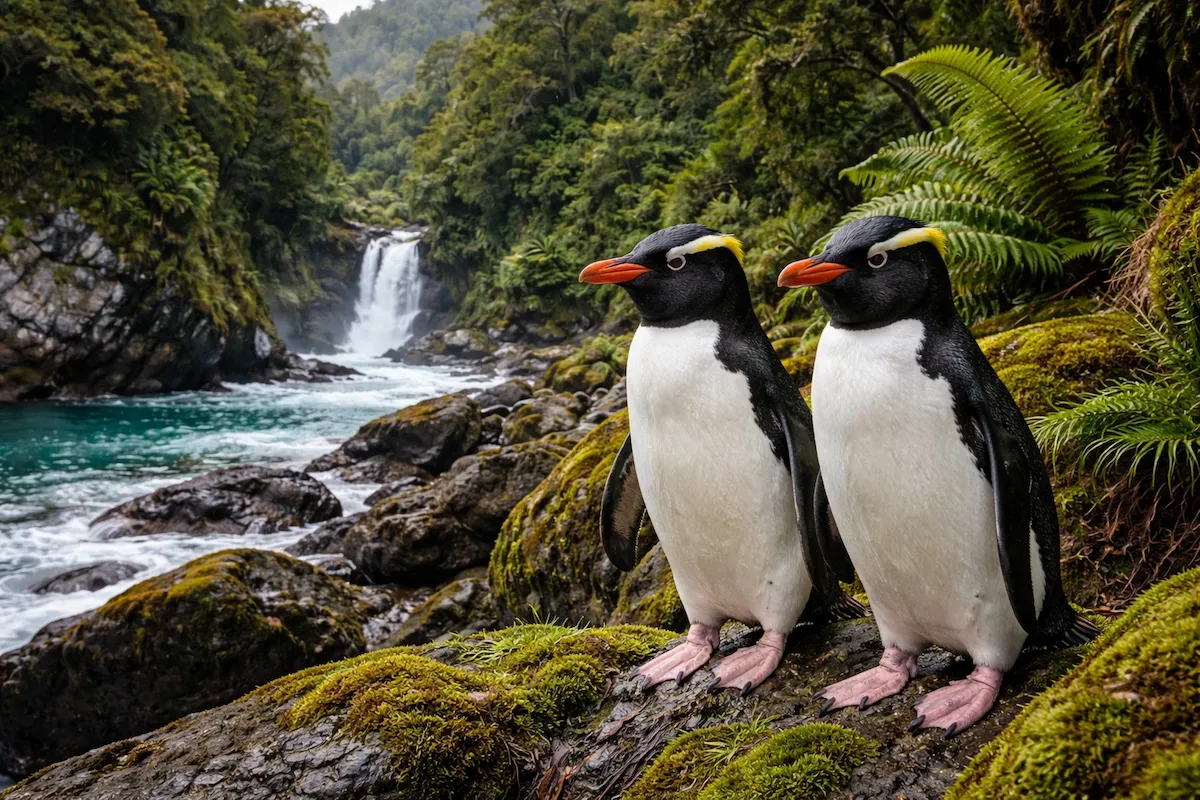
fiordland penguin
Short definition: The word fiordland penguin refers to a crested penguin found in the remote southwestern regions of New Zealand, known for its dark plumage, yellow eyebrow stripe, and nesting in dense forests near rocky shores.
Looking for a clear and natural explanation of the term fiordland penguin? This name often appears in wildlife guides, documentaries, and articles about New Zealand’s southern coast. A fiordland penguin is known for its shy behavior, dark feathers, and the pale stripes that run above and behind its eyes. Unlike many penguins that gather in huge open colonies, this one prefers hidden, forested places. Below, each meaning is explained in a calm and natural way, with long definitions and realistic examples.
Forms: fiordland penguin (singular), fiordland penguins (plural)
Related: penguin n., crested penguin n., seabird n.
Syllable: fi-ord-land pen-guin
-
(Noun) A crested penguin species with pale eyebrow stripes, native to the southwest coast of New Zealand.
A fiordland penguin is a medium-sized penguin that can be recognized by the light-colored stripes that run above and behind its eyes. Its body is mostly dark, which helps it blend into shadowy coastal waters and rocky shorelines. Fiordland penguins live along New Zealand’s rugged southern coast, where steep cliffs, dense forests, and cold seas meet. They are powerful swimmers but tend to avoid open, crowded nesting areas.
The fiordland penguin emerged quietly from the water, its pale facial markings briefly visible before it disappeared into the shadows.Once you learn to spot the eyebrow stripe, identifying a fiordland penguin becomes much easier.We were lucky to see a fiordland penguin resting on the rocks just before dusk.Synonyms: Fiordland crested penguin, tawaki, southern crested penguin, New Zealand penguin, coastal penguin, seabird penguin, diving penguin, forest-edge penguin, cold-water penguin, island penguin, marine penguin, rock-nesting penguin
Antonyms: smooth-headed penguin, non-crested penguin, flying bird, songbird, inland bird, forest bird, desert bird, freshwater bird, tree-dwelling bird, airborne bird, land mammal, non-coastal species -
(Noun) A shy penguin species that prefers secluded nesting sites in forests, caves, or hidden coastal areas.
Unlike penguins that nest in large, open colonies, the fiordland penguin is known for being secretive. It often chooses nesting spots hidden under tree roots, inside caves, or beneath thick vegetation. This behavior helps protect eggs and chicks from predators but also makes the species harder to observe. When people mention fiordland penguins this way, they are usually emphasizing privacy and avoidance of disturbance.
The guide asked us to stay quiet because a fiordland penguin was nesting nearby in a shaded forest hollow.Spotting a fiordland penguin on land is rare, as it prefers to remain hidden during daylight hours.The fiordland penguin slipped back into the trees instead of staying on the open beach.Synonyms: shy penguin, secretive penguin, forest-nesting penguin, cave-nesting penguin, hidden-nest penguin, reclusive seabird, solitary penguin, low-visibility species, disturbance-sensitive penguin, private nester, cautious penguin, sheltered-nesting bird
Antonyms: colony penguin, open-nesting penguin, social penguin, crowded breeder, beach-nesting bird, exposed nester, group-living species, communal breeder, noisy colony bird, public nester, highly social penguin, open-coast species -
(Noun) A penguin closely linked to New Zealand’s rugged fjords, rainforests, and stormy southern seas.
The term fiordland penguin is often used to describe a penguin shaped by harsh coastal conditions. These birds live where heavy rain, thick forest, and rough ocean waters are part of everyday life. Their strong bodies and dark coloring help them survive in low light and turbulent seas. In this sense, the name reflects a penguin adapted to one of the most dramatic coastal environments in the Southern Hemisphere.
Watching a fiordland penguin dive into rough water showed how comfortable it was in harsh conditions.The steep cliffs and rain-soaked forest felt like classic fiordland penguin territory.Life as a fiordland penguin means constant exposure to wind, rain, and cold seas.Synonyms: rugged-coast penguin, fjord penguin, forest-coast penguin, southern coastal penguin, subantarctic penguin, cold-ocean penguin, rocky-shore penguin, marine island bird, coastal seabird, diving seabird, New Zealand seabird, harsh-habitat penguin
Antonyms: ice-shelf penguin, inland animal, desert species, grassland bird, freshwater bird, forest songbird, tree bird, flying seabird, airborne bird, land mammal, non-coastal wildlife, urban species -
(Noun) (By extension) A symbol used in conservation to represent fragile coastal forests and sensitive wildlife.
Outside strict biology, fiordland penguin is often mentioned in conservation campaigns. Because it depends on both healthy oceans and undisturbed forests, it represents the balance between land and sea. In this sense, the penguin becomes a reminder of how human activity can affect even well-hidden species. The name is frequently used to encourage careful tourism and habitat protection.
The conservation sign featured a fiordland penguin to remind visitors to respect quiet nesting areas.Using the fiordland penguin as a symbol helped explain why forest and marine protection go together.Children learned about habitat loss through stories centered on the fiordland penguin.Synonyms: conservation symbol, wildlife icon, habitat-protection emblem, sensitive-species symbol, coastal-forest icon, environmental mascot, biodiversity emblem, protected wildlife image, ecological symbol, nature-education icon, conservation emblem, heritage species symbol
Antonyms: generic symbol, common-species image, abstract icon, corporate logo, non-animal symbol, industrial emblem, urban icon, artificial image, text-only logo, mass-market branding, non-nature theme, commercial symbol