dunlin

Short definition: The word dunlin refers to a small sandpiper commonly found on mudflats and tidal areas, known for its drooping bill, dense flocks, and long migrations between Arctic breeding grounds and southern coasts.

Looking for a clear and natural explanation of the word dunlin? The word dunlin is mainly used in birdwatching, wildlife studies, and coastal nature writing. It refers to a small widespread shorebird commonly seen feeding in large flocks on mudflats and beaches. You will hear it in discussions about wetlands, estuaries, tidal flats, and long seasonal migrations. Although not common in everyday conversation, it appears often in field guides and birding reports. Below, each meaning is explained in a calm and natural way, with enough detail to feel clear, human, and informative.

dunlin n. /ˈdʌnlɪn/

Forms: dunlin, dunlins
Related: shorebird n., sandpiper n., wader n.
Syllable: dun-lin

  1. (Noun) A small migratory shorebird with a slightly downcurved bill often found feeding on mudflats and coastal wetlands.

    A dunlin is a small sandpiper known for its compact body slightly curved bill and habit of feeding in large flocks, commonly seen probing soft mud and shallow water for insects worms and tiny crustaceans in estuaries tidal flats and marshes.

    The dunlin moved quickly across the exposed mudflat probing the surface repeatedly as the tide slowly receded in the early morning light.
    Birdwatchers watched hundreds of dunlins rise into the air together forming a shifting cloud above the wetland.
    During winter dunlins are often the most numerous shorebirds seen along coastal mudflats.

    Synonyms: shorebird, sandpiper, wading bird, small wader, migratory shorebird, mudflat bird, coastal feeder, probing bird, tidal flat species, wetland bird, flocking shorebird, marsh bird
    Antonyms: forest bird, tree dwelling bird, domestic bird, flightless bird, inland land bird, raptor, seed eating bird, woodland species, urban bird, non migratory bird, ground running bird, landlocked species

  2. (Noun) A shorebird famous for flying in dense coordinated flocks that change shape rapidly.

    Dunlins are also well known for their spectacular flocking behavior, where large groups fly tightly together and shift direction in unison, creating dramatic visual patterns that help protect them from predators.

    The dunlins formed a fast moving cloud that twisted and turned above the shoreline as a hawk passed overhead.
    Watching a flock of dunlins change shape in midair is one of the highlights of winter birding.
    Scientists study dunlin flocking behavior to better understand group movement and predator avoidance.

    Synonyms: flocking shorebird, coordinated flyer, group flying bird, mass movement species, defensive flock bird, synchronized flier, collective behavior example, predator avoiding species, aerial display bird, movement study species, migratory flock bird, teamwork flyer
    Antonyms: solitary bird, lone feeder, non flocking species, isolated animal, independent flyer, single forager, territorial solo bird, non social species, individual hunter, solitary wildlife, lone migrant, independent species
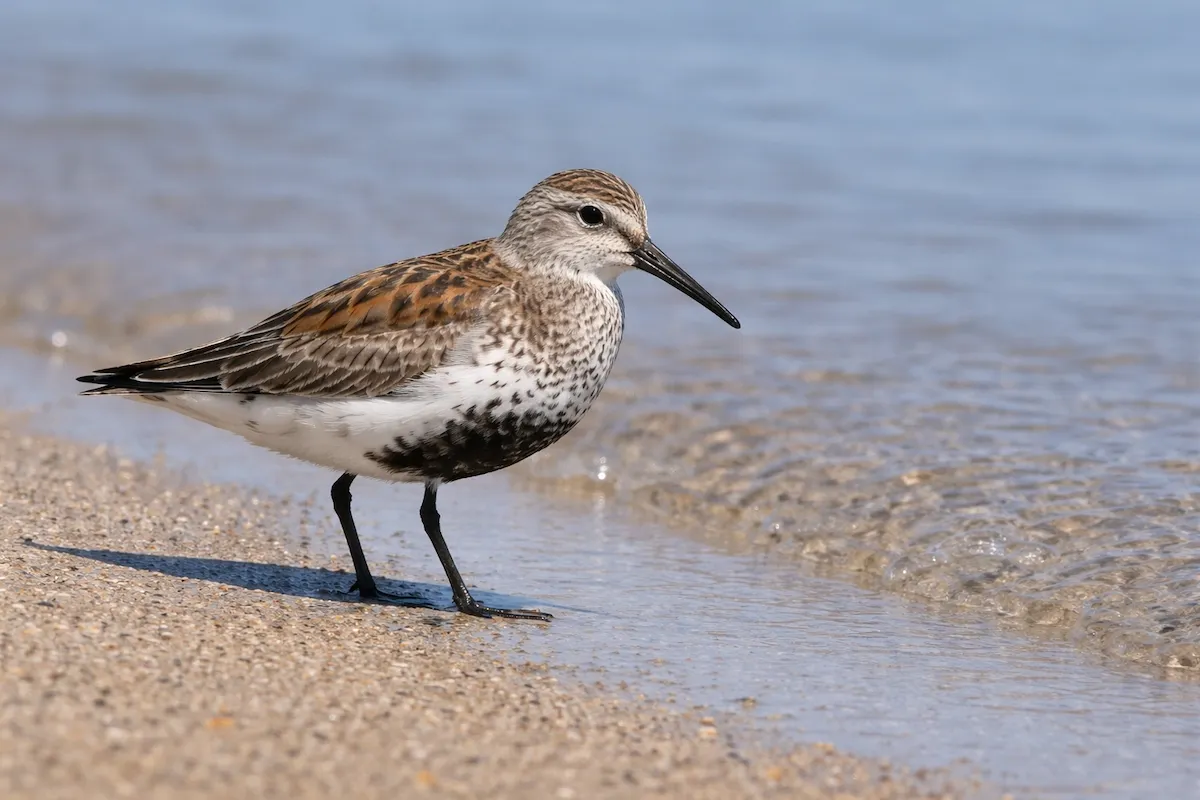
An Explanation of the Word "dunlin" in an Image

A dunlin bird standing on wet sand near gentle waves, showing a short downcurved black bill, speckled brown and gray feathers, dark legs, and a calm shoreline background.
A clear wildlife photograph of a dunlin standing at the water’s edge on a sandy beach, highlighting its slightly downcurved black bill, mottled brown-and-gray plumage, and compact shorebird shape.

Conversation Using the Word Dunlin

This conversation takes place at a muddy river mouth between Sarah and David. It highlights the dunlin's breeding plumage and its slightly drooping bill.

Sarah: Look at that little wader with the black patch on its belly; that's a dunlin in its summer plumage.

David: Oh, I see it! The dunlin has a very distinct look compared to the plain gray birds around it.

Sarah: Another way to identify a dunlin is to look for the slight downward droop at the very end of its bill.

David: You're right, it’s not perfectly straight like a stint's bill—this dunlin has a much more elegant curve.

Sarah: During the winter, the dunlin will lose that black belly patch and turn a more uniform brownish-gray.

David: I’ve seen huge flocks of dunlin performing amazing aerial displays over the estuary in the evenings.

Sarah: Those "murmurations" of dunlin are incredible to see when they all turn at once, flashing their white bellies.

David: It’s a great defense against hawks, as the dunlin flock moves like a single, confusing organism.

Sarah: This dunlin seems to be very successful at finding food in the sticky mud near the channel.

David: They are very common birds, but I never get tired of seeing a dunlin during my morning walks.

Sarah: Neither do I; the dunlin is such a quintessential part of our local wetlands.

David: Let’s see if we can count how many dunlin are in this specific group before they move on.

Phrases Containing the Word Dunlin

The phrases below show how the word dunlin is used to describe small shorebirds, drooping bills, and dense flocks feeding on muddy flats.

Dunlin probing the mud

A dunlin searching for food.

The dunlin probing the mud moved rhythmically as if sewing the surface.

Dunlin on mudflats

A dunlin living on muddy shores.

The dunlin on mudflats fed nonstop as the tide receded.

Dunlin feeding actively

A dunlin searching for prey.

The dunlin feeding actively barely lifted its head between probes.

Dunlin behavior

The typical actions of dunlins.

Dunlin behavior is busy, social, and strongly synchronized within flocks.

Dunlin flock

A group of dunlins together.

A dunlin flock rose suddenly and turned as one.

Dunlin silhouette

The outline of a dunlin.

The dunlin silhouette showed a slightly curved bill.

Dunlin in winter plumage

A dunlin with muted colors.

The dunlin in winter plumage blended into the gray mud.

Dunlin feeding at low tide

A dunlin hunting on exposed mud.

The dunlin feeding at low tide followed the retreating waterline.

Dunlin resting briefly

A dunlin pausing activity.

The dunlin resting briefly soon returned to feeding.

Dunlin near tidal pools

A dunlin using shallow water.

A dunlin near tidal pools probed carefully along the edges.

Dunlin moving in unison

Dunlins flying together.

The dunlin moving in unison created shifting patterns in the sky.

Dunlin in early morning

A dunlin active at dawn.

The dunlin in early morning light fed continuously.

Dunlin calling softly

A dunlin vocalizing quietly.

The dunlin calling softly stayed close to the flock.

Dunlin across muddy flats

A dunlin seen at a distance.

A dunlin across muddy flats looked like a moving shadow.

Dunlin watching carefully

A dunlin staying alert.

The dunlin watching carefully froze at sudden movement.

Dunlin feeding quietly

A dunlin eating calmly.

The dunlin feeding quietly focused on tiny invertebrates.

Dunlin near marsh edges

A dunlin close to vegetation.

A dunlin near marsh edges stayed alert for predators.

Dunlin in migration

A dunlin traveling seasonally.

The dunlin in migration relied on rich feeding grounds.

Dunlin pair

Two dunlins together.

A dunlin pair fed side by side without conflict.

Familiar dunlin

A dunlin often seen in the same place.

The familiar dunlin returned each winter to the same mudflat.

Words Rhyme with dunlin

in
bin
fin
pin
sin
tin
win
grin
spin
skin
thin
twin
begin
within
penguin
genuine
discipline
violin
mandolin
bulletin
origin
margin
virgin
engine
linn
chin
shin
akin
napkin
pumpkin
POS: Noun  Category: Birds