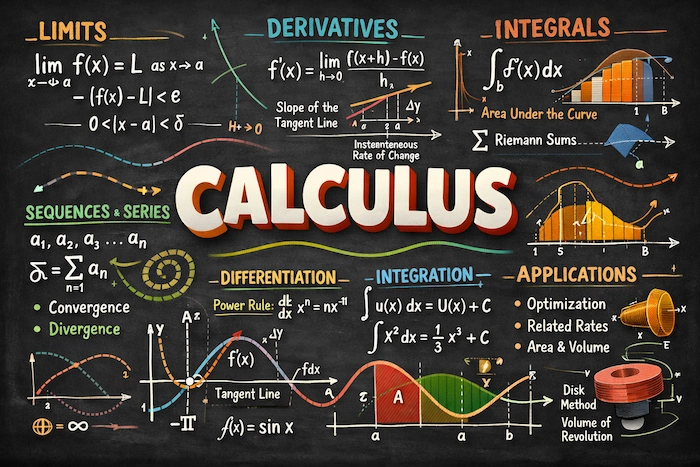
calculus
Short definition: The word calculus means a branch of mathematics that focuses on understanding change, movement, and how values grow or decrease. People use it in school, science, and engineering to solve problems involving speed, distance, curves, and real-life situations that involve constant change.
Looking for a clear and natural explanation of the word calculus? The word calculus often sounds serious and difficult, but at its heart, it is simply about understanding change and movement. People use calculus to describe how things grow, slow down, speed up, or shift over time. In everyday life, calculus appears not only in classrooms, but also behind the scenes in technology, engineering, economics, and even medical research. Below, each meaning is explained in a relaxed and natural way, with explanations that feel human instead of stiff like a textbook.
Noun forms: calculus (no plural in this sense)
Related: derivative n., integral n.
Syllable: cal-cu-lus
-
A branch of mathematics that studies change and movement.
In its most common meaning, calculus is the part of math that helps people understand how things change. It looks at speed, growth, and movement, whether it is a car getting faster, a population increasing, or money gaining interest. Even though it feels abstract at first, calculus is really about real-life situations that move and evolve over time.
She started learning calculus and finally understood how speed and distance connect.Engineers use calculus to design bridges that can handle changing forces.Without calculus, many modern technologies would not exist.Synonyms: advanced mathematics, higher math, math of change, rate-of-change math, mathematical analysis, continuous math, motion math, growth math, dynamic math, applied math field, math of movement, scientific math
Antonyms: basic math, simple arithmetic, elementary math, counting, basic numbers, simple calculation, early math, beginner math, basic operations, simple sums, primary math, basic numeracy -
A school subject that challenges and shapes thinking.
For many students, calculus is not just a topic, but a turning point in their education. It teaches patience, problem-solving, and how to think in steps. At first it can feel overwhelming, but over time it builds confidence and shows students they can handle difficult ideas.
He struggled with calculus at first, but later felt proud of how far he had come.Many students remember calculus as the class that taught them real discipline.Passing calculus made her believe she could succeed in engineering.Synonyms: challenging subject, advanced course, higher-level math, demanding class, tough math subject, academic milestone, thinking subject, logic builder, problem-solving course, mental training, advanced study, rigorous class
Antonyms: easy subject, simple class, light course, beginner topic, basic lesson, relaxed study, entry-level class, simple math, casual learning, low-pressure subject, easy course, basic study -
A tool used in science, technology, and engineering.
Beyond the classroom, calculus works quietly behind many modern inventions. It helps scientists predict weather, doctors understand how medicine moves in the body, and programmers build smarter systems. In this sense, calculus is not just theory, but a practical tool that shapes everyday life.
Scientists rely on calculus to model climate change over time.Medical researchers use calculus to understand how drugs spread in the body.Space engineers depend on calculus to plan rocket launches accurately.Synonyms: scientific tool, engineering math, research math, technical method, analytical tool, modeling method, problem-solving math, system-analysis tool, prediction math, applied mathematics, scientific calculation, technical math
Antonyms: guesswork, trial and error, rough estimation, simple thinking, non-technical approach, unscientific method, casual reasoning, basic logic only, intuitive guess, random choice, simple judgment, unsystematic thinking -
A way of thinking about limits and possibilities.
At a deeper level, calculus teaches people how to think about what happens at the edge of things— when numbers get very small, or when change happens very fast. It encourages careful thinking and patience with complex ideas.
Learning calculus helped him see problems from a new angle.She realized that calculus is really about understanding limits in life.The logic of calculus trained his mind to think more clearly.Synonyms: analytical thinking, deep reasoning, limit-based thinking, advanced logic, higher-level thought, structured thinking, complex reasoning, systematic analysis, precise thinking, mathematical mindset, careful logic, thoughtful approach
Antonyms: shallow thinking, careless reasoning, rushed judgment, simple logic only, surface thinking, random thought, unstructured thinking, vague ideas, loose reasoning, unclear logic, careless thought, impulsive thinking -
A symbol of advanced learning and intellectual growth.
For many people, calculus represents a step into serious academic thinking. It often stands for dedication, mental strength, and the courage to face difficult challenges. In this way, calculus becomes more than a subject— it becomes a personal achievement.
Passing calculus felt like a major victory in his education.She saw calculus as proof that she could handle tough subjects.For many students, finishing calculus marks a new level of confidence.Synonyms: academic milestone, intellectual challenge, higher learning symbol, advanced study marker, mental achievement, education benchmark, learning peak, academic achievement, knowledge milestone, growth symbol, study victory, learning success
Antonyms: easy achievement, simple success, basic milestone, low challenge, minimal effort win, simple task, easy study, basic level, small goal, beginner success, low-level achievement, simple progress