Short definition: The phrase far fewer is used to stress that the number of people or things is much smaller than before or than expected, often highlighting a noticeable difference rather than a small or minor change.
Looking for a clear and natural explanation of the phrase far fewer?
The phrase far fewer is used to compare quantities and emphasize a very large difference.
It commonly appears in explanations, reports, statistics, and everyday conversation.
People use it when the number being talked about is much smaller than expected or compared to something else.
Below, each meaning is explained in a calm and natural way,
with enough detail to feel clear, human, and precise.
far fewerdet. phrase/fɑːr ˈfjuːər/
Forms: far fewer Related: fewer det., much less phrase, far less phrase Syllable: far few-er
(Determiner phrase) Used to emphasize that the number of things or people is much smaller than another number.
Far fewer is used when comparing two quantities to show that one group has a significantly smaller number than the other, not just slightly smaller, and it often highlights a surprising or important difference.
Far fewer people attended the meeting this year because many employees were working remotely or traveling at the same time.
There were far fewer errors in the final report after the team added multiple review stages and clearer guidelines.
The new policy resulted in far fewer complaints, which showed that most customers appreciated the changes.
Synonyms:
many fewer, significantly fewer, much fewer, a lot fewer, greatly reduced number, substantially fewer, far less in number, noticeably fewer, sharply fewer, dramatically fewer, considerably fewer, heavily reduced Antonyms:
far more, many more, significantly more, a lot more, much greater number, substantially more, dramatically more, noticeably more, sharply more, heavily increased, considerably more, greatly increased
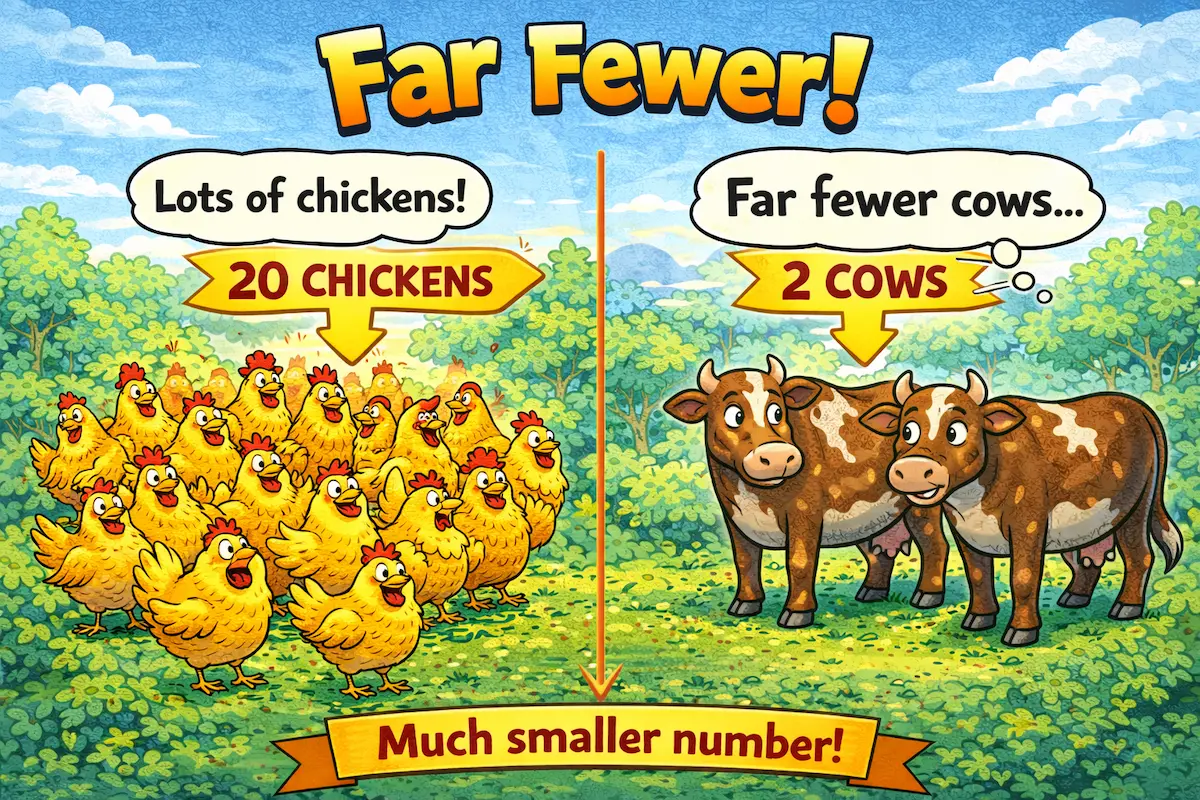
An Explanation of the Word "far fewer" in an Image
A clear cartoon illustration explaining the phrase “far fewer,” showing a large group of chickens compared with only a few cows, emphasizing a much smaller number through an easy-to-understand visual contrast.
Conversation Using the Phrase Far Fewer
The following conversation takes place between two coworkers reviewing recent results.
It shows how the phrase far fewer is used naturally to emphasize a strong
reduction in numbers and noticeable differences.
Oliver: Did you see the latest report from last quarter?
Sophia: Yes, and I was surprised to see far fewer complaints this time.
Oliver: That must be because the new system fixed most of the issues.
Sophia: I think so, we also had far fewer support requests overall.
Oliver: It feels good to see such a clear improvement.
Sophia: Definitely, far fewer problems makes everyone’s work much easier.
Oliver: Hopefully we can keep this trend going.
Sophia: Agreed, far fewer setbacks would be ideal moving forward.
Phrases Containing the Expression Far Fewer
The phrases below show how far fewer is commonly used to emphasize strong contrasts
in numbers, amounts, or participation in everyday English.
Far fewer people
A much smaller number of people.
After the policy change, far fewer people applied for the program because the requirements became stricter.
Far fewer students
A significantly smaller group of learners.
This year, far fewer students chose that major after hearing about the increased workload.
Far fewer mistakes
A large reduction in errors.
With better training and clearer instructions, the team made far fewer mistakes than last time.
Far fewer problems
Much less trouble.
Once the system was updated, there were far fewer problems reported by users.
Far fewer options
A limited set of choices.
During the holiday season, shoppers noticed far fewer options due to supply delays.
Far fewer complaints
A big drop in negative feedback.
After customer service improved, the company received far fewer complaints than before.
Far fewer customers
A noticeable decline in visitors.
On rainy days, the café usually sees far fewer customers compared to sunny afternoons.
Far fewer cases
A sharp decrease in incidents.
Thanks to better prevention, far fewer cases were reported over the following months.
Far fewer resources
A much smaller supply.
The team had to work carefully with far fewer resources than originally planned.
Far fewer errors
Greatly improved accuracy.
After reviewing the guidelines, the final report contained far fewer errors and inconsistencies.
Far fewer opportunities
A reduced number of chances.
In smaller towns, there are far fewer opportunities for specialized careers.
Far fewer meetings
A reduced number of discussions.
Remote work resulted in far fewer meetings, giving employees more time to focus.
Far fewer details
Less information provided.
The summary included far fewer details, but still captured the main idea clearly.
Far fewer delays
A significant reduction in waiting time.
With better planning, the project experienced far fewer delays than expected.
Far fewer people involved
A much smaller group.
The final decision was made with far fewer people involved to speed up the process.
Far fewer changes
A stable situation.
The second draft required far fewer changes because the first version was already strong.
Far fewer visitors
A lower number of guests.
During the off-season, the museum attracts far fewer visitors but feels more peaceful.
Far fewer requests
A drop in demand.
After automating the process, the support team received far fewer requests.
Far fewer supplies
A limited stock.
The clinic had to operate with far fewer supplies during the emergency period.
Far fewer people than expected
A surprising difference.
Far fewer people than expected attended the event, possibly due to the weather.