train

Short definition: The word train means a series of connected rail vehicles that run on tracks, used to transport passengers or goods over short or long distances, known for efficiency, capacity, and regular scheduled travel.

Looking for a clear and natural explanation of the word train? This word is extremely common in everyday English and can be used as both a noun and a verb. A train can refer to a powerful form of transportation, or to the act of practicing and improving skills. You’ll hear it in conversations about travel, commuting, work, education, and sports. Below, each meaning is explained in a calm and natural way, with enough detail to feel human and clear.

train n., v. /treɪn/

Forms: train, trains, trained, training
Related: railway n., coach n., practice v.
Syllable: train

  1. (Noun) A long vehicle made of connected cars that travels on rails to carry people or goods.

    A train is a form of transportation that runs on railway tracks and is pulled by a locomotive. Trains are commonly used for commuting, long-distance travel, and transporting cargo. They can carry many passengers at once and are often seen as efficient and reliable. This is one of the most familiar and practical meanings of the word.

    She takes the train to work every morning instead of driving.
    The train arrived late because of bad weather.
    We traveled across the country by train to enjoy the scenery.

    Synonyms: railway train, rail vehicle, passenger train, freight train, locomotive, rail transport, railcar system, commuter train, express train, transport train, goods train, rail service
    Antonyms: car, bus, airplane, motorcycle, bicycle, truck, private vehicle, walking, on foot, air travel, road transport, personal transport

  2. (Verb) To teach someone or yourself a skill through practice and instruction.

    To train means to practice regularly in order to improve an ability or learn something new. This can involve physical training, job training, or mental preparation. It often requires time, discipline, and guidance. This meaning is very common in education, sports, and professional life.

    She is training hard to become a professional athlete.
    New employees are trained before starting their jobs.
    He trained himself to stay calm under pressure.

    Synonyms: practice, coach, instruct, prepare, teach, drill, educate, condition, develop skills, rehearse, mentor, guide
    Antonyms: neglect, ignore, unteach, confuse, discourage, mislead, abandon practice, avoid learning, remain untrained, forget skills, weaken ability, stop practicing

  3. (Verb) To aim or focus something in a particular direction.

    Train can also mean directing attention, movement, or an object toward a specific target. This usage is common with eyes, cameras, or weapons. It emphasizes focus and intention rather than learning. The meaning is more precise and situational.

    She trained her eyes on the stage.
    The camera was trained on the speaker throughout the event.
    His attention was trained on the final result.

    Synonyms: aim, direct, focus, point, fix on, concentrate on, target, center on, align, orient, lock onto, set on
    Antonyms: distract, ignore, overlook, avoid, turn away, misdirect, lose focus, scatter attention, wander, shift away, unfocus, blur
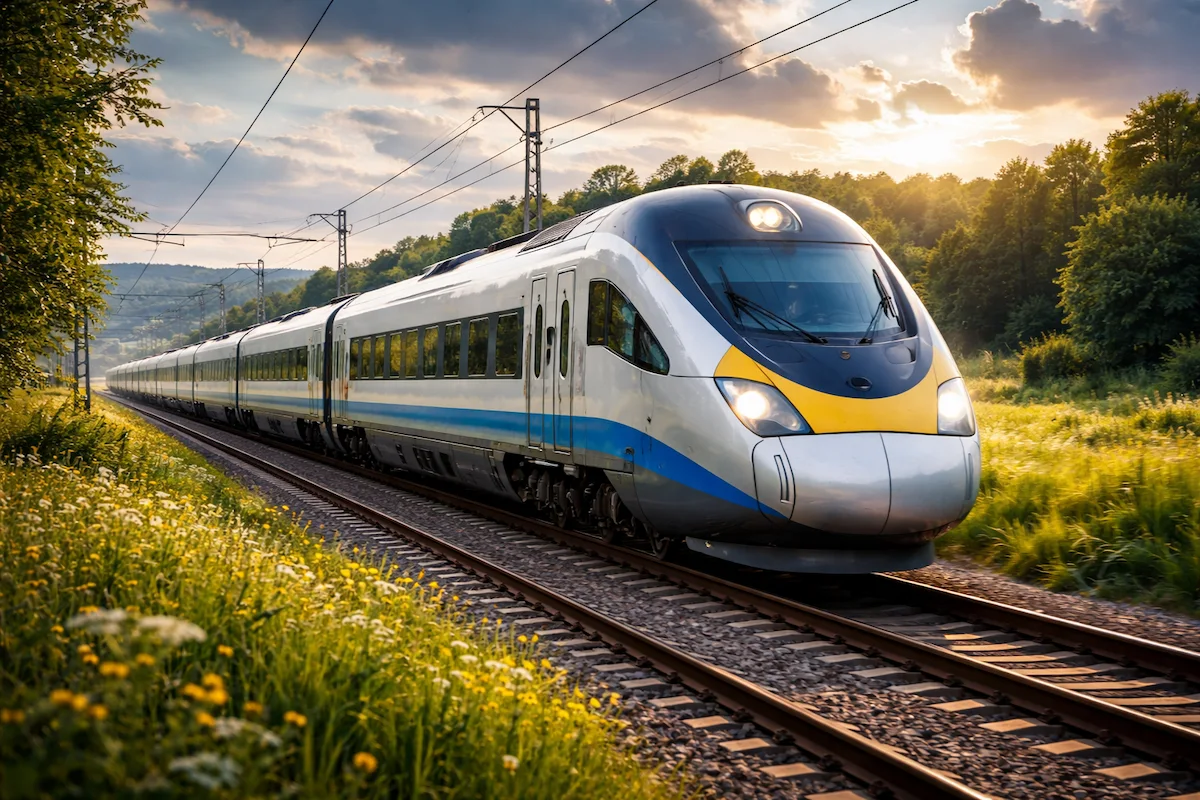
An Explanation of the Word "train" in an Image

Modern passenger train on railway tracks, showing a sleek aerodynamic front, multiple carriages, overhead power lines, and a scenic green landscape.
A modern high-speed passenger train traveling through a green countryside, highlighting its streamlined aerodynamic design, large windows, electric lines, and efficient rail transport in natural daylight.

Conversation Using the Word Train

On a high-speed platform at a grand central station, travelers Liam and Chloe are checking their departure times. This dialogue explores the train as a sophisticated mode of long-distance travel, discussing its comfort, speed, and the unique experience of watching the landscape pass by.

Liam: Taking the high-speed train to the capital is so much more relaxing than dealing with the security lines and delays at the airport.

Chloe: I agree; on the train, you have plenty of legroom and the freedom to walk around whenever you need to stretch your legs.

Liam: I noticed that the train arrived exactly on the second; the punctuality of the rail system here is truly impressive to witness.

Chloe: I read that a modern maglev train can reach speeds of over three hundred miles per hour by using magnetic levitation technology.

Liam: If we get a seat in the dining car, we can enjoy a full meal while the train carries us through the beautiful mountain scenery.

Chloe: I saw an old steam train at the museum that reminded me of how much travel has evolved over the last hundred years.

Liam: It’s a very sustainable way to travel; a train emits far less carbon per passenger than a short-haul flight or a long car trip.

Chloe: I love the rhythmic sound of the train on the tracks; it’s very soothing and makes it easy to take a nap during the journey.

Liam: The train conductor just announced that we’ll be arriving at our destination in ten minutes, so we should start gathering our bags.

Chloe: That was a fast trip; I’m definitely going to choose the train for our next vacation because it was so convenient and easy.

Phrases Containing the Word Train

The phrases below show how the word train is used to talk about rail transport, travel routines, schedules, and long-distance journeys.

Take the train

To travel by train.

She prefers to take the train because it’s comfortable and allows her to work during the journey.

Catch a train

To arrive in time for departure.

He rushed through the station to catch a train that was about to leave.

Miss the train

To fail to board.

Missing the train forced them to wait another hour.

Train station

A place where trains stop.

The historic train station was filled with travelers and luggage.

Train journey

A trip by train.

The scenic train journey passed through mountains and rivers.

Train ticket

A pass for train travel.

She booked her train ticket online to avoid long queues.

Train schedule

The timetable of trains.

Checking the train schedule helped him plan his day better.

Train platform

The area where passengers board.

People waited quietly on the train platform as announcements echoed.

High-speed train

A fast rail service.

The high-speed train cut travel time in half.

Train conductor

The staff member in charge.

The train conductor checked tickets and answered questions politely.

Train commute

Daily travel by train.

His daily train commute gave him time to read and relax.

Train delay

A late departure or arrival.

The train delay caused frustration among passengers.

Train service

A rail transport system.

Reliable train service is essential for large cities.

Train carriage

A single coach.

The train carriage was clean and surprisingly spacious.

Train route

The path a train follows.

The train route connects rural areas with major cities.

Overnight train

A train traveling at night.

The overnight train allowed them to save on hotel costs.

Train travel

Journeying by rail.

Train travel is often more environmentally friendly than flying.

Train connection

A transfer between trains.

They missed their train connection due to a delay.

Train network

A system of rail lines.

The country invested heavily in expanding its train network.

Train journey experience

The feeling of rail travel.

The calm train journey experience made the trip enjoyable.

Words Rhyme with train

brain
cane
chain
crane
drain
fain
gain
grain
lane
main
pain
plain
rain
sane
stain
vain
vane
wain
abstain
attain
complain
contain
detain
explain
maintain
obtain
remain
restrain
retain
sustain
POS: Noun, Verb  Category: Vehicles