Definition of supernova

Short definition: The word supernova means a massive star explosion that releases enormous energy and light into space, often briefly outshining entire galaxies and helping create new elements that later form planets, stars, and even life.

Looking for a clear and natural explanation of the word supernova? The word supernova is commonly used in astronomy, science education, and space discussions. It refers to one of the most powerful events in the universe, when a star suddenly explodes and releases an enormous amount of energy. Supernovae play an important role in creating heavy elements and shaping galaxies. You will hear the word in documentaries, textbooks, and news about space discoveries. Below, each meaning is explained in a calm and natural way, with enough detail to feel clear, human, and informative.

supernova n. /ˌsuːpərˈnoʊvə/

Forms: supernova, supernovae, supernovas
Related: star n., explosion n., galaxy n.
Syllable: su-per-no-va

  1. (Noun) A powerful explosion that happens when a star reaches the end of its life.

    A supernova is a massive explosion that occurs when a star can no longer support its own gravity, causing it to collapse or erupt violently and release an enormous amount of light energy and matter into space.

    The supernova was so bright that it could be seen from Earth even though it happened millions of light years away.
    Scientists study supernova remnants to learn how stars die and how elements are spread through space.
    When a supernova occurs it can briefly shine brighter than an entire galaxy.

    Synonyms: stellar explosion, star burst, cosmic explosion, stellar collapse event, star death explosion, massive star eruption, cosmic blast, stellar detonation, star destruction event, galactic explosion, luminous burst, space explosion
    Antonyms: star formation, star birth, calm star phase, stable star, steady burning star, stellar balance, quiet star life, slow stellar aging, star growth, stellar stability, non explosive phase, calm stellar state

  2. (Noun) A symbol of sudden dramatic change or intense impact.

    Figuratively, a supernova can describe an event or person that appears suddenly with overwhelming intensity, causing major change attention or disruption before fading or transforming.

    Her debut album hit the music scene like a supernova and changed her career overnight.
    The scandal exploded like a supernova completely altering public opinion.
    His short but intense success was often described as a supernova moment.

    Synonyms: sudden explosion, dramatic breakthrough, intense burst, overwhelming impact, explosive moment, powerful arrival, major disruption, attention grabbing event, rapid rise, brilliant flash, massive change, shocking emergence
    Antonyms: gradual change, slow development, steady growth, quiet progress, smooth transition, calm evolution, low impact event, subtle shift, gentle change, steady advancement, minor effect, slow rise
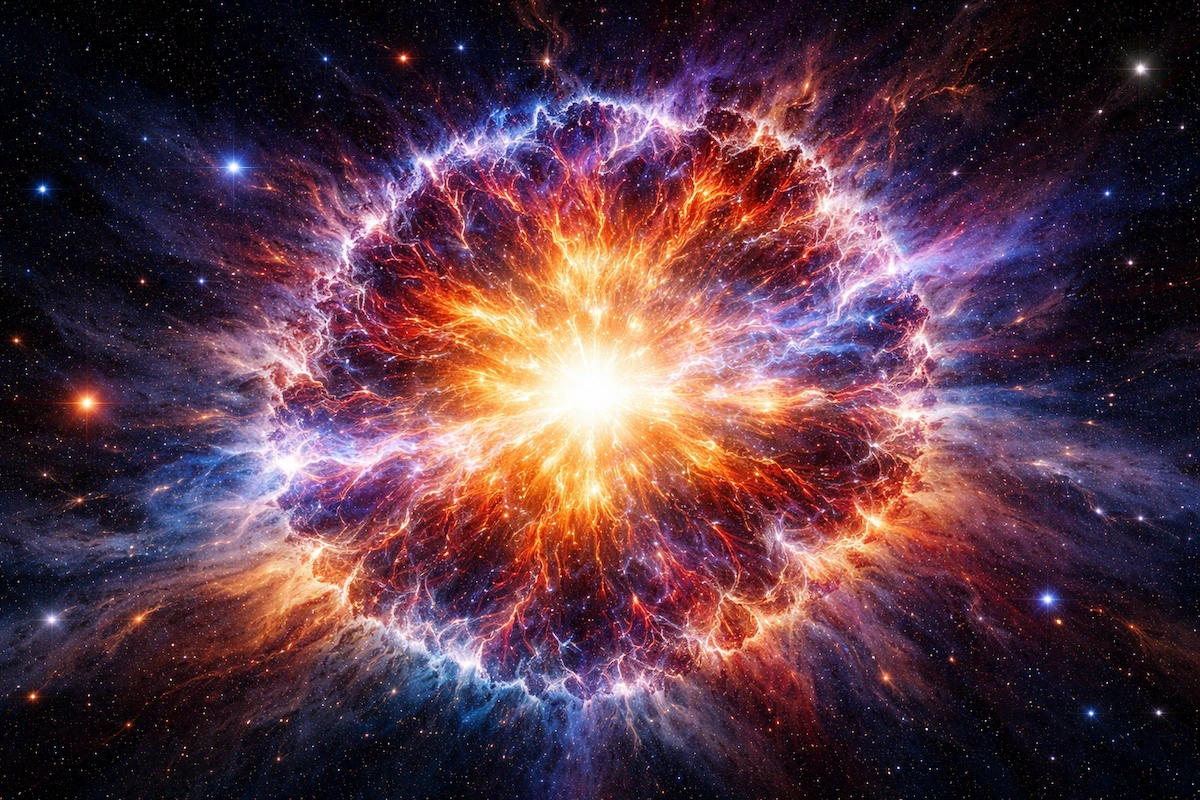
An Explanation of the Word "supernova" in an Image

Landscape illustration of a supernova explosion in outer space, featuring a bright stellar core, expanding energy waves, and colorful cosmic gases against a dark star-filled background.
A powerful landscape illustration of a supernova explosion in deep space, showing an intense burst of light and energy as a massive star collapses and releases glowing waves of cosmic matter.

Conversation Using the Word Supernova

The following conversation takes place between two friends after attending a public astronomy lecture. It shows how the word supernova is used naturally when discussing space, scale, and curiosity.

The exchange reflects how cosmic events often inspire awe and reflection about the universe and our place in it.

Oliver: I still can’t believe how powerful a supernova is.

Emily: Same, the idea that a single star can release that much energy is unreal.

Oliver: The speaker said we’re made of elements from a supernova.

Emily: Yeah, that part really changed how I think about space.

Oliver: It makes the universe feel connected in a strange way.

Emily: Exactly, a supernova isn’t just destruction, it’s also creation.

Oliver: Space suddenly feels much bigger and closer at the same time.

Emily: That’s the power of learning about things like supernovae.

Phrases Containing the Word Supernova

The phrases below show how the word supernova is commonly used when talking about astronomy, cosmic events, scale, and transformation.

Supernova explosion

A star’s violent end.

A supernova explosion can release more energy in seconds than the sun will emit in its entire lifetime.

Supernova remnant

Material left behind.

The colorful clouds visible in space are often supernova remnants expanding over thousands of years.

Supernova event

A rare cosmic occurrence.

A nearby supernova event would be visible from Earth even during the daytime.

Supernova light

Extreme brightness.

The supernova light briefly outshone the entire galaxy surrounding it.

Supernova shockwave

Expanding energy wave.

The supernova shockwave pushes surrounding gas outward at incredible speeds.

Supernova debris

Scattered material.

Supernova debris contains heavy elements essential for forming new stars and planets.

Supernova observation

Scientific monitoring.

Modern telescopes allow detailed supernova observation across vast distances.

Supernova brightness

Extreme luminosity.

The sudden supernova brightness surprised astronomers studying the region.

Supernova discovery

Finding a new explosion.

The supernova discovery helped confirm theories about stellar death.

Supernova energy

Released power.

Supernova energy plays a major role in shaping galaxies.

Supernova core collapse

A star’s internal failure.

In a core collapse supernova, gravity overwhelms the star’s internal pressure.

Supernova radiation

Emitted particles.

Supernova radiation can be detected long after the explosion itself.

Supernova timeline

Stages of the explosion.

Scientists study the supernova timeline to understand how stars evolve.

Supernova distance

How far it occurs.

Measuring supernova distance helps astronomers calculate the expansion of the universe.

Supernova matter

Destroyed stellar material.

Supernova matter eventually becomes part of new star systems.

Supernova formation

How it happens.

Supernova formation depends on the mass and life stage of a star.

Supernova detection

Finding an explosion.

Automated systems now assist with early supernova detection.

Supernova influence

Cosmic impact.

Supernova influence extends far beyond its original star system.

Supernova science

The study of stellar explosions.

Supernova science connects physics, chemistry, and astronomy.

Supernova history

Recorded past events.

Ancient records describe supernova history observed by early astronomers.

Words Rhyme with supernova

nova
over
clover
rover
drover
moreover
pavlova
casanova
terracotta
sofa
yoga
toga
quota
iota
pagoda
armada
cicada
data
beta
theta
zeta
gondola
canola
viola
koala
impala
valhalla
mandala
guava
java
POS: Noun  Category: Celestial Bodies, Disasters