bus

Short definition: The word bus refers to a large road vehicle built to carry many passengers, usually operating on fixed routes, widely used for public transportation in urban and rural areas to move people efficiently.

Looking for a clear and natural explanation of the word bus? This word is extremely common in everyday English and is closely tied to public transportation and city life. A bus helps many people travel together along fixed routes at an affordable cost. You’ll hear it in conversations about commuting, school, travel, and urban planning. Below, each meaning is explained in a calm and natural way, with enough detail to feel human and clear.

bus n. /bʌs/

Forms: bus, buses
Related: public transport n., route n., commute v.
Syllable: bus

  1. (Noun) A large road vehicle designed to carry many passengers along a fixed route.

    A bus is a public vehicle used to transport groups of people from one place to another. It usually follows a scheduled route with specific stops. Buses are common in cities and towns and are often used for daily commuting. This meaning focuses on shared, affordable transportation.

    She takes the bus to work every morning to avoid traffic.
    The bus stopped at every station along the main road.
    Tourists waited for the bus outside the museum.

    Synonyms: public bus, coach, city bus, transit vehicle, passenger bus, route bus, transport bus, commuter bus, mass transit vehicle, motor coach, shuttle bus, people carrier
    Antonyms: car, taxi, bicycle, motorcycle, private vehicle, personal transport, walking, train, scooter, individual transport, on foot, private ride

  2. (Noun) A vehicle used to transport a specific group, such as students or tourists.

    A bus can also refer to a vehicle hired or assigned for a particular group. Examples include school buses, tour buses, or company shuttles. This sense emphasizes purpose rather than public access. It is common in education, tourism, and events.

    The school bus picked up students early in the morning.
    A tour bus took them around the historic district.
    Employees arrived on a company bus for the event.

    Synonyms: school bus, tour bus, shuttle, charter bus, group transport, hired coach, company bus, excursion bus, transport coach, event shuttle, passenger coach, group carrier
    Antonyms: private car, personal ride, individual vehicle, taxi, rideshare, solo transport, walking, cycling, motorcycle, private commute, self-drive, personal travel
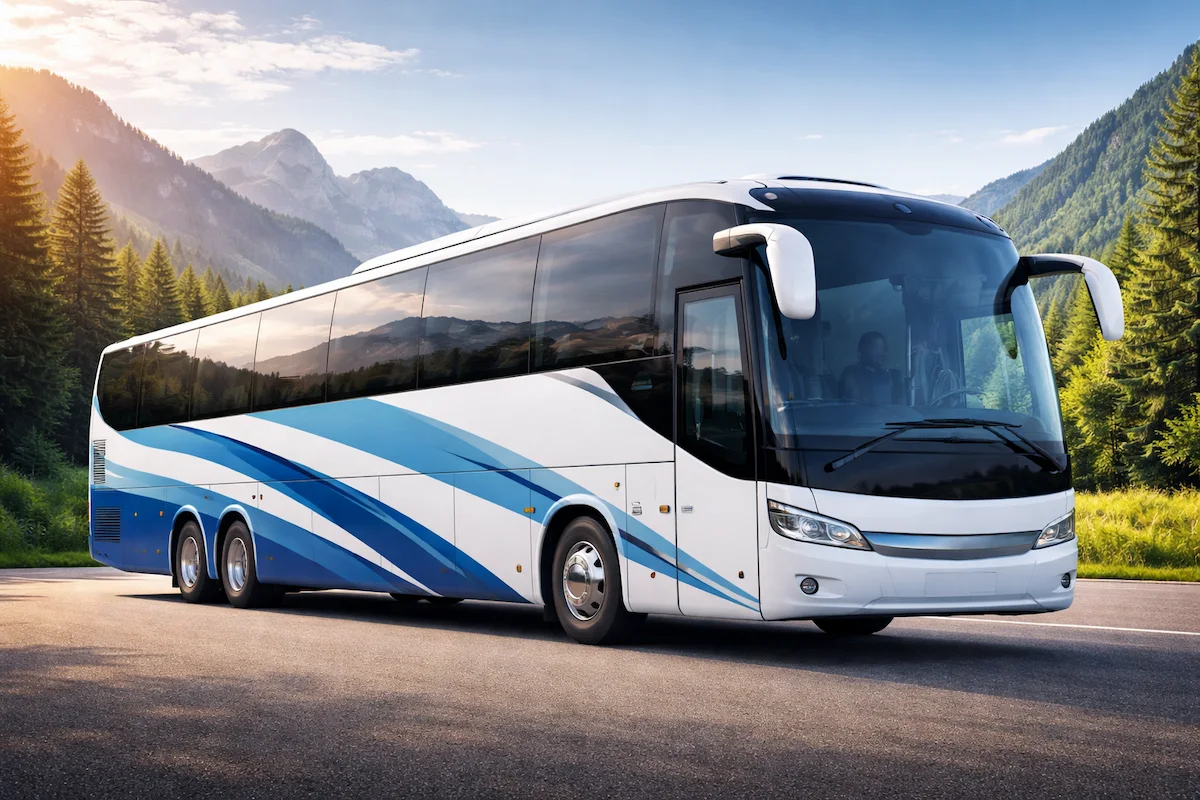
An Explanation of the Word "bus" in an Image

Modern white and blue coach bus on a mountain road, showing large windows, smooth body lines, multiple axles, and a forested mountain background.
A modern long-distance coach bus traveling along a scenic mountain road, highlighting its sleek aerodynamic design, large panoramic windows, and comfortable passenger transport in a natural landscape.

Conversation Using the Word Bus

At a crowded urban transit hub during the morning rush hour, commuters Arthur and Beatrice are waiting for their ride. The conversation highlights the bus as a pillar of public transportation, discussing its efficiency in reducing traffic congestion and the convenience of dedicated lanes in a modern city.

Arthur: I hope the express bus arrives on time today; I have a very important meeting at nine o'clock sharp.

Beatrice: I noticed that the bus is usually more reliable during the winter months because the city prioritizes clearing the transit routes.

Arthur: Taking the bus allows me to catch up on my reading or check my emails instead of stressing over the heavy morning traffic.

Beatrice: I read that a single bus can take up to fifty cars off the road, which significantly lowers the overall carbon footprint of the city.

Arthur: I saw the new electric bus they added to the fleet last week; it’s so quiet that you barely hear it pulling into the stop.

Beatrice: That’s a huge improvement for urban noise pollution; a standard diesel bus can be quite loud when it’s idling at a light.

Arthur: If the bus fare remains affordable, I think even more people will be willing to leave their private vehicles at home.

Beatrice: I agree; a high-quality bus system is the backbone of a functional and sustainable metropolitan area for everyone.

Arthur: Here comes the bus now; we should get our transit cards ready so we don't hold up the line of people boarding.

Beatrice: Let's head to the back; there’s usually more room to sit on the bus if you move away from the front entrance area.

Phrases Containing the Word Bus

The phrases below show how the word bus is used to talk about public transportation, commuting, travel routines, and shared journeys.

Take the bus

To travel by bus.

She takes the bus every morning because it’s cheaper and less stressful than driving.

Catch a bus

To get on a bus before it leaves.

He ran to catch a bus that was already pulling away from the stop.

Miss the bus

To fail to get on a bus.

Missing the bus made her late for an important appointment.

Bus stop

A place where buses stop.

People waited quietly at the bus stop as rain began to fall.

Bus station

A terminal for buses.

The bus station was crowded with travelers heading home for the holidays.

Bus ride

A journey by bus.

The long bus ride gave her time to read and relax.

Bus driver

A person who drives a bus.

The bus driver greeted passengers warmly every morning.

Bus route

The path a bus follows.

The bus route changed recently, confusing many daily commuters.

Bus ticket

A pass for riding a bus.

She bought a bus ticket online to avoid waiting in line.

Bus fare

The cost of a bus ride.

The bus fare increased slightly due to rising fuel prices.

Bus schedule

A timetable for buses.

Checking the bus schedule helped him plan his commute better.

School bus

A bus for transporting students.

The school bus arrived early, giving parents peace of mind.

City bus

A bus operating within a city.

City buses are often crowded during rush hour.

Bus service

A system of buses.

Improved bus service made public transport more attractive.

Bus terminal

A major bus station.

The bus terminal connects several cities across the region.

Bus lane

A road lane reserved for buses.

The bus lane helped reduce travel time during peak hours.

Bus commute

Daily travel by bus.

Her daily bus commute allowed her to avoid traffic stress.

Bus journey

A long trip by bus.

The overnight bus journey was tiring but affordable.

Bus network

A connected system of buses.

The city expanded its bus network to underserved areas.

Bus travel

Traveling using buses.

Bus travel is popular among students and budget travelers.

Words Rhyme with bus

us
plus
fuss
muss
thus
cuss
truss
discuss
minus
bonus
focus
hocus
crocus
locust
chorus
porous
walrus
campus
census
consensus
surplus
syllabus
omnibus
octopus
stimulus
impetus
pocus
fungus
among us
tremendous
POS: Noun, Verb  Category: Vehicles