Short definition: The phrase quite slowly is used to say that something happens at a relaxed or unhurried pace, slower than normal but not extremely slow, often giving a calm, careful, or thoughtful impression.
Looking for a clear and natural explanation of the phrase quite slowly?
The phrase quite slowly is used to describe the speed of an action or process.
It often suggests noticeable slowness, but without sounding extreme or negative.
You will see it in descriptions of movement, change, learning, or progress.
Depending on context, it can feel calm, careful, patient, or simply unhurried.
Below, each meaning is explained in a calm and natural way,
with enough detail to feel clear, human, and precise.
(Adverb phrase) Moving or happening at a noticeably slow speed without urgency.
Quite slowly describes an action that progresses at a relaxed unhurried pace allowing time for careful movement or gradual change, often suggesting patience calmness or deliberate control rather than delay or weakness.
The line moved quite slowly as people checked their tickets carefully and stopped to ask questions before entering.
She spoke quite slowly during the presentation so everyone could clearly follow each point without feeling rushed.
The project advanced quite slowly at first while the team focused on planning and avoiding early mistakes.
Synonyms:
fairly slowly, rather slowly, at a slow pace, unhurriedly, gradually, calmly, at an easy pace, little by little, with patience, gently progressing, step by step, measuredly Antonyms:
very quickly, rapidly, fast, at high speed, hurriedly, suddenly, swiftly, quickly, at full pace, in a rush, immediately, without delay
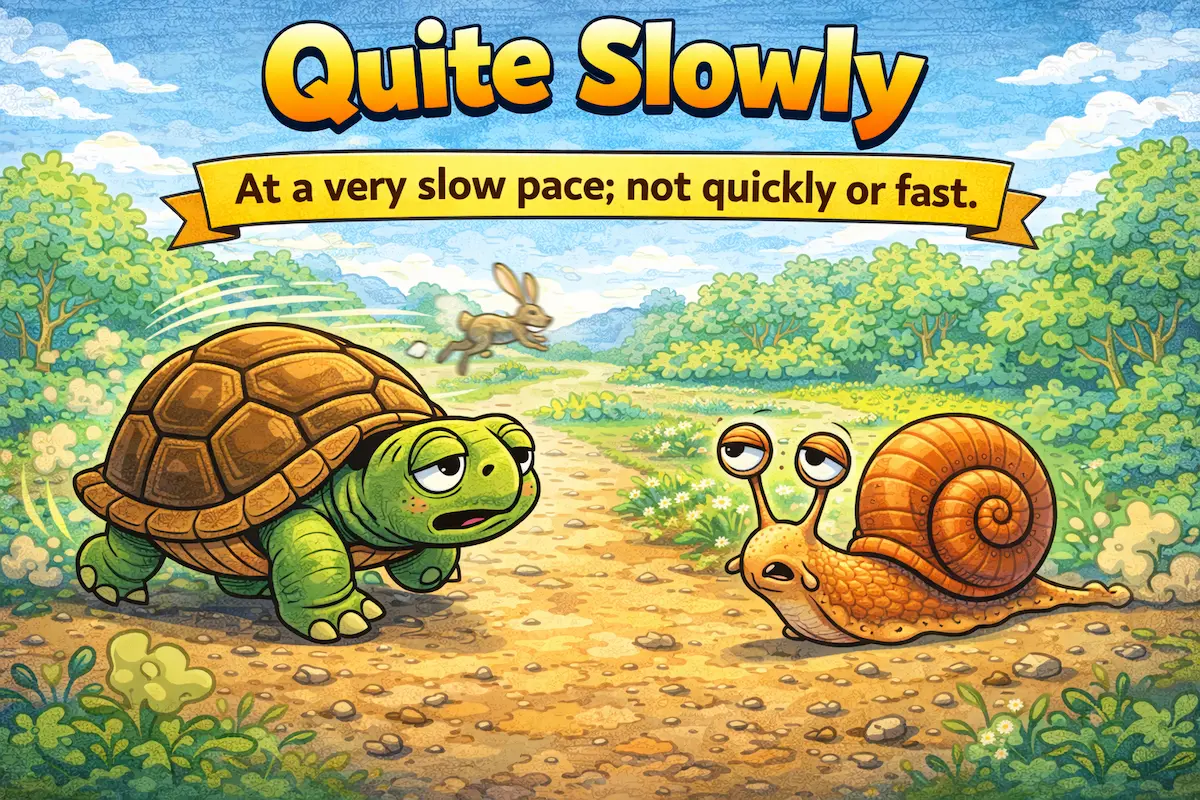
An Explanation of the Word "quite slowly" in an Image
A gentle cartoon illustration explaining the phrase “quite slowly,” showing a tortoise and a snail moving at a very slow pace along a path, clearly emphasizing gradual movement rather than speed.
Conversation Using the Phrase Quite Slowly
The following conversation takes place between two coworkers discussing progress on a long-term project.
It shows how the phrase quite slowly is used naturally to describe gradual movement and careful pacing.
Emma: How is the new system coming along?
Ryan: It is moving quite slowly, but that is intentional so we do not miss any details.
Emma: That makes sense, rushing usually creates more problems later.
Ryan: Exactly, we decided to move quite slowly at first to make sure everything is stable.
Emma: I would rather see slow progress than big mistakes.
Ryan: Same here, progress that moves quite slowly but steadily usually lasts longer.
Emma: Let me know if you need extra support.
Ryan: Will do, thanks for understanding the pace.
Phrases Containing the Expression Quite Slowly
The phrases below show how quite slowly is commonly used to describe movement,
progress, change, or development in everyday English.
Move quite slowly
To move at a gentle pace.
After the long hike, they moved quite slowly along the trail, taking breaks to enjoy the scenery and recover their energy.
Walk quite slowly
To walk without rushing.
She walked quite slowly through the park, paying attention to her thoughts and the quiet sounds around her.
Progress quite slowly
To improve at a gradual pace.
The project progressed quite slowly at first as the team took time to understand the requirements clearly.
Change quite slowly
To develop over time.
His opinion changed quite slowly as he listened to different perspectives and reflected on them.
Recover quite slowly
To heal gradually.
After the injury, she recovered quite slowly, following the doctor’s advice and avoiding unnecessary pressure.
Grow quite slowly
To develop at a modest pace.
The business grew quite slowly in the beginning, but the steady approach helped build a strong foundation.
Learn quite slowly
To absorb information at a relaxed pace.
He learned quite slowly at first, but repetition and patience helped everything become clearer over time.
Speak quite slowly
To talk carefully and calmly.
The teacher spoke quite slowly to make sure everyone could follow the explanation without feeling rushed.
Move forward quite slowly
To advance with caution.
Negotiations moved forward quite slowly as both sides wanted to avoid misunderstandings.
Work quite slowly
To work at a careful pace.
She worked quite slowly on the report, checking every detail to avoid mistakes.
Build quite slowly
To develop step by step.
Trust between them was built quite slowly through honest conversations and consistent actions.
Improve quite slowly
To get better gradually.
His confidence improved quite slowly, but each small success made a difference.
Move quite slowly at first
Starting carefully.
The team decided to move quite slowly at first to avoid making costly mistakes.
Develop quite slowly over time
Gradual long-term change.
The relationship developed quite slowly over time, growing stronger with shared experiences.
Proceed quite slowly
To continue with caution.
The guide advised them to proceed quite slowly because the path was narrow and uneven.
Respond quite slowly
To take time before reacting.
He responded quite slowly to the message, choosing his words carefully.
Move quite slowly through traffic
Slow movement in crowded conditions.
During rush hour, cars moved quite slowly through traffic, testing everyone’s patience.
Heal quite slowly
Gradual physical or emotional recovery.
Some wounds heal quite slowly, especially when they involve deep emotional stress.
Advance quite slowly
Careful forward movement.
The line advanced quite slowly, but people remained calm and patient.
Fade quite slowly
To disappear gradually.
The sound of music faded quite slowly as the night grew quieter.