tariffs
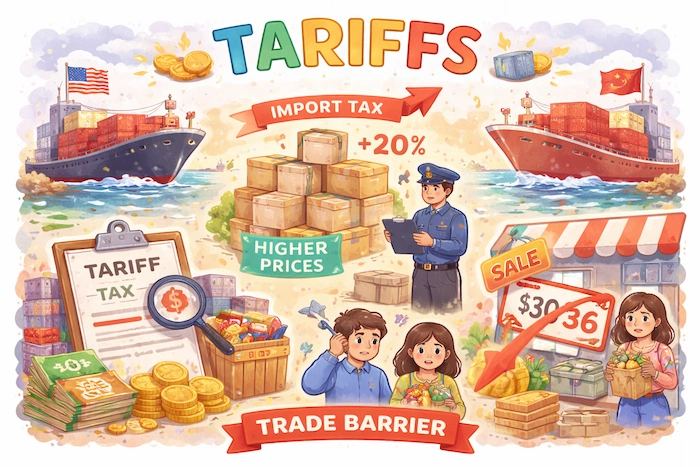
Short definition: The word tariffs means taxes that a government puts on products coming from other countries. People use it to talk about trade rules, prices of goods, and how countries protect their local industries or control imports.
Looking for a clear and natural explanation of the word tariffs? The word tariffs comes up a lot when people talk about trade, prices, and relationships between countries. At its core, tariffs are extra charges added to goods that cross borders. Sometimes they are used to protect local businesses, sometimes to raise money for the government, and sometimes as a political tool in bigger economic battles. In everyday life, tariffs can quietly affect how much we pay for food, clothes, electronics, and many other things. Below, each meaning is explained in a relaxed and natural way, so it feels clear and human, not like a dry economics textbook.
Singular: tariff
Plural: tariffs
Related: tax n., duty n., import fee n.
Syllable: ta-riffs
-
Extra taxes added to goods that come from another country.
In its most common meaning, tariffs are fees that a government puts on products imported from abroad. When a company brings in shoes, cars, or food from another country, tariffs make those items more expensive. The idea is often to help local businesses compete, but it can also mean higher prices for shoppers.
Because of new tariffs, imported electronics suddenly cost much more.The company raised prices after tariffs were placed on raw materials.Many customers didn’t realize that tariffs were the reason for the increase.Synonyms: import taxes, customs duties, trade taxes, border fees, import charges, duty fees, customs charges, trade duties, foreign-goods tax, border taxes, import levies, trade fees
Antonyms: free trade, duty-free imports, zero tariffs, tax-free goods, open trade, no import fees, tariff-free trade, open-market system, free exchange, no trade barriers, unrestricted trade, open borders for goods -
A tool governments use to protect local industries.
Tariffs are often used to help local businesses survive. By making foreign products more expensive, governments hope people will choose local brands instead. Supporters say this saves jobs, while critics say it limits choice and raises costs.
Farmers supported the tariffs because cheaper imports were hurting their sales.The factory stayed open after tariffs protected it from foreign competition.Critics argued that tariffs only made everyday goods harder to afford.Synonyms: trade protection, market shielding, local-industry support, economic defense, domestic protection policy, industry-saving taxes, market barriers, trade barriers, protectionist measures, local-market defense, national trade shield, industry support tool
Antonyms: open competition, free market, global trade access, fair trade openness, open economy, market freedom, international cooperation, trade liberalization, economic openness, borderless trade, free exchange policy, competitive openness -
A way for governments to raise money.
Another role of tariffs is simple: they bring money into the government. Every time goods cross the border, the fees collected help fund public services like roads, schools, and healthcare.
The government relied on tariffs to support its public programs.Before income tax became common, tariffs were a major source of national income.Higher tariffs helped cover the cost of new infrastructure projects.Synonyms: revenue taxes, government fees, public-income source, border revenue, trade income, customs revenue, state fees, national income charges, import-based revenue, duty income, public-funding taxes, treasury charges
Antonyms: tax cuts, revenue loss, reduced fees, zero charges, government subsidy, public spending support, free import policy, no-fee system, tax-free trade, income reduction, free-entry trade, open border policy -
A political tool in trade conflicts between countries.
Tariffs are sometimes used as pressure. One country raises tariffs to send a message, and another responds with its own. These back-and-forth actions are often called trade wars, and they can affect global prices and relationships.
The two countries raised tariffs in response to each other’s policies.Businesses felt nervous as tariffs became part of political battles.Economists warned that higher tariffs could hurt everyone in the long run.Synonyms: trade pressure, economic weapon, political trade tool, trade-war tactic, economic leverage, diplomatic pressure tool, trade conflict measure, power-through-trade move, economic retaliation, trade sanction light, policy weapon, negotiation pressure
Antonyms: trade cooperation, economic partnership, friendly trade policy, diplomatic trade relations, mutual trade agreement, peaceful trade system, shared growth policy, collaborative economy, trade harmony, global cooperation, partnership-based trade, open diplomacy -
Something that quietly affects everyday prices.
Even if people don’t follow politics, tariffs can still affect daily life. When companies pay more to bring goods in, they often pass that cost to customers. So a decision made far away can change the price of items at your local store.
She noticed groceries cost more, not knowing tariffs played a part.Higher tariffs slowly changed how families planned their budgets.The store owner explained that tariffs were behind the new prices.Synonyms: price influencer, cost-raising factor, hidden expense, indirect tax effect, consumer-price driver, cost pressure, price-impact tool, expense booster, market-price changer, daily-cost factor, spending influencer, cost-shifting force
Antonyms: price stability, cost reduction, affordable pricing, low-cost access, consumer savings, cheap imports, price relief, budget-friendly market, low-expense trade, cost-free entry, affordable trade system, low-price flow