ask for trouble

Short definition: The phrase ask for trouble means to behave in a careless, risky, or provocative way that is likely to cause problems, punishment, or negative consequences, as if someone is intentionally inviting difficulty or conflict.

Looking for a clear and natural explanation of the phrase ask for trouble? This idiom is common in everyday English and often appears in warnings or advice. To ask for trouble means behaving in a way that is very likely to cause problems. You will hear it in casual conversations, stories, and situations where someone ignores common sense. Below, each meaning is explained in a calm and natural way, with long definitions and realistic examples.

ask for trouble idiom /æsk fər ˈtrʌb.əl/

Forms: ask for trouble (fixed idiom)
Related: provoke v., risk n., consequence n.
Syllable: ask for trou-ble

  1. (Idiom) To behave in a risky or careless way that is very likely to cause problems.

    To ask for trouble means doing something even though you know it could lead to negative consequences. It often suggests ignoring warnings, advice, or common sense. People use this idiom to point out that the resulting problem should not be a surprise. The tone can be serious, critical, or slightly humorous.

    Driving that fast on wet roads is just asking for trouble.
    He’s asking for trouble by arguing with his boss in public.
    Leaving your phone unattended like that is asking for trouble.

    Synonyms: invite trouble, take a risk, provoke problems, court danger, bring problems on yourself, tempt fate, play with fire, risk consequences, act carelessly, cause issues, push your luck, invite conflict
    Antonyms: avoid trouble, act wisely, play it safe, be cautious, take precautions, prevent problems, act responsibly, stay out of danger, think ahead, minimize risk, use common sense, be careful

  2. (Idiom) To deliberately provoke a negative reaction or conflict from others.

    Ask for trouble can also mean intentionally doing something that will annoy, anger, or challenge someone. In this sense, the person may be aware that conflict will follow. It is often used when someone behaves provocatively or disrespectfully. The emphasis here is on intention rather than carelessness.

    Making jokes about the referee was asking for trouble with the crowd.
    He knew he was asking for trouble by bringing up the topic again.
    Challenging them like that is really asking for trouble.

    Synonyms: provoke conflict, stir trouble, invite confrontation, antagonize others, push buttons, start problems, incite reactions, provoke anger, challenge authority, create tension, spark conflict, invite backlash
    Antonyms: keep the peace, avoid conflict, calm the situation, act diplomatically, respect boundaries, stay neutral, de-escalate, smooth things over, reduce tension, avoid provocation, be tactful, promote harmony
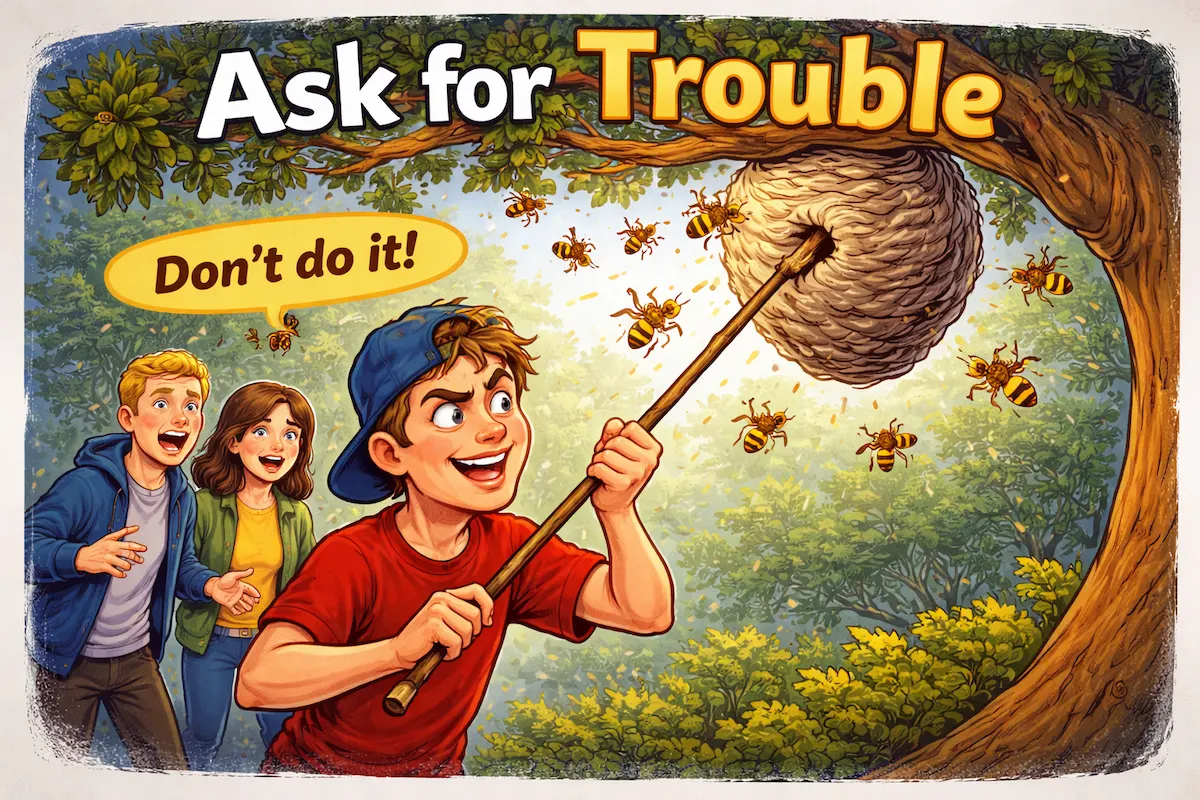
An Explanation of the Word "ask for trouble" in an Image

Colorful landscape illustration of the idiom Ask for Trouble, depicting a person provoking danger to represent intentionally doing something likely to cause problems.
A lively educational illustration of the idiom Ask for Trouble, showing a reckless action that clearly invites problems, symbolizing behavior that knowingly leads to negative consequences.

Conversation Using the Idiom Ask for trouble

In a cautionary discussion about safety and risky behavior, Julian and Chloe talk about a friend's recent choices. The dialogue highlights the idiom ask for trouble, which means to act in a way that is very likely to result in problems, danger, or difficulty.

Julian: Leaving your car unlocked in this neighborhood is really just going to ask for trouble.

Chloe: I agree; walking home alone through that dark alley at night is definitely going to ask for trouble too.

Julian: I read that ignoring the safety warnings on heavy machinery is a fast way to ask for trouble in the workshop.

Chloe: I noticed that he likes to ask for trouble by constantly arguing with the supervisor during team meetings.

Julian: If you ask for trouble by not wearing a helmet, you can't be surprised if you get hurt in an accident.

Chloe: It’s important to be sensible; some people seem to ask for trouble just to get a bit of attention.

Julian: I saw a hiker go off the marked trail without a map, which is a classic way to ask for trouble.

Chloe: You’re just going to ask for trouble if you try to fix that electrical wiring yourself without any training.

Julian: I’m glad we are being careful; there’s no need to ask for trouble when a few simple precautions can prevent it.

Chloe: I agree; life is complicated enough without going out of your way to ask for trouble.

Phrases Containing the Expression Ask for Trouble

The phrases below show how the expression ask for trouble is used to describe behavior that is likely to cause problems or negative consequences.

Ask for trouble

To invite problems.

Ignoring repeated warnings is just asking for trouble in the long run.

Ask for trouble at work

To create workplace problems.

Missing deadlines repeatedly is asking for trouble at work.

Ask for trouble by lying

To invite consequences.

Lying about the mistake is asking for trouble when the truth eventually comes out.

Ask for trouble on purpose

To knowingly invite problems.

He knew arguing in public was asking for trouble on purpose.

Ask for trouble by speeding

To risk punishment.

Driving that fast through the city is asking for trouble.

Ask for trouble online

To invite digital conflict.

Posting inflammatory comments is asking for trouble online.

Ask for trouble with authority

To challenge rules.

Arguing with security without reason is asking for trouble.

Ask for trouble by ignoring advice

To reject guidance.

Ignoring expert advice is often asking for trouble.

Ask for trouble socially

To risk social conflict.

Making jokes about sensitive topics is asking for trouble socially.

Ask for trouble in traffic

To behave dangerously.

Cutting across lanes without signaling is asking for trouble in traffic.

Ask for trouble financially

To risk money problems.

Spending beyond your means is asking for trouble financially.

Ask for trouble by overreacting

To escalate a situation.

Overreacting to criticism is asking for trouble.

Ask for trouble in relationships

To risk personal conflict.

Keeping secrets is asking for trouble in relationships.

Ask for trouble by being careless

To invite mistakes.

Being careless with important documents is asking for trouble.

Ask for trouble at school

To risk punishment.

Skipping classes regularly is asking for trouble at school.

Ask for trouble by provoking others

To invite conflict.

Provoking others online is asking for trouble.

Ask for trouble in public

To behave recklessly.

Shouting in public is asking for trouble.

Ask for trouble by cutting corners

To risk failure.

Cutting corners on safety is asking for trouble.

Ask for trouble repeatedly

To invite ongoing problems.

Ignoring feedback repeatedly is asking for trouble.

Ask for trouble without realizing

To unknowingly cause problems.

He was asking for trouble without realizing how serious the situation was.

Words Rhyme with ask for trouble

task for bubble
mask for double
flask for rubble
bask for stubble
cask for suble
task for stubble
unmask the rubble
mask the double
bask in bubble
cask of rubble
trouble
bubble
double
rubble
stubble
subtle
rebuttal
scuttle
shuttle
huddle
muddle
puddle
cuddle
befuddle
struggle
snuggle
juggle
smuggle
couple
supple
POS: Verb Phrase