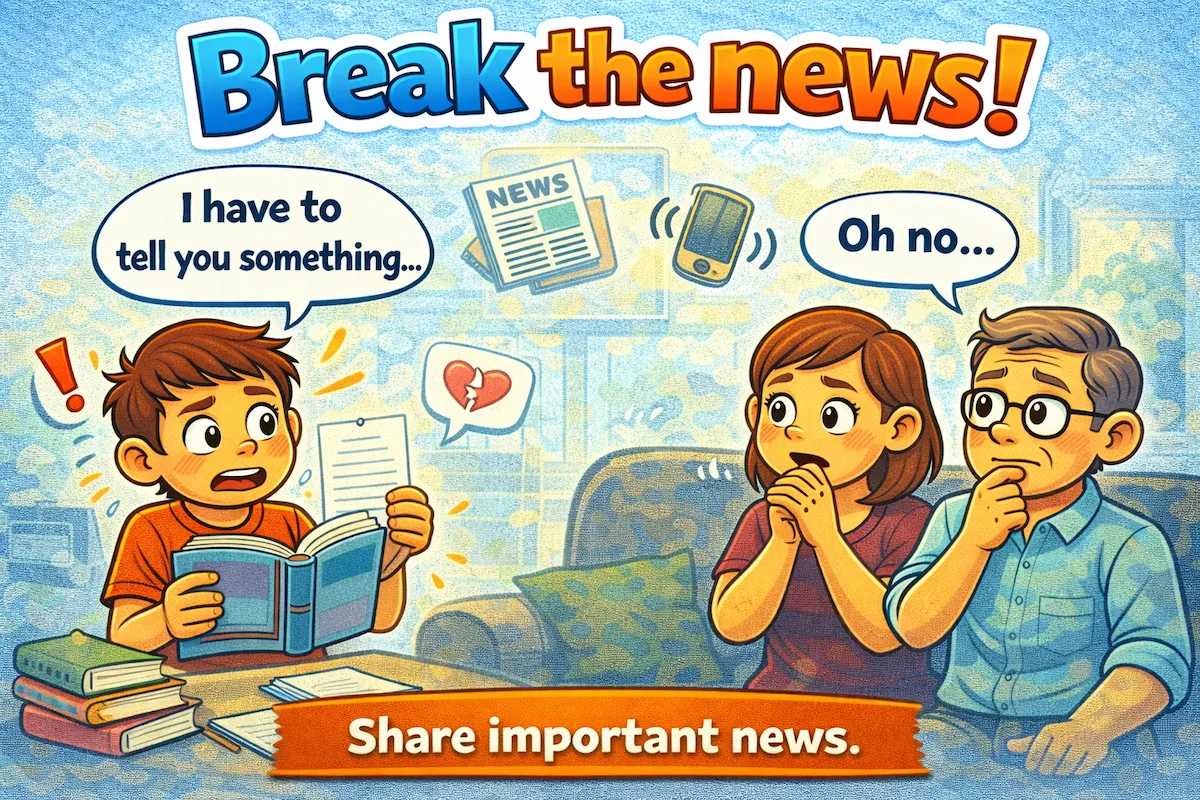
break the news
Short definition: The phrase break the news means to tell someone important information, especially something surprising, serious, or unpleasant, requiring care, sensitivity, and awareness of how the listener may react.
Looking for a clear and natural explanation of the phrase break the news?
This phrase is very common in everyday English, especially when talking about sharing important or sensitive information.
To break the news means telling someone news that may be surprising, serious, or emotional.
You will hear it in conversations about family matters, work situations, and major life events.
Below, each meaning is explained in a calm and natural way, with long definitions and realistic examples.
Forms: break the news, breaks the news, broke the news, breaking the news
Related: announce v., inform v., reveal v.
Syllable: break the news
-
(Verb Phrase) To tell someone important or serious information, especially when it may cause an emotional reaction.
To break the news means sharing information that could surprise, shock, or deeply affect someone.
This is often used for bad news, but it can also apply to life-changing or unexpected updates.
The phrase focuses on the act of telling, not the news itself.
People often choose their words carefully when they break the news.
She didn’t know how to break the news about the accident to her family.
The doctor gently broke the news to the patient in a private room.
He asked his manager to help him break the news to the team.
Synonyms:
tell someone, deliver the news, share the information, inform gently, announce carefully, reveal the truth, give the update, communicate the news, pass on information, notify, disclose, make known
Antonyms:
keep it secret, withhold information, hide the truth, stay silent, avoid telling, conceal the news, keep quiet, say nothing, delay informing, cover up, suppress information, remain silent
-
(Verb Phrase) To officially announce news to a group or the public.
Break the news can also be used when someone formally announces information.
This meaning is common in workplaces, media, and organizations.
The focus here is on responsibility and timing.
It often involves preparation and clear communication.
The company CEO broke the news about the merger during the meeting.
The teacher broke the news of the schedule change to the class.
Journalists rushed to break the news as soon as it was confirmed.
Synonyms:
announce officially, make an announcement, release information, go public, report the news, declare, inform publicly, broadcast, communicate officially, reveal publicly, notify everyone, share formally
Antonyms:
keep private, delay announcement, hold back information, embargo the news, avoid announcing, keep confidential, postpone disclosure, restrict information, remain unofficial, stay quiet publicly, suppress release, keep internal
Conversation Using the Phrase Break the news
In a quiet hospital waiting room, Dr. Thomas and a nurse, Mia, are preparing to speak with a family. The dialogue explores the phrase break the news, which means to tell someone about something important that has happened, especially if the information is sad, shocking, or surprising.
Thomas: I have to go and break the news to the family that the surgery was much more complicated than we initially expected.
Mia: It’s the hardest part of the job; I’ll come with you while you break the news just in case they need extra support.
Thomas: I read that the way you break the news to a patient can significantly affect their emotional response and their recovery process.
Mia: I noticed that you always choose a quiet, private space when you have to break the news about a difficult diagnosis.
Thomas: If we break the news gently but honestly, it helps the family start to process the situation with a clear understanding of the facts.
Mia: I saw a reporter break the news about the earthquake on live television, and she managed to stay very calm under pressure.
Thomas: It’s never easy to break the news of a job loss or a failed project, but it’s always better to do it directly and in person.
Mia: I agree; waiting too long to break the news only makes the situation more stressful for everyone involved in the end.
Thomas: I’m going in now; I just hope that by the time I break the news, they feel like they have all the information they need.
Mia: I’ll be right there; we’ll break the news together and make sure they know what the next steps in the treatment will be.
Phrases Containing the Expression Break the News
The phrases below show how the expression break the news is used to describe
telling someone important information—often surprising, sensitive, or difficult—carefully and clearly.
Break the news
To tell someone important or difficult information.
She didn’t know how to break the news that the plan had changed, because everyone had worked so hard and expected a different outcome.
Break the news gently
To tell someone in a careful, kind way.
He tried to break the news gently, choosing calm words and giving her time to process what he was saying.
Break the news to someone
To inform a specific person.
They had to break the news to their parents that they were moving abroad, even though they knew it would be emotional.
Break the news in person
To tell someone face-to-face.
He decided to break the news in person because a message would feel cold, and he wanted to show respect and support.
Break the news by phone
To tell someone over a call.
She had to break the news by phone since they lived far apart, and she didn’t want him to hear it through rumors first.
Break the news calmly
To deliver information without panic.
Even though he was anxious, he broke the news calmly so the conversation didn’t spiral into fear and confusion.
Break the news honestly
To tell the truth clearly.
She broke the news honestly, explaining what happened, what she knew for sure, and what was still uncertain.
Break the news carefully
To choose words thoughtfully to reduce harm.
He broke the news carefully, avoiding harsh language and focusing on next steps so the listener didn’t feel helpless.
Break the news at the right time
To choose a suitable moment to share information.
They waited to break the news at the right time, because doing it during a stressful week would have made everything harder.
Break the news abruptly
To tell someone suddenly, without preparation.
He broke the news abruptly in the middle of dinner, and the shock made everyone fall silent for a long moment.
Break the news gradually
To reveal information step by step.
She broke the news gradually, starting with the context and then explaining the decision, so it didn’t feel like a sudden hit.
Break the news to the team
To inform a group of coworkers.
Management gathered the staff to break the news to the team, then answered questions so people wouldn’t rely on rumors.
Break the news about a delay
To inform someone that something will be late.
I had to break the news about a delay, explaining what caused it, how we’ll fix it, and when we realistically expect delivery.
Break the news about a change
To announce an update that affects plans.
She broke the news about a change in schedule and reassured everyone that the main goal would stay the same.
Break the news with empathy
To deliver information while showing care and understanding.
He broke the news with empathy, acknowledging how hard it was to hear and offering real support instead of empty comfort.
Break the news professionally
To announce information in a formal, appropriate way.
She broke the news professionally by stating the facts clearly, avoiding blame, and outlining what the team should do next.
Break the news without sugarcoating
To tell the truth directly, without making it sound nicer.
He broke the news without sugarcoating it, because false hope would only create bigger disappointment later.
Break the news softly
To speak gently and carefully when telling something sensitive.
She broke the news softly, keeping her voice steady so the listener felt supported instead of overwhelmed.
Break the news and offer a plan
To share difficult information and also explain next steps.
He broke the news and offered a plan right away, because people handle bad news better when they know what happens next.
Break the news responsibly
To share information carefully, considering its impact.
Leaders should break the news responsibly by confirming details first and communicating clearly, so panic and misinformation don’t spread.