"Different" vs. "Difference": Contrasting Word Form Roles
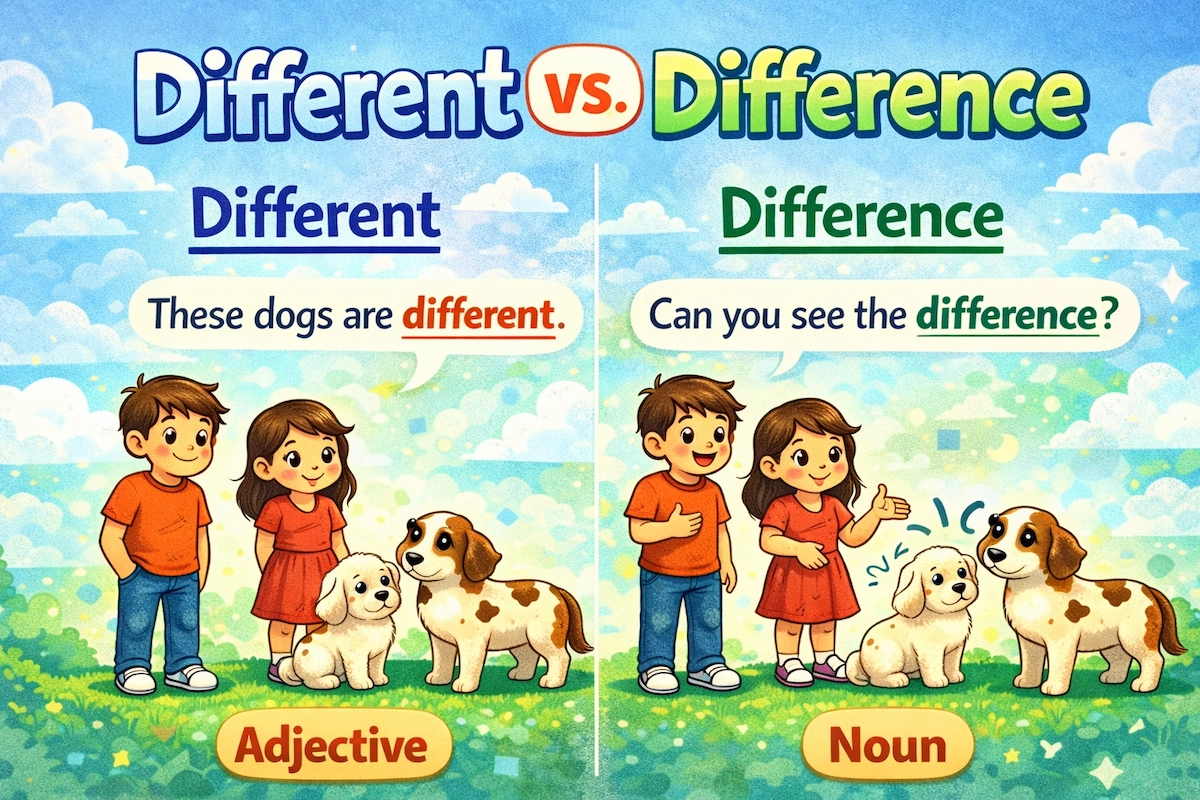
This Sentence Patterns usage guide explains the difference between “different” and “difference.” Learn how adjective and noun roles affect sentence structure, explore common comparison patterns, and avoid frequent learner mistakes so you can express contrast clearly and naturally in English.
One of the most common grammar confusions in English involves two very familiar words: different and difference. Learners know both words, recognize their meanings, and understand the idea behind them — yet still hesitate when using them in sentences.
The reason is simple: these two words look similar, share the same root, and describe the same concept. But grammatically, they play very different roles. One is an adjective. The other is a noun. Mixing them up can break sentence structure, even if the general meaning remains clear.
In this usage guide, we’ll explore the exact grammatical roles of different and difference, examine common sentence patterns where each one appears, and show you how to choose the correct form naturally and confidently.
The Core Difference Between “Different” and “Difference”
The most important distinction is grammatical function.
- Different is an adjective.
- Difference is a noun.
This single fact determines where each word can appear in a sentence.
If you remember nothing else, remember this: adjectives describe nouns, while nouns name things.
What Does “Different” Do in a Sentence?
Different describes how one thing is not the same as another. Because it is an adjective, it must modify a noun.
They have different opinions.
Here, different describes the noun opinions.
You cannot use different alone as the subject or object of a sentence.
Common Sentence Pattern: “Different + Noun”
The most basic and common pattern is:
different + noun
We tried different approaches.
People have different priorities.
This structure appears constantly in spoken and written English.
Using “Different” with “From”
One of the most important sentence patterns with different is different from.
This plan is different from the original one.
In standard modern English, different from is the safest and most widely accepted form.
Other variants exist, but learners should master this one first.
What “Different” Cannot Do
Because different is an adjective, it cannot:
- Act as a subject
- Act as an object
- Follow an article like a or the by itself
Incorrect: There is a different between them.
This error happens when learners use the adjective where a noun is required.
What Does “Difference” Do in a Sentence?
Difference names the concept of how things are not the same. Because it is a noun, it can function as a subject, object, or complement.
There is a difference between the two options.
Here, difference is the subject of the sentence.
Common Sentence Pattern: “There Is a Difference”
One of the most common patterns learners encounter is:
There is a difference between A and B.
There’s a big difference between theory and practice.
This structure emphasizes the existence of contrast.
Using “Difference” with Articles
Because difference is a countable noun, it often appears with articles.
a difference the difference
A small difference can change the outcome.
This is another clear signal that you are dealing with a noun, not an adjective.
Difference as an Object
Difference frequently appears as the object of verbs like see, notice, or explain.
I can’t see the difference.
She explained the difference clearly.
In these sentences, difference receives the action.
Comparing “Different” and “Difference” Side by Side
Compare these two correct sentences:
They chose different solutions. There is a difference in their solutions.
Both sentences express contrast, but the grammar is different.
Sentence Pattern: “Make a Difference”
One very common idiomatic pattern with difference is:
make a difference
Small actions can make a difference.
This expression means to have an impact, not just to be different.
Using “Different” in Comparative Thinking
Different is often used when focusing on variety or contrast within a group.
We need a different strategy.
Here, the speaker emphasizes change rather than comparison.
Using “Difference” to Emphasize Contrast
Difference is more analytical and is often used in explanations.
The main difference lies in the cost.
This structure highlights contrast in a clear, structured way.
Common Learner Mistakes
Learners frequently make these errors:
- Using different where a noun is needed
- Using difference to modify a noun
- Forgetting articles with difference
Incorrect: We noticed many difference opinions. Correct: We noticed many different opinions.
Why These Mistakes Happen
Many languages use the same word form for both adjective and noun. English does not.
Learning to separate word forms is a key step toward advanced fluency.
Sentence Pattern Test
Ask yourself:
Am I describing a noun, or naming a thing?
If you are describing, use different. If you are naming, use difference.
Formal vs Informal Usage
Both words appear in all registers of English.
However, difference is more common in academic, analytical, and professional writing.
Different appears more often in everyday conversation.
Why Mastering This Pair Matters
Correctly using different and difference improves clarity and precision.
It also prevents small grammatical errors that can distract readers or listeners.
Final Thoughts: One Root, Two Roles
Different and difference share meaning, but not function.
Once you understand their roles — adjective versus noun — sentence patterns become predictable and easy to control.
Mastering this distinction is a small step that leads to much more confident English.