Assume vs. Presume: The Subtle Difference You Need to Know
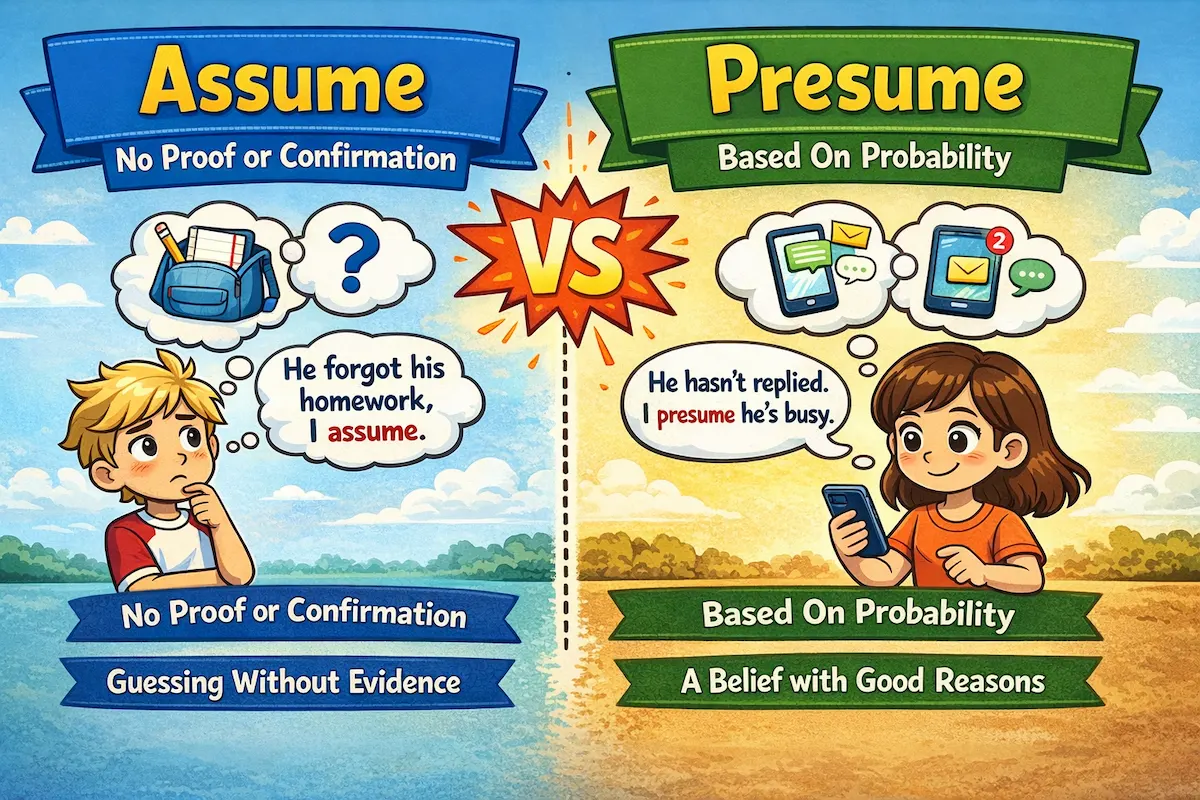
This guide explains the difference between “assume” and “presume.” Learn when assume suggests guessing without evidence and when presume reflects logical conclusions, with clear examples, professional context, and interactive practice questions.
The verbs “assume” and “presume” are often treated as twins in English. Many dictionaries even list them as near-synonyms, which makes the confusion worse. In everyday conversation, people mix them freely — and usually get away with it.
But in careful, professional, or academic English, the difference between assuming and presuming matters. The choice you make subtly reveals how confident you are, how much evidence you have, and even how polite or arrogant you might sound.
In this guide, we’ll break down the real difference between assume and presume, show you how native speakers feel the contrast, and help you choose the right word in business, writing, and daily conversation.
The Core Difference in Plain English
At its simplest, the difference looks like this:
- Assume → guess without strong evidence
- Presume → conclude based on some evidence or logic
Both involve uncertainty — but not the same degree of uncertainty.
What Does “Assume” Really Mean?
Assume means to accept something as true without checking or without solid proof.
I assumed the meeting was canceled.
In this sentence, the speaker did not verify the information. The belief is based on convenience, habit, or personal expectation.
Common Situations Where We “Assume”
- Everyday misunderstandings
- Unverified beliefs
- Personal expectations
- Stereotypes or shortcuts in thinking
Don’t assume everyone knows the rules.
Here, “assume” warns against careless thinking.
The Hidden Risk of “Assume”
“Assume” often carries a negative tone — especially in professional settings.
It can suggest:
- Lack of verification
- Carelessness
- Bias
- Overconfidence
You shouldn’t assume things without asking.
What Does “Presume” Mean?
Presume also means accepting something as true — but with a crucial difference.
When you presume, you are using logic, experience, or available evidence to reach a conclusion.
I presume the train is delayed because of the weather.
The speaker doesn’t know for sure, but the conclusion is reasonable.
Presume Sounds More Careful — and More Polite
In professional English, presume often sounds:
- More thoughtful
- More logical
- More cautious
- Less judgmental
I presume you’ve already reviewed the document.
This sounds softer than “I assume,” especially in emails.
Side-by-Side Comparison
I assumed he was finished. I presumed he was finished.
The first suggests a guess. The second suggests a conclusion based on context.
Evidence vs. Expectation
A helpful way to choose:
- If it’s mostly expectation → assume
- If it’s based on clues → presume
Assume in Warnings and Advice
“Assume” is frequently used in negative advice.
Never assume someone’s intentions.
The word highlights the danger of jumping to conclusions.
Presume in Professional Communication
In emails and meetings, “presume” softens statements.
I presume this timeline still works for you.
It leaves room for correction.
Legal and Formal Usage
In legal English, presume has a special meaning.
The defendant is presumed innocent.
This shows how “presume” often aligns with reasoned judgment.
Can They Ever Be Interchangeable?
In casual speech, yes — people often treat them as synonyms.
In writing and formal speech, the distinction becomes important.
Common Learner Mistakes
- ❌ I presume without any evidence.
- ❌ Don’t presume things carelessly.
Better choices:
I assume without evidence. Don’t assume things carelessly.
A Simple Memory Trick
Think of presume as “pre-sum” — you add up clues first.
Assume skips that step.
Assume vs. Presume in Business English
I assume the client is unavailable. I presume the client is unavailable due to the time difference.
The second sounds more professional because it explains reasoning.
Practice Test
Please answer the following questions. To see the correct answer, please click the arrow icon.
Which word suggests a guess without strong evidence?
Answer: Assume. Explanation: It implies expectation rather than logic.
Which word sounds more polite in professional emails?
Answer: Presume. Explanation: It leaves room for correction.
“The roads are wet, so I ___ it rained.” Which fits best?
Answer: Presume. Explanation: The conclusion is based on evidence.
Which word often appears in warnings?
Answer: Assume. Explanation: It highlights risky thinking.
Are these words interchangeable in formal writing?
Answer: No. Explanation: The nuance matters in tone and meaning.
Final Thoughts: Guessing vs. Reasoning
Both “assume” and “presume” deal with uncertainty — but they send different signals.
Use assume when you’re guessing. Use presume when you’re reasoning.
Mastering this subtle difference will make your English sound more precise, thoughtful, and professional.