Prepositions with "Arrive": Why You Never "Arrive To"
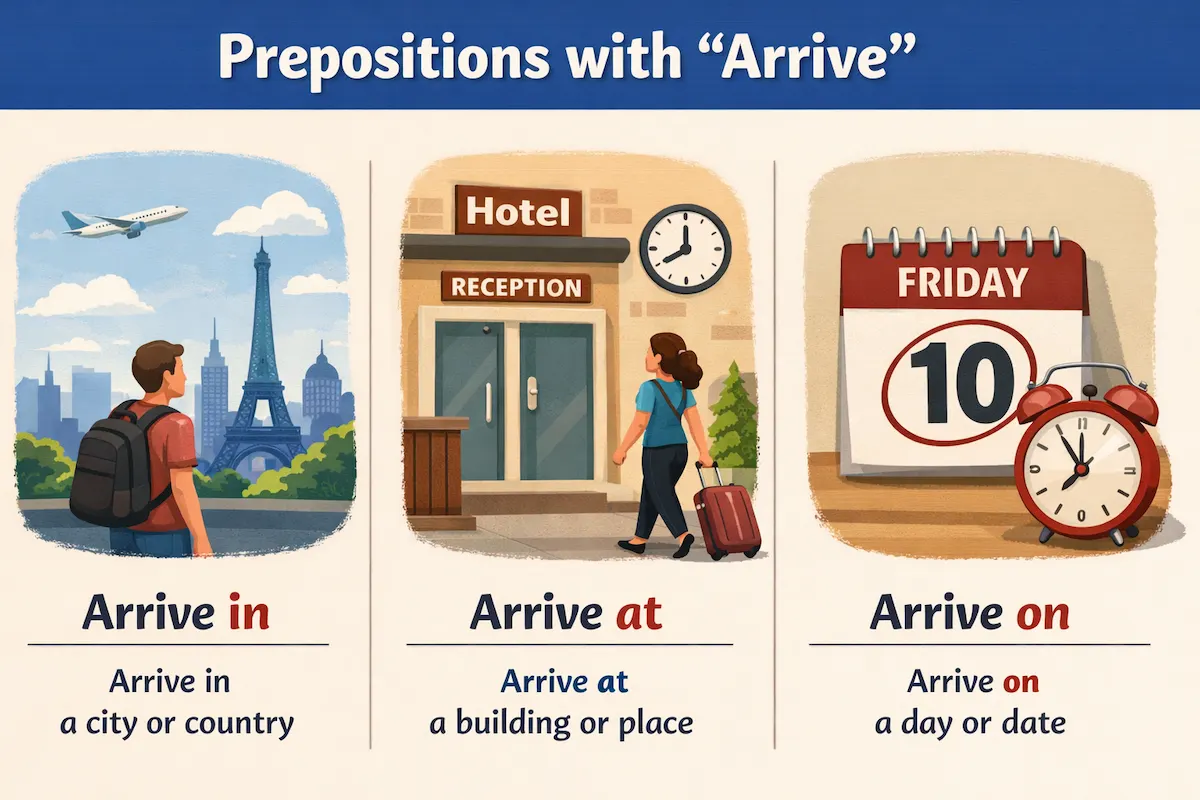
Confused about “arrive in” and “arrive at”? This guide explains why you never say “arrive to,” how destination size determines the preposition, and how to apply the rule confidently in both formal and informal English.
Few preposition mistakes are as common — and as instantly noticeable — as saying “arrive to”. If you’ve ever written a sentence like “I arrived to the airport at 6 a.m.”, you’re not alone.
The problem is simple: in standard English, we never use “arrive to” when talking about destinations. Instead, we use:
- Arrive in (for cities, countries, large areas)
- Arrive at (for specific places, buildings, points)
In this complete guide, you’ll master the logic behind “arrive in” and “arrive at,” understand why “arrive to” sounds wrong, and learn how to apply the rule confidently in real-world speaking and writing.
Why “Arrive To” Is Incorrect
Many learners assume that because we say “go to,” “travel to,” or “drive to,” we should also say “arrive to.” That sounds logical — but English does not follow that pattern here.
The verb arrive historically pairs with prepositions that describe position or location — not movement toward a place.
❌ I arrived to London yesterday. ✔ I arrived in London yesterday.
Notice how the preposition signals the type of destination.
Arrive In – Large Areas and Cities
Use arrive in when referring to:
- Countries
- Cities
- States or provinces
- Large regions
We arrived in Paris late at night. She arrived in Japan during cherry blossom season. They arrived in California last summer.
Think of “in” as describing entry into a large container or area. A city or country is conceptually spacious.
Arrive At – Specific Locations
Use arrive at when referring to:
- Buildings
- Specific addresses
- Events
- Small points or stops
I arrived at the airport early. She arrived at the office at 9 a.m. We arrived at the restaurant just in time.
“At” focuses on a precise point.
Quick Comparison Table
Arrive in → London, Brazil, Europe, New York Arrive at → the hotel, the station, the meeting, the door
What About “Arrive Home”?
Interestingly, we say:
✔ I arrived home at midnight.
We do not say:
❌ I arrived at home.
“Home” behaves like an adverb of place and does not require a preposition.
Why Learners Confuse “Arrive To”
The confusion often comes from translation patterns. Many languages use a direct equivalent of “to” for destination verbs.
English simply treats “arrive” differently.
Formal vs Informal Usage
The rule applies equally in formal and informal English.
Formal: The delegation arrived in Geneva yesterday. Informal: We arrived at the party late.
Arrive at an Idea (Abstract Use)
“Arrive at” also works metaphorically:
We arrived at a conclusion. She arrived at the correct answer.
Here, the “destination” is a specific mental result.
Memory Trick
Think:
- IN = big container (city, country)
- AT = precise point (building, event)
Practice Test
Please answer the following questions. To see the correct answer, please click the arrow icon.
Which is correct: "She arrived ___ New York."
Answer: in Explanation: New York is a city, so we use "arrive in."
Which is correct: "They arrived ___ the station."
Answer: at Explanation: A station is a specific location, so use "arrive at."
Is this correct: "I arrived to the airport."
Answer: No. Explanation: We never use "arrive to." The correct form is "arrived at the airport."
Which is correct: "He arrived ___ Canada."
Answer: in Explanation: Canada is a country, so we use "arrive in."
Which is correct: "We arrived ___ home late."
Answer: (no preposition) Explanation: We say "arrived home," not "arrived at home."
Final Takeaway
You never “arrive to” a destination in standard English.
Use:
- Arrive in for cities and countries
- Arrive at for specific locations
- No preposition with home
Mastering this rule instantly improves your fluency and makes your English sound more natural and professional.