"Staid" vs. "Stayed" – Did You Remain or Are You Serious?
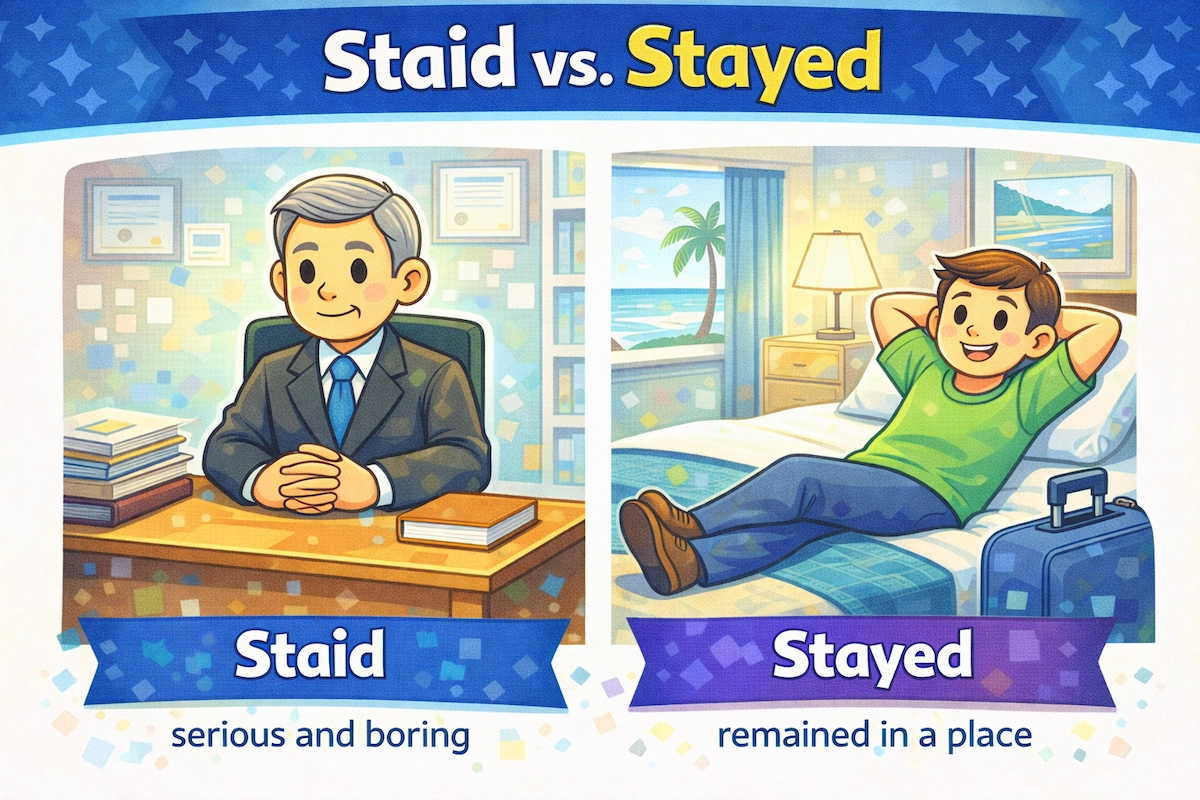
This Common Mistakes usage guide explains the difference between “staid” and “stayed.” Learn which one means remaining and which describes a serious personality, see real examples, and avoid a common homophone error that can confuse readers and weaken your writing.
English has a long list of words that sound alike but mean completely different things. These words often cause confusion in writing, even for advanced learners and native speakers. One particularly tricky pair is “staid” and “stayed.”
At first glance, the confusion makes sense. Both words are pronounced the same in most accents. But in meaning, grammar, and usage, they couldn’t be more different. One describes remaining in a place. The other describes a serious, reserved personality.
In this usage guide, we’ll break down the difference between staid and stayed, explain why they’re commonly mixed up, and show you how to choose the correct word every time — without hesitation.
Why “Staid” and “Stayed” Are Commonly Confused
The main reason these words cause trouble is pronunciation. In most varieties of English, staid and stayed sound identical. This makes them classic homophones — words that sound the same but have different meanings and spellings.
In spoken English, context usually clears up the meaning. In writing, however, a single wrong letter can change the message entirely.
He stayed calm during the meeting.
He staid calm during the meeting.
The first sentence is correct. The second is not — and yet, many writers make this mistake because the words sound the same.
What Does “Stayed” Mean?
Stayed is the past tense and past participle of the verb stay. It means to remain in a place, condition, or situation.
This word is extremely common in both spoken and written English.
We stayed at the hotel for three nights.
She stayed silent during the discussion.
In these examples, stayed clearly refers to remaining — physically or emotionally — in a certain state.
You’ll see stayed used with locations, conditions, emotions, and decisions.
Common Uses of “Stayed”
Here are some common patterns where stayed naturally appears:
- Stayed + place (stayed home, stayed at a hotel)
- Stayed + adjective (stayed calm, stayed focused)
- Stayed + decision (stayed late, stayed behind)
- Stayed + situation (stayed in touch, stayed involved)
Because stayed is a verb form, it always relates to action or state over time.
What Does “Staid” Mean?
Staid is an adjective, not a verb. It describes a person, behavior, or environment that is serious, calm, reserved, or traditional — sometimes to the point of being dull.
Unlike stayed, staid is far less common and is usually found in formal writing or descriptive contexts.
He has a staid personality and rarely shows strong emotion.
The office had a staid, conservative atmosphere.
In these sentences, staid describes character or mood, not action.
The Tone of “Staid”
The word staid often carries a subtle judgment. It can be neutral, but it sometimes suggests that something lacks excitement or creativity.
The brand’s image felt staid compared to its competitors.
Because of this nuance, staid is typically used carefully and deliberately.
Side-by-Side Comparison
Seeing the words next to each other makes the difference clearer:
- Stayed → verb (past tense of stay)
- Staid → adjective (serious, reserved)
One answers what happened? The other answers what kind?
Common Mistakes with “Staid”
Many writers accidentally use staid when they mean stayed, especially in sentences about remaining calm or quiet.
Incorrect:
She staid focused despite the pressure.
Correct:
She stayed focused despite the pressure.
Remember: if the sentence involves remaining in a state, you almost always want stayed.
Can “Staid” Ever Replace “Stayed”?
No. Despite sounding the same, staid and stayed are not interchangeable. They belong to different grammatical categories and serve different purposes.
If you’re describing an action or state over time, staid will always be wrong.
How Context Helps You Choose the Right Word
A quick way to choose correctly is to look at what comes after the word.
If the word is followed by a place, condition, or duration, you need stayed.
They stayed inside because of the weather.
If the word is followed by a noun like personality, manner, or tone, you likely need staid.
His staid manner made him seem unapproachable.
Why This Mistake Matters in Writing
Confusing staid and stayed may not completely block understanding, but it can distract readers and make your writing look careless.
In professional, academic, or published writing, these small errors reduce credibility — even when the message is clear.
Avoiding common mistakes like this improves clarity and shows attention to detail.
Simple Memory Trick
Here’s an easy way to remember the difference:
- Stayed → has “stay” inside it (action)
- Staid → describes a state of personality
If you can replace the word with “remained,” then stayed is correct.
Final Thoughts: Similar Sound, Very Different Meaning
Staid and stayed may sound identical, but they live in completely different parts of English. One describes what someone did. The other describes what someone is like.
Understanding this difference helps you avoid a common writing mistake and improves both clarity and confidence.
When in doubt, slow down, check the context, and choose the word that matches the meaning — not the sound.