"Hard" vs. "Difficult" – Physical Strength vs. Mental Effort
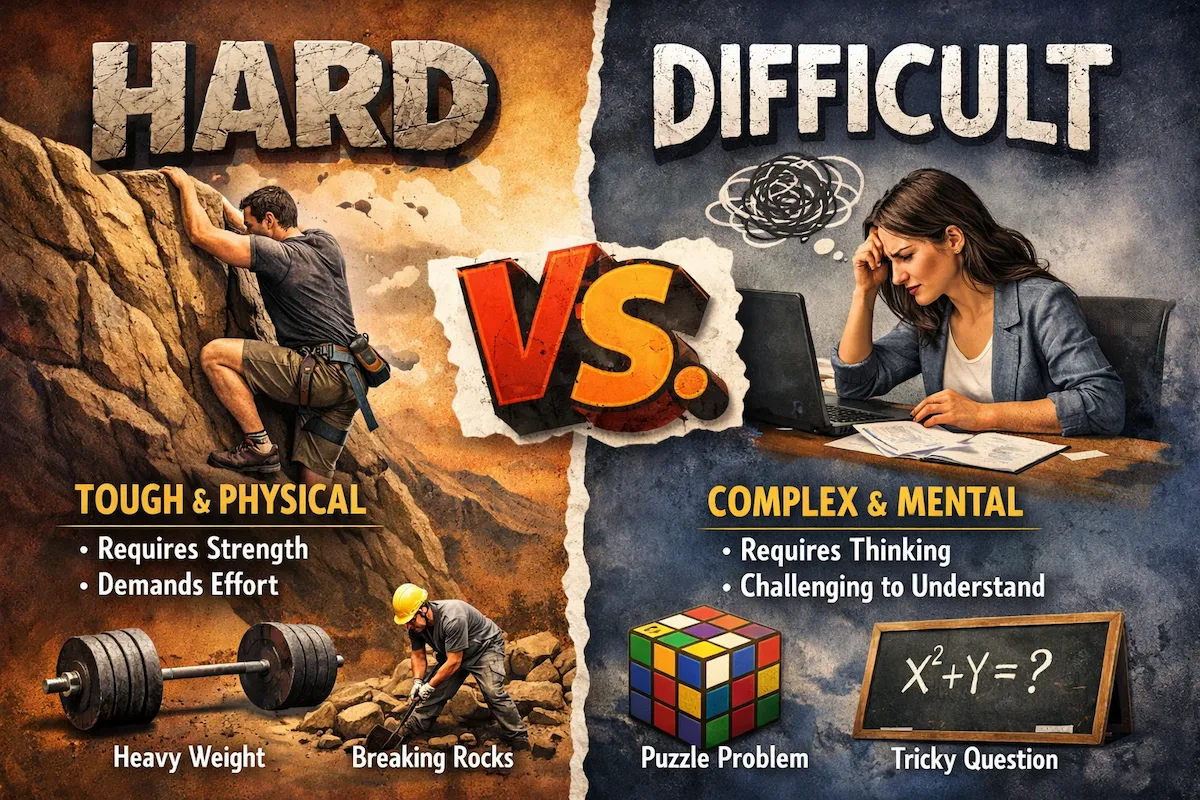
This synonyms-in-context usage guide explains how “hard” and “difficult” differ in meaning and tone. Learn when each word fits best, how physical effort contrasts with intellectual challenge, and how choosing the right term improves clarity and fluency.
At first glance, hard and difficult seem almost interchangeable. Many learners use them as direct synonyms, assuming both simply mean “not easy.” In everyday English, however, these two words point to very different kinds of challenges.
One often relates to physical effort, intensity, or resistance. The other is more closely connected to mental effort, complexity, and problem-solving. Native speakers may switch between them naturally, but the choice is rarely random.
In this usage guide, we’ll explore how hard and difficult differ in meaning, tone, and context. You’ll learn when each word sounds natural, when it feels wrong, and how the distinction reflects how English separates physical strain from intellectual challenge.
The Core Difference in Simple Terms
Hard often focuses on effort, force, or intensity. Difficult focuses on complexity, thinking, or understanding.
Both describe challenges, but the nature of the challenge matters.
What Does “Hard” Really Mean?
Hard is a flexible word with several related meanings.
It commonly describes:
- Physical resistance or solidity
- Strong effort or intensity
- Emotionally tough situations
- Work that requires stamina
This box is hard to lift.
The difficulty comes from physical effort, not understanding.
Hard and Physical Effort
One of the most common uses of hard involves the body.
Manual labor is hard work. The ground was hard after the cold night.
In these examples, “hard” refers to physical conditions or exertion.
Hard as Intensity, Not Complexity
Hard can also describe intensity rather than confusion.
She trained hard for the marathon. He hit the ball hard.
Nothing here is intellectually complex — only forceful or demanding.
Emotional and Life Uses of “Hard”
English also uses hard for emotionally heavy experiences.
It was a hard year for the family.
This use focuses on endurance and emotional strain, not problem-solving.
What Does “Difficult” Mean?
Difficult is more specific and more formal.
It usually describes:
- Complex tasks
- Challenging decisions
- Problems requiring thought
- Situations with no easy solution
This math problem is difficult.
The challenge here is mental, not physical.
Difficult and Intellectual Challenge
Difficult often appears in academic and professional contexts.
The concept is difficult to understand. It was a difficult decision to make.
The word highlights complexity and reasoning.
Why “Difficult” Sounds More Formal
Compared to hard, difficult feels more precise and neutral.
It is common in:
- Academic writing
- Reports
- Professional explanations
The procedure is difficult and requires training.
When Both Words Are Possible
Sometimes both hard and difficult work, but the emphasis shifts.
Learning a new language is hard. Learning a new language is difficult.
“Hard” emphasizes effort and persistence. “Difficult” emphasizes complexity and rules.
Subtle Tone Differences
Using hard can sound more personal and emotional.
Using difficult can sound more analytical.
It was hard to say goodbye. It was difficult to understand his reasoning.
Common Learner Mistake #1
Awkward: The stone is difficult. Better: The stone is hard.
Physical properties favor “hard.”
Common Learner Mistake #2
Awkward: This theory is hard to understand. Better: This theory is difficult to understand.
Abstract ideas favor “difficult.”
Hard vs Difficult in Negative Statements
Both words often appear in negative constructions.
It’s hard to believe this happened. It’s difficult to explain the process.
The first reflects emotional reaction; the second reflects explanation.
Comparative and Superlative Forms
Both words form comparisons, but tone still matters.
This task is harder than I expected. This question is more difficult than the last one.
The grammar works similarly, but meaning shifts.
Hard Is Broader Than Difficult
Hard covers:
- Physical effort
- Emotional strain
- Intensity
- General struggle
Difficult is narrower and more intellectual.
Practice Test
Please answer the following questions. To see the correct answer, please click the arrow icon.
Which word fits: This suitcase is ___ to carry.
Answer: hard Explanation: The challenge is physical effort.
Which word fits: The instructions were ___ to follow.
Answer: difficult Explanation: The challenge is understanding.
Which word sounds more emotional?
Answer: hard Explanation: “Hard” often reflects personal struggle.
Can both words ever be correct in the same sentence?
Answer: Yes. Explanation: They shift emphasis, not meaning entirely.
Why This Distinction Improves Fluency
Choosing between hard and difficult correctly:
- Makes speech more natural
- Clarifies meaning
- Shows sensitivity to context
Native speakers hear the difference immediately.
Final Thoughts: Not All Challenges Are the Same
English separates challenges into different types.
Hard highlights effort, strength, and endurance. Difficult highlights complexity, reasoning, and understanding.
Mastering this distinction helps you describe experiences more accurately — and sound more fluent doing it.