"Smart" vs. "Intelligent" vs. "Wise" – Different Kinds of Brainpower
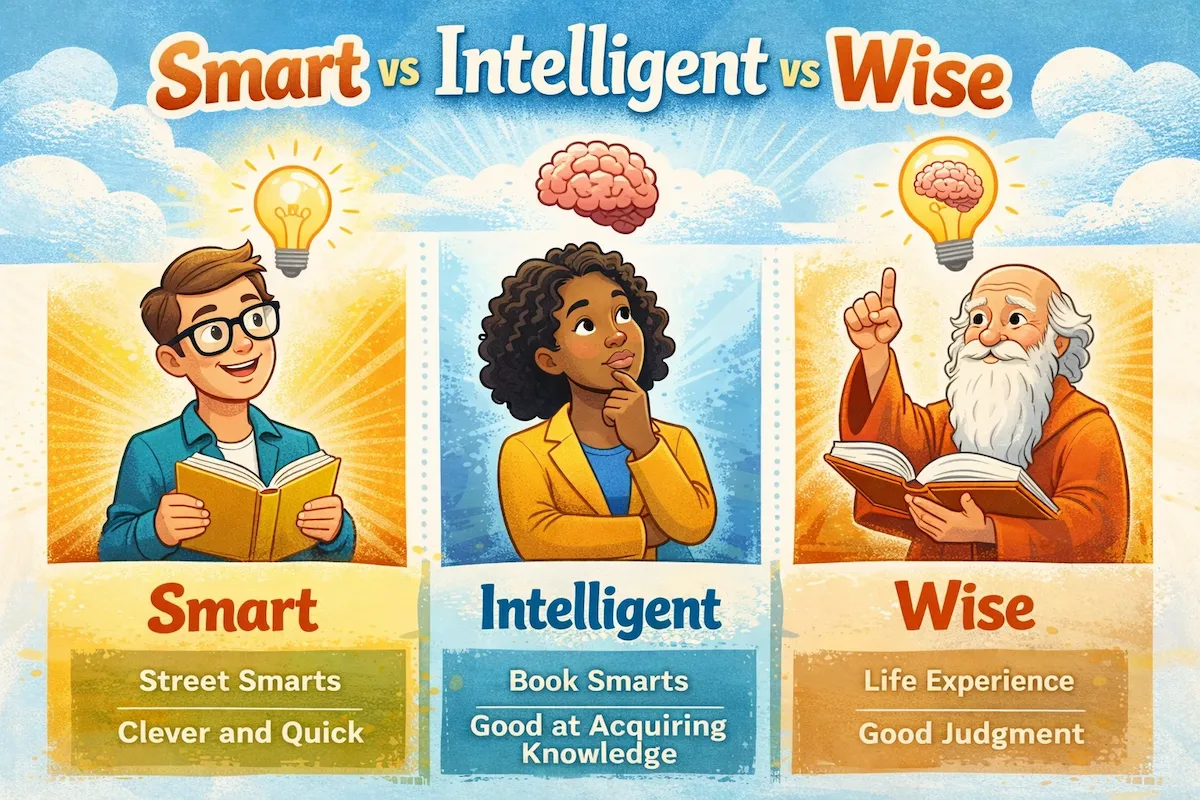
This synonyms-in-context usage guide explains how “smart,” “intelligent,” and “wise” differ in meaning and use. Learn how English separates quick thinking, academic ability, and life judgment, and discover which word fits best in different real-world contexts.
English has many words for describing mental ability, but few are as commonly confused as smart, intelligent, and wise. On the surface, all three seem to mean “good at thinking.” In reality, each word highlights a very different kind of brainpower.
You might know someone who is extremely smart but makes terrible life choices. Or someone who isn’t academically intelligent, yet gives the best advice in difficult situations. These contrasts exist because English separates mental ability into categories — and these three words sit in different categories.
In this usage guide, we’ll explore what smart, intelligent, and wise really mean, how native speakers choose between them, and how context changes which word sounds most natural.
Why These Words Are Not True Synonyms
Although dictionaries often list these words as synonyms, native speakers do not use them interchangeably.
Each word emphasizes a different aspect of thinking:
- Smart → quick thinking and practical ability
- Intelligent → intellectual and academic capacity
- Wise → judgment shaped by experience
Understanding this distinction helps you describe people more accurately — and more respectfully.
What Does “Smart” Really Mean?
Smart is the most flexible and informal of the three.
It often describes someone who:
- Thinks quickly
- Adapts well
- Finds practical solutions
- Handles situations efficiently
She made a smart decision by leaving early.
Here, “smart” refers to practicality, not deep analysis.
“Smart” in Everyday English
Native speakers frequently use smart in casual conversation.
That was a smart move.
This does not mean the move was intellectually complex — only effective.
What Does “Intelligent” Mean?
Intelligent is more formal and more specific.
It usually describes:
- Logical thinking
- Abstract reasoning
- Academic ability
- Problem-solving at a conceptual level
She is an intelligent researcher with a strong analytical mind.
This word often appears in education, science, and professional evaluations.
Why “Intelligent” Sounds More Formal
Compared to “smart,” intelligent feels more objective.
It suggests measured ability rather than instinct.
He is intelligent, but lacks practical experience.
This sentence would sound strange with “smart.”
What Does “Wise” Mean?
Wise focuses on judgment rather than raw thinking power.
A wise person:
- Understands consequences
- Learns from experience
- Makes balanced decisions
- Thinks long-term
It was wise to wait before responding.
Wisdom is often associated with maturity, not speed.
Why a Smart Person Might Not Be Wise
This is one of the most important distinctions.
A person can:
- Solve problems quickly (smart)
- Understand complex ideas (intelligent)
- Still make poor life decisions
He’s smart, but not very wise when it comes to money.
Here, “wise” implies experience and restraint.
Comparing the Three Side by Side
Smart → quick and effective Intelligent → deep and analytical Wise → thoughtful and experienced
All three are positive, but they praise different strengths.
Context Matters More Than Meaning
Choosing the right word depends on context.
She’s smart in negotiations. She’s intelligent in mathematics. She’s wise in handling conflict.
Each sentence highlights a different type of brainpower.
Formal vs Informal Usage
In informal speech, smart dominates.
In formal writing, intelligent and wise appear more often.
The candidate demonstrated intelligent reasoning and wise judgment.
Common Learner Mistake #1
Incorrect: He is very wise at math. Correct: He is very intelligent at math.
Math ability relates to intellect, not life judgment.
Common Learner Mistake #2
Incorrect: That was an intelligent choice in the moment. Better: That was a smart choice in the moment.
Speed and practicality favor “smart.”
Can One Person Be All Three?
Absolutely.
A person can be smart, intelligent, and wise — but each quality develops differently.
She’s intelligent academically, smart in business, and wise in relationships.
Practice Test
Please answer the following questions. To see the correct answer, please click the arrow icon.
Which word best describes someone who learns from past mistakes?
Answer: Wise. Explanation: Wisdom is closely tied to experience and reflection.
Which word fits best in academic evaluations?
Answer: Intelligent. Explanation: It refers to analytical and intellectual ability.
Which word describes quick, effective decision-making?
Answer: Smart. Explanation: “Smart” emphasizes speed and practicality.
Can someone be intelligent but not wise?
Answer: Yes. Explanation: Intelligence does not guarantee good judgment.
Why This Distinction Improves Your English
Using these words accurately:
- Makes descriptions more precise
- Prevents unintended meanings
- Reflects native-level understanding
It also shows cultural awareness of how English evaluates ability.
Final Thoughts: Different Brains, Different Strengths
English doesn’t rank smart, intelligent, and wise — it separates them.
Each word celebrates a different kind of strength. Choosing the right one allows you to describe people with accuracy, respect, and nuance.
Mastering these distinctions is a small step that makes your English sound thoughtful and advanced.