"See" vs. "Look" vs. "Watch" – The Focus of Your Eyes
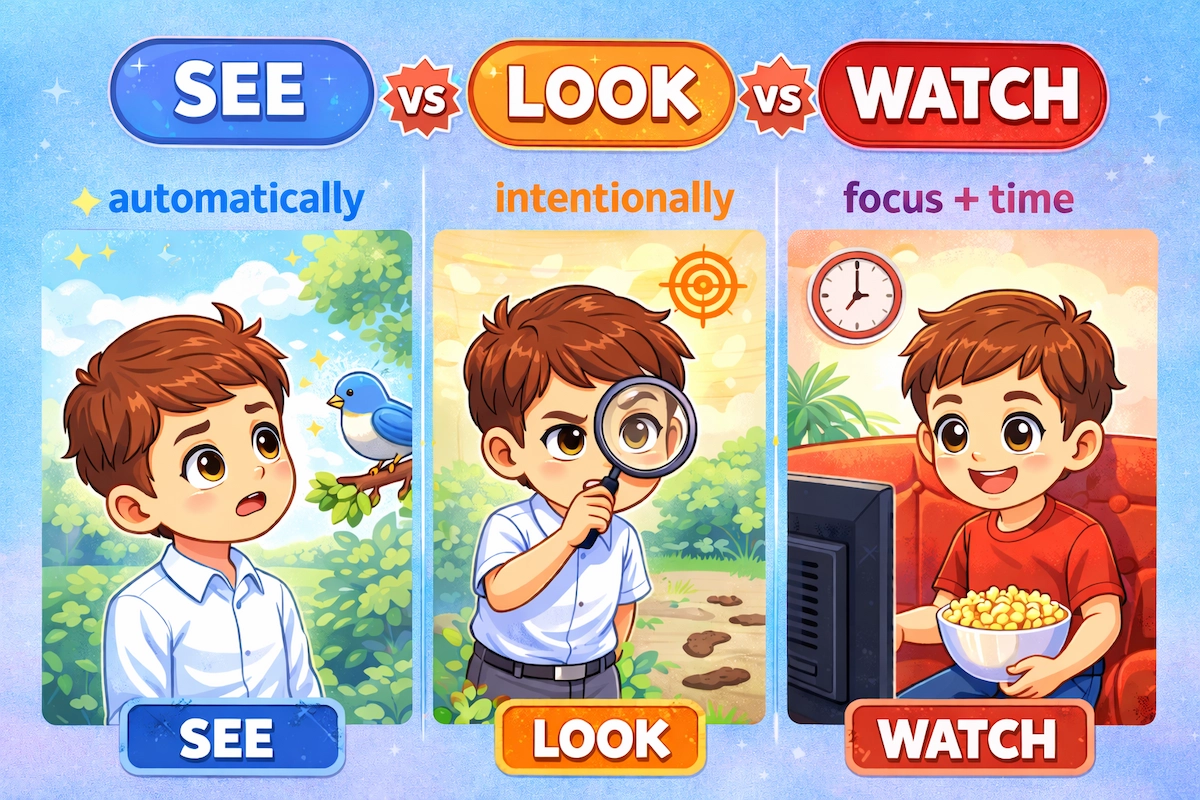
This synonyms-in-context usage guide explains how “see,” “look,” and “watch” describe different visual actions. Learn when to use passive seeing, intentional looking, or continuous watching to sound more natural and precise in everyday English conversations.
The verbs see, look, and watch are often taught as simple synonyms related to vision. At first glance, they all seem to mean the same thing: using your eyes. But in real English, these three verbs describe very different kinds of visual experiences.
Many English learners say things like “I watched a bird on the street” or “I was looking a movie last night” and feel confused when native speakers correct them. The issue isn’t vocabulary size — it’s understanding focus, intention, and duration.
In this usage guide, we’ll break down the real differences between see, look, and watch, explore how native speakers choose between them, and help you use these visual verbs naturally and accurately in daily English.
Why These Three Verbs Are So Confusing
The confusion comes from translation. In many languages, a single verb covers all visual actions. English, however, separates vision into:
- Passive perception
- Directed attention
- Sustained observation
See, look, and watch each represent one of these categories.
“See”: Passive Vision
See is the most passive of the three verbs. It describes what your eyes perceive without effort.
I can see the mountains from my window.
You are not choosing to focus. The image simply enters your vision.
Because of this, see is often used for:
- Noticing something
- Realizing or understanding
- Accidental perception
Common Meanings of “See”
See can also mean:
- Understand: I see your point.
- Meet: I’ll see her tomorrow.
- Find out: Let’s see what happens.
These meanings are abstract extensions of perception.
When “See” Sounds Wrong
Because see is passive, it sounds incorrect when effort or intention is involved.
Incorrect: I saw the TV for two hours. Correct: I watched TV for two hours.
“Look”: Directed Attention
Look describes intentional movement of the eyes. You choose to focus on something.
Look at this photo.
Unlike see, look requires effort and direction.
This is why look is usually followed by a preposition:
- Look at
- Look for
- Look into
Common Uses of “Look”
Native speakers use look when:
- Giving instructions
- Asking for attention
- Searching visually
Look at the screen carefully.
“Look” vs “See” in Context
Look at the sign. Can you see what it says?
You look first (action), then you see the result (perception).
“Watch”: Sustained Attention Over Time
Watch involves continuous observation, often of something that moves or changes.
We watched the sunset together.
Watching implies:
- Time
- Focus
- Interest
You don’t just glance — you stay engaged.
Common Things You “Watch”
- TV
- Movies
- Sports
- People or animals moving
She watched the children play in the park.
Why “Watch” Sounds Wrong Sometimes
Because watch implies duration, it doesn’t fit for quick actions.
Incorrect: I watched the sign on the wall. Correct: I looked at the sign on the wall.
Side-by-Side Comparison
See → passive perception Look → intentional direction Watch → sustained attention
Sentence Patterns Native Speakers Use
I saw something strange on the road. I looked at it more closely. Then I watched it move away.
Each verb matches a different stage of visual experience.
Common Learner Mistake #1
Incorrect: I am seeing TV right now. Correct: I am watching TV right now.
Common Learner Mistake #2
Incorrect: Look the picture. Correct: Look at the picture.
Abstract Uses of Visual Verbs
English often uses vision verbs metaphorically.
I see what you mean. Let’s look at the problem together. We’re watching the situation closely.
The same logic applies: perception, attention, duration.
How Context Determines the Right Verb
Ask yourself:
- Was it accidental? → see
- Was it intentional? → look
- Did it continue over time? → watch
Why Native Speakers Feel the Difference Instinctively
Native speakers don’t memorize rules — they associate these verbs with physical experience.
That’s why practice with real examples matters more than definitions.
Practice Tip
When describing something you saw today, try telling the story using all three verbs correctly.
This trains your instinct.
Final Thoughts: One Sense, Three Perspectives
See, look, and watch don’t compete — they cooperate.
Each describes a different relationship between your eyes, your attention, and time.
Mastering these verbs doesn’t just improve grammar — it makes your English more precise, natural, and expressive.