Every day vs. Everyday: The Space That Changes Your Lifestyle!
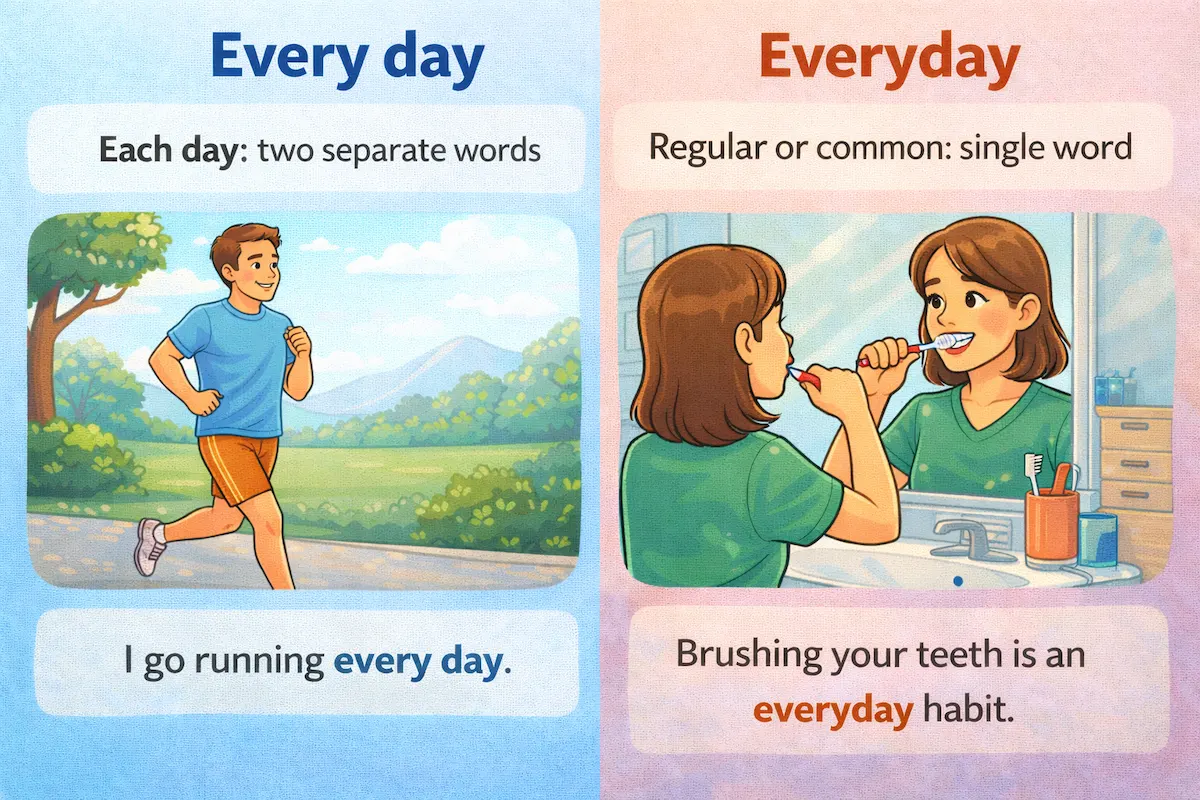
This confusing-words guide explains the difference between every day and everyday. Learn how spacing changes meaning, when to use each form, and how to tell frequency apart from common or routine activities in natural English writing.
Few English mistakes are as small — yet as noticeable — as confusing every day and everyday. Just one space separates them, but that space completely changes the meaning of your sentence.
Native speakers instantly hear the difference, while learners often hesitate before writing. Is it an everyday habit, or something you do every day? The answer depends not on vocabulary level, but on understanding word form and sentence role.
In this confusing-words guide, you’ll learn how to tell every day and everyday apart with confidence, how they function grammatically, and how to avoid one of the most common spacing errors in modern English writing.
Why One Space Can Change Meaning
English uses spacing to distinguish between phrases and single adjectives. Although every day and everyday look almost identical, they belong to different grammatical categories.
- Every day → adverbial phrase (frequency)
- Everyday → adjective (common or routine)
Understanding this distinction instantly solves the problem.
What Does “Every Day” Mean?
Every day means each day. It answers the question: How often?
I drink coffee every day.
Here, every day describes frequency, not the nature of the activity.
Grammar Role of “Every Day”
Every day functions as an adverbial phrase. It modifies verbs.
She practices the piano every day.
It cannot describe a noun directly.
Common Contexts for “Every Day”
- Daily routines
- Habits
- Schedules
- Repeated actions
We check our emails every day.
What Does “Everyday” Mean?
Everyday means ordinary, typical, or routine.
This is my everyday routine.
It describes the type of thing, not how often it happens.
Grammar Role of “Everyday”
Everyday is an adjective. It modifies nouns.
She wears everyday clothes to work.
It cannot stand alone without a noun.
Everyday Is About Commonality
When something is everyday, it is not special, formal, or unusual.
These are everyday problems.
The problems may or may not happen daily — the word focuses on normality.
Side-by-Side Comparison
I wear this jacket every day. → frequency This is my everyday jacket. → common type
The words look similar but do very different jobs.
Why Learners Mix Them Up
Many learners assume that removing or adding a space doesn’t change meaning. In English, that assumption is often wrong.
Similar pairs include:
- Any time vs anytime
- Some day vs someday
- Every one vs everyone
A Simple Test to Choose Correctly
Replace the phrase with each day.
If it works → use every day If it doesn’t → use everyday
I walk to work each day. ✓ → every day These are each day shoes. ✗ → everyday shoes
Everyday in Professional Writing
In professional contexts, everyday often contrasts with “specialized” or “formal.”
We aim to simplify everyday tasks for our users.
Every Day in Reports and Logs
Every day is common in schedules, tracking, and routines.
The system runs a backup every day.
Spoken English vs Written English
In speech, the difference is invisible. In writing, it is very visible.
That’s why this mistake appears frequently in emails, articles, and captions.
Common Mistakes to Avoid
- Using “everyday” to describe frequency
- Using “every day” before a noun
- Assuming spellcheck will catch the error
Practice Test
Please answer the following questions. To see the correct answer, please click the arrow icon.
Choose the correct option: “I go jogging ___.”
Answer: every day Explanation: It describes how often the action happens.
Choose the correct option: “These are my ___ shoes.”
Answer: everyday Explanation: The word describes the type of shoes.
Which phrase answers the question “How often?”
Answer: Every day Explanation: It refers to frequency.
Is this sentence correct? “This app helps with every day tasks.”
Answer: No. Explanation: The correct form is “everyday tasks.”
Why Native Speakers Notice Instantly
To native readers, confusing these two feels like mixing up verb tense or article usage. The sentence still works — but it sounds off.
Correct usage signals attention to detail and strong writing skills.
Final Thoughts: Small Space, Big Meaning
Every day talks about when something happens. Everyday talks about what kind of thing it is.
Once you see this difference, the choice becomes automatic. One space, two meanings — and no more hesitation in your writing.