"Lose" vs. "Loss": The Word Form of Depletion
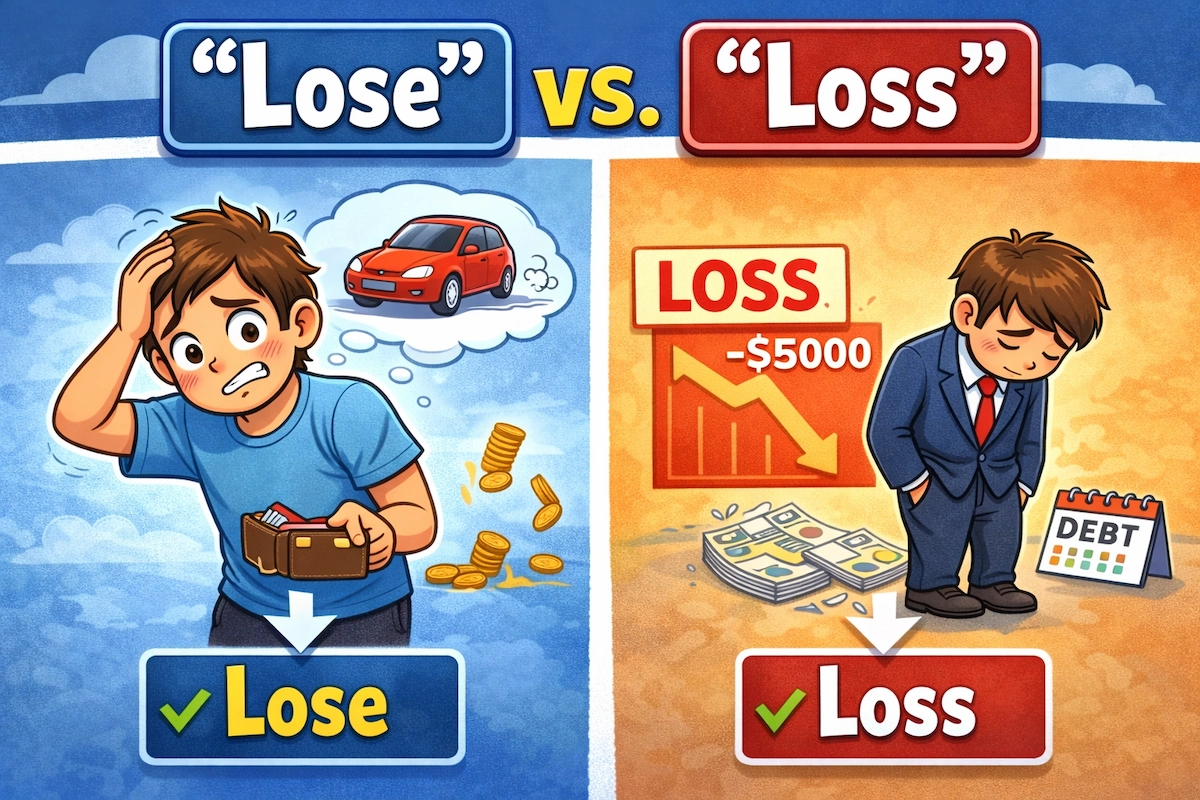
This Sentence Patterns usage guide explains the difference between “lose” and “loss.” Learn how verb and noun forms change sentence structure, explore common patterns, and avoid frequent spelling and grammar mistakes so you can express depletion, defeat, and absence clearly in English.
Few English word pairs confuse learners as consistently as lose and loss. They look similar, sound related, and share the same core idea — something is missing, gone, or reduced. Yet grammatically, they are completely different, and using the wrong one can instantly break a sentence.
This confusion usually comes from one small detail: word form. Lose is a verb. Loss is a noun. That single distinction determines where each word can appear and how it interacts with other elements in a sentence.
In this usage guide, we’ll break down the roles of lose and loss, explore their most common sentence patterns, and help you avoid mistakes that even advanced learners still make.
The Core Difference: Verb vs Noun
Let’s start with the most important rule.
- Lose → verb (an action)
- Loss → noun (a thing or concept)
If the sentence needs an action, you need lose. If it needs a subject or object, you need loss.
What Does “Lose” Mean?
Lose means to fail to keep something, to misplace something, or to experience defeat or reduction.
I don’t want to lose my keys again.
Here, lose describes an action — something that happens or might happen.
Because it is a verb, lose changes form based on tense.
Verb Forms of “Lose”
Understanding verb forms helps reinforce why lose cannot be replaced by loss.
lose – present lost – past losing – continuous
She lost her phone yesterday.
A noun cannot behave this way.
Common Sentence Pattern: Subject + Lose + Object
The most basic pattern for lose is:
Subject + lose + object
He might lose his job.
The verb requires an object — something that is lost.
Using “Lose” for Physical Objects
One of the earliest uses learners encounter is losing physical items.
I always lose my sunglasses.
This usage is concrete and easy to visualize.
Using “Lose” for Abstract Things
Lose is also used with abstract nouns.
Don’t lose confidence.
She began to lose patience.
Even though nothing physical disappears, the verb pattern remains the same.
Lose in Competitive Contexts
Another very common meaning of lose relates to competition.
Our team lost the final match.
Here, lose means to be defeated.
What “Lose” Cannot Do
Because lose is a verb, it cannot:
- Follow an article like a or the
- Act as the subject without a verb
- Name a concept or state
Incorrect: The lose was unexpected.
This sentence needs a noun, not a verb.
What Does “Loss” Mean?
Loss refers to the state, result, or concept of something being lost.
The loss of data caused major problems.
Here, loss names the situation — it does not describe an action.
Common Sentence Pattern: “A Loss”
Loss is a countable noun in many contexts.
a loss the loss
This failure represents a significant loss.
Articles are a clear signal that you are dealing with a noun.
Loss as a Subject
Loss can function as the subject of a sentence.
The loss was difficult to accept.
A verb like lose cannot fill this role.
Loss as an Object
Loss often appears as the object of verbs such as suffer, experience, or face.
The company suffered a major loss.
The action happens to the loss, not the other way around.
Loss in Emotional Contexts
Loss frequently refers to emotional or personal experiences.
The loss of a loved one can be devastating.
This usage focuses on the impact, not the act of losing.
Lose vs Loss: Side-by-Side Comparison
She lost her wallet. The loss of her wallet caused stress.
The first sentence describes an action. The second describes a result.
Common Learner Mistake #1
Using loss as a verb.
Incorrect: I loss my phone yesterday. Correct: I lost my phone yesterday.
Common Learner Mistake #2
Using lose where a noun is required.
Incorrect: This was a big lose for the team. Correct: This was a big loss for the team.
Why the Spelling Matters
One missing letter completely changes the grammatical role.
Native speakers notice this error immediately because it disrupts sentence structure, not just meaning.
Sentence Pattern Test
Ask yourself:
Am I describing an action, or naming a result?
Action → lose Result → loss
Formal vs Informal Usage
Lose appears frequently in everyday conversation.
Loss is common in formal writing, reports, news, and emotional discussion.
Informal: I don’t want to lose this chance. Formal: The financial loss was substantial.
Why Mastering This Pair Matters
Confusing lose and loss is a small mistake with a big impact.
Mastering verb–noun distinctions improves accuracy, confidence, and clarity.
Final Thoughts: Action vs Outcome
Lose describes what happens. Loss describes what remains afterward.
Once you internalize this distinction, sentence patterns become predictable and natural.
One letter matters — but understanding matters more.