How to Think on Your Feet: The "A-R-E" Speaking Method
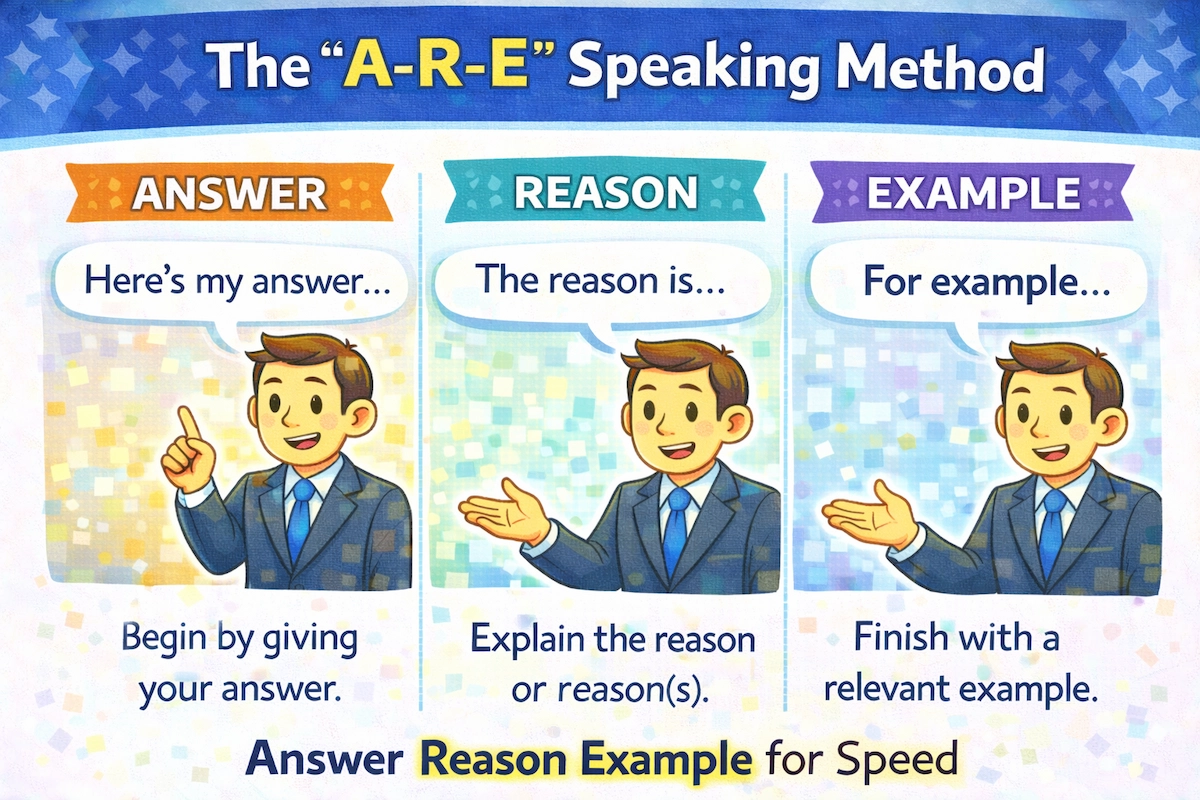
This Speaking Fluency usage guide introduces the A-R-E Method: Answer, Reason, Example. Learn how this fast mental framework helps you think on your feet, organize ideas instantly, and speak more confidently and fluently when facing unexpected questions in real conversations.
Almost everyone has experienced that moment: someone asks you a question in English, all eyes turn toward you, and suddenly your mind goes blank. You know the words. You understand the question. But forming a clear answer under pressure feels impossible.
This isn’t a vocabulary problem or a grammar problem. It’s a thinking speed problem. Fluent speakers don’t speak faster because they know more words — they speak faster because they follow simple mental patterns.
In this usage guide, you’ll learn one of the most effective frameworks for spontaneous speaking: the A-R-E Method. ARE stands for Answer, Reason, Example. This method trains your brain to organize ideas quickly, even when questions come unexpectedly.
Why Fluency Breaks Down Under Pressure
When you feel pressure, your brain tries to do too many things at once. You think about grammar, vocabulary, pronunciation, and what the listener expects — all at the same time.
This overload causes hesitation, long pauses, or overly short answers.
“Uh… I think… maybe… it’s good… I mean…”
The problem isn’t lack of English ability. It’s lack of structure.
How Native Speakers Think While Speaking
Native speakers rarely plan perfect sentences in advance. Instead, they rely on predictable response patterns.
When asked a question, they instinctively:
- Answer directly
- Give a reason
- Add a quick example or detail
The ARE Method simply makes this instinct visible and trainable.
What Is the A-R-E Speaking Method?
The A-R-E Method breaks your response into three fast steps:
- Answer – Give a clear, direct response
- Reason – Explain why
- Example – Add a concrete detail
You don’t need long sentences. You need a clear sequence.
Step 1: Answer (Say Something Immediately)
The biggest mistake learners make is delaying the answer. They think first, speak later.
Fluent speakers do the opposite: they speak first, then build.
Question: Do you enjoy working remotely?
Answer: Yes, I do.
Even a simple “Yes,” “No,” or “I think so” gives your brain time to prepare the next step.
Step 2: Reason (Buy Thinking Time)
After answering, add a short reason. This keeps the conversation moving and gives structure to your thoughts.
Yes, I do, because it helps me focus better.
The word because is powerful. It signals continuation and reduces pressure.
Common reason starters:
- because
- since
- as
- mainly because
Step 3: Example (Make It Sound Natural)
The final step is a simple example or detail. This is where fluency really shows.
Yes, I do, because it helps me focus better. For example, I can manage my time more efficiently without interruptions.
You don’t need a perfect example — just a real one.
Why ARE Works So Fast
The ARE Method works because it:
- Reduces cognitive load
- Creates automatic structure
- Prevents awkward silence
- Sounds natural in conversation
Once trained, your brain starts producing answers automatically in this pattern.
ARE in Casual Conversations
Let’s see how ARE works in daily speaking.
Question: Do you like this restaurant?
Yes, I do, because the food is simple and fresh. For example, I really like how quickly everything is served.
This sounds relaxed, not rehearsed.
ARE in Business and Professional Settings
ARE is especially useful in meetings and interviews.
Question: Do you think this approach will work?
Yes, I do, because it aligns with our current resources. For example, it allows the team to focus on priorities without adding complexity.
Clear, confident, and structured.
ARE for Difficult or Unexpected Questions
When questions catch you off guard, structure matters even more.
Question: What’s your biggest weakness?
I’d say it’s delegation, because I tend to take on too much myself. For example, I’ve learned to involve my team earlier to improve outcomes.
Notice how ARE keeps the answer controlled and forward-looking.
Common Mistake: Skipping the Answer
Many learners jump straight to reasons or examples without answering clearly.
Incorrect: Because I like flexibility and working independently…
This sounds incomplete. Always anchor your response with an answer first.
How Short Can ARE Be?
ARE doesn’t have to be long. Even one sentence can include all three parts.
Yes, I do, because it saves time, especially during busy weeks.
Fluency is about flow, not length.
Training Your Brain with ARE
To make ARE automatic, practice intentionally.
- Answer everyday questions using ARE
- Practice aloud, not silently
- Time yourself (10–15 seconds per answer)
- Focus on structure, not perfection
Repetition builds speed.
ARE vs Memorized Answers
Memorization fails under pressure. Structure adapts.
ARE allows you to respond to any question without preparing exact sentences in advance.
Why ARE Improves Confidence
Confidence comes from knowing what to do next.
When your brain knows the sequence — answer, reason, example — fear decreases and fluency increases.
Final Thoughts: Fluency Is a System
Speaking fluently isn’t about speaking fast or perfectly. It’s about thinking clearly under pressure.
The A-R-E Method gives your brain a reliable system for handling unexpected questions in conversations, meetings, and interviews.
Train the structure, and fluency will follow.