"Wide" vs. "Width": Describing Span with Correct Word Forms
This sentence-patterns guide explains how “wide” and “width” differ in grammar and meaning. Learn when to use the adjective versus the noun, explore common sentence structures, and avoid frequent learner mistakes when describing span and measurements in English.
English often changes meaning not by changing vocabulary entirely, but by shifting word forms. A small change — such as moving from an adjective to a noun — can completely alter how a sentence is structured. A classic example of this is the pair wide and width.
Many learners understand what these words mean, but still struggle to place them correctly in sentences. They might say “the width is wide” or “the table is width”, which sounds unnatural to native speakers even though the general idea is clear.
In this usage guide, we’ll explore the difference between wide and width, explain their grammatical roles, and walk through the most common sentence patterns used to describe horizontal dimensions accurately and fluently.
The Core Difference: Adjective vs Noun
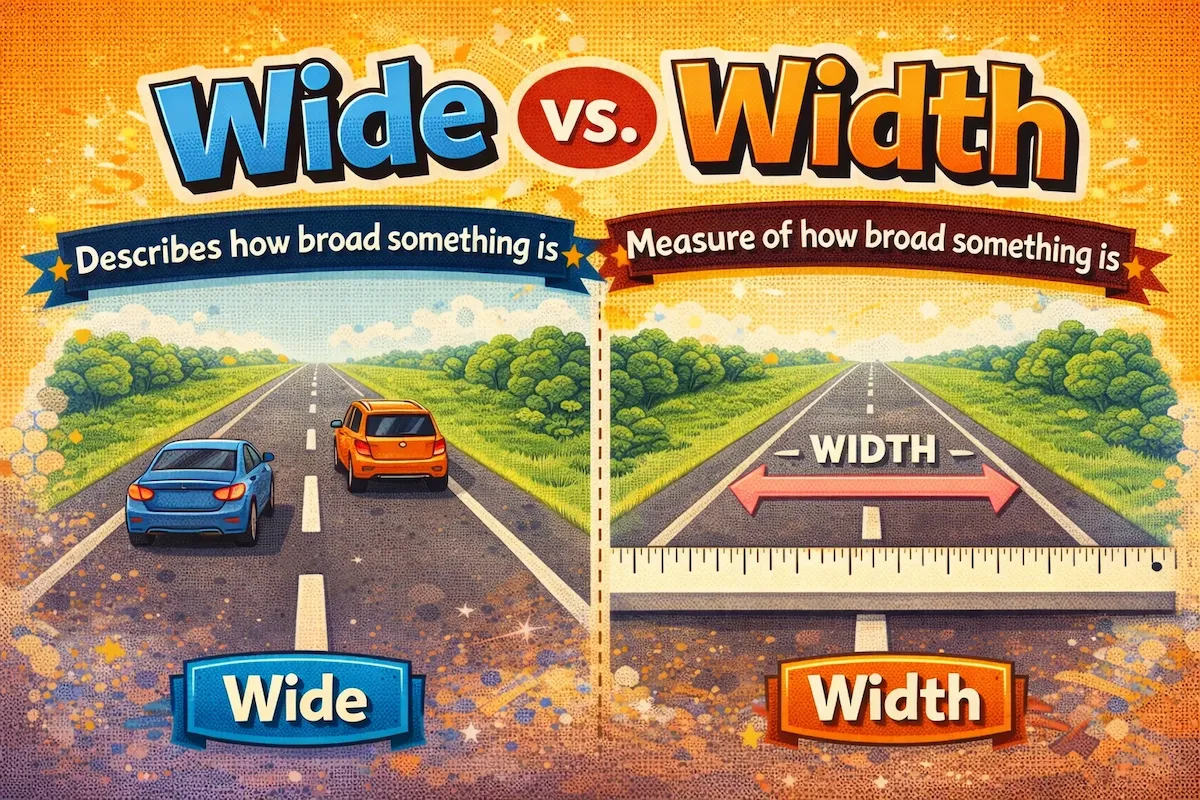
Wide → adjective (describes) Width → noun (names the measurement)
This distinction is the foundation of every correct sentence using these words.
What Does “Wide” Mean?
Wide is an adjective. It describes how far something extends from side to side.
You use wide when you want to modify a noun.
The river is wide. She opened her eyes wide. The road is wide enough for two trucks.
In each case, wide answers the question: How wide?
Common Sentence Patterns with “Wide”
The most common structures include:
- Subject + be + wide
- Adverb + wide
- Wide + noun (attributive)
The hallway is wide. The door opened wide. A wide bridge connects the islands.
Wide with Measurements
Wide often appears after a measurement.
The table is two meters wide.
This pattern is extremely common in descriptive and technical English.
What Does “Width” Mean?
Width is a noun. It refers to the measurement itself — the concept or amount of horizontal distance.
The width of the table is two meters.
Here, width is the subject or object of the sentence.
Common Sentence Patterns with “Width”
Typical patterns include:
- The width of + noun
- Have a width of
- Increase / reduce the width
The width of the road is impressive. The room has a width of five meters. They reduced the width of the bridge.
Wide vs Width Side by Side
The river is wide. The width of the river is impressive.
Both sentences are correct, but the focus is different.
Focus Difference: Description vs Measurement
Wide focuses on how something feels or appears.
Width focuses on data, numbers, and analysis.
A wide street feels open and comfortable. The width of the street meets safety standards.
Why Learners Mix Them Up
Many languages use the same form for adjective and noun, which makes English distinctions harder.
In English, word form controls sentence structure.
Common Mistake #1
Incorrect: The table is width. Correct: The table is wide.
After be, we need an adjective, not a noun.
Common Mistake #2
Incorrect: The wide of the road is small. Correct: The width of the road is small.
After the, we usually need a noun.
Using Both in One Sentence
Advanced English sometimes includes both forms.
The door is wide, but its width is limited by the frame.
This contrast highlights different aspects of the same object.
Formal vs Informal Contexts
Wide is common in everyday speech.
Width appears more often in formal, technical, or academic contexts.
Wide, Width, and Related Word Families
Wide → adjective Width → noun Widen → verb
Understanding the family helps with sentence flexibility.
Practice Test
Please answer the following questions. To see the correct answer, please click the arrow icon.
Which word should complete the sentence: “The bridge is ___.”
Answer: wide Explanation: The sentence needs an adjective.
Which sentence is correct?
Answer: The width of the river is 300 meters. Explanation: “Width” correctly functions as a noun.
Which word refers to a measurement?
Answer: width Explanation: It names the dimension itself.
Can “wide” follow a measurement?
Answer: Yes. Explanation: “Two meters wide” is a common pattern.
Why This Distinction Improves Fluency
Correctly switching between wide and width shows strong control of English sentence patterns.
Native speakers expect this shift automatically.
Final Thoughts: Shape Your Sentences Precisely
Describing space isn’t just about vocabulary — it’s about structure.
Use wide to describe how something looks or feels. Use width to talk about the measurement itself.
Once you understand the pattern, choosing the correct form becomes natural and automatic.