"Envelop" vs. "Envelope" – How One Extra "E" Changes the Part of Speech
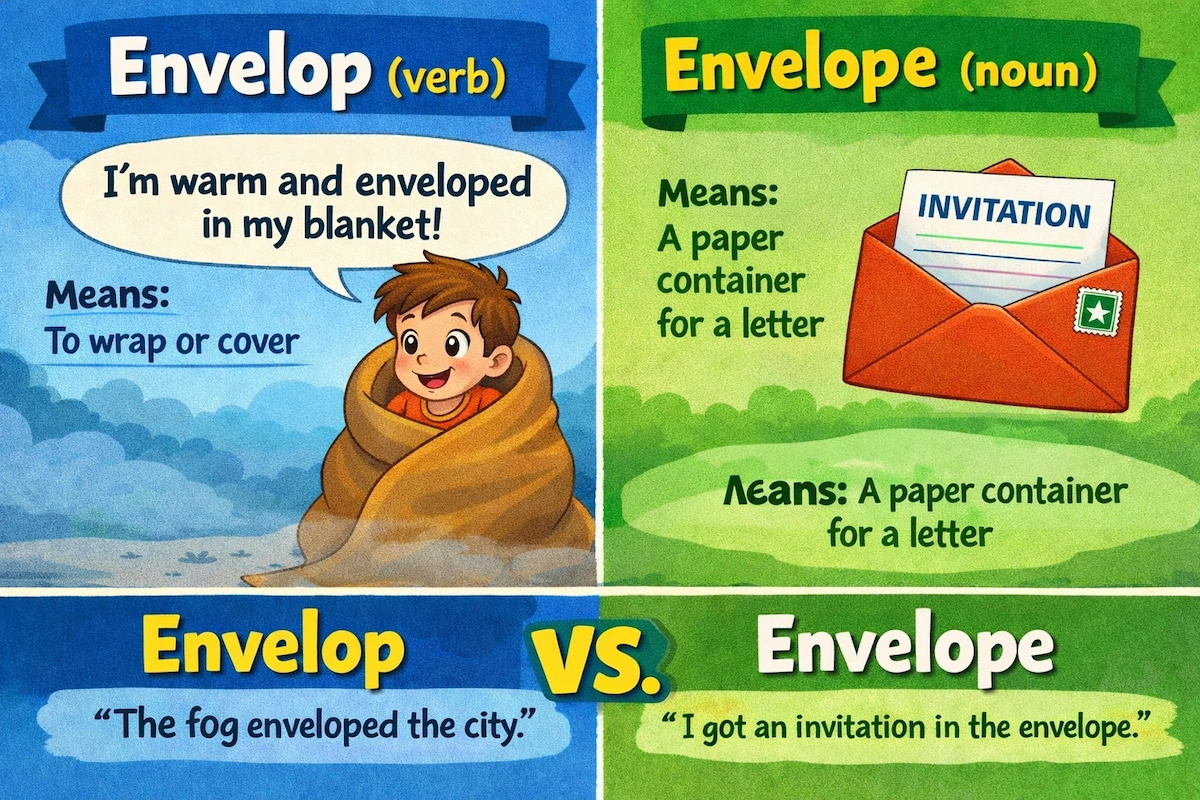
This common-mistakes usage guide explains the difference between “envelop” and “envelope.” Learn how the extra final “e” changes a verb into a noun, why spellcheck often misses this error, and how to choose the correct word instantly in writing and professional communication.
English is full of word pairs that look almost identical but behave very differently. One extra letter can completely change meaning, grammar, and usage. A perfect example of this is the pair envelop and envelope.
At first glance, these two words seem interchangeable. Many learners assume envelop is simply a shorter spelling of envelope. In reality, they are two different words with two different grammatical roles — one is a verb, the other a noun.
In this usage guide, we’ll explain the difference between envelop and envelope, show why the final “E” matters so much, and help you avoid one of the most common spelling and part-of-speech mistakes in English.
Why This Mistake Is So Common
Learners often confuse envelop and envelope because:
- The words look almost identical
- They share the same root
- Pronunciation differences are subtle
- Spellcheck doesn’t always catch the error
Unlike many spelling mistakes, this one creates a real word — just the wrong one.
Understanding the Root Meaning
Both words come from the idea of covering or surrounding. This shared origin is what causes confusion.
However, English uses different word forms to express actions and objects — and that’s where the final “E” becomes critical.
“Envelop” (Verb): To Surround or Cover
Envelop is a verb. It means to completely surround, cover, or wrap something.
Thick fog enveloped the city overnight.
When something envelops something else, it closes around it from all sides.
Common Contexts for “Envelop”
You’ll often see envelop used in:
- Descriptive writing
- Literature
- Formal or poetic language
- Abstract situations
A sense of calm enveloped her as she listened to the music.
Here, envelop describes an experience, not a physical object.
Grammatical Behavior of “Envelop”
Because envelop is a verb, it:
- Changes tense (enveloped, enveloping)
- Takes a subject and an object
- Describes an action or process
Darkness enveloped the forest.
“Envelope” (Noun): A Physical Object
Envelope is a noun. It refers to the paper container used to hold a letter or document.
She placed the letter inside the envelope.
This is the everyday meaning most learners intend — but often spell incorrectly.
Common Uses of “Envelope”
Envelope is used in:
- Mailing letters
- Office communication
- Formal writing
- Instructions and documentation
Please sign the document and return it in the enclosed envelope.
Pronunciation Differences
Although the spellings are similar, the pronunciation helps distinguish them.
Envelop (verb):
- Stress on the second syllable
- en-VEL-op
Envelope (noun):
- Stress on the first syllable
- EN-vel-ope (or EN-vuh-lope)
Listening carefully helps reinforce the difference.
Why the Final “E” Matters
The extra “E” in envelope is not decorative — it signals a change in part of speech.
Envelop → verb (action) Envelope → noun (thing)
Removing or adding that final letter completely changes the grammar of the sentence.
Common Learner Mistake #1
Incorrect: I put the letter in the envelop. Correct: I put the letter in the envelope.
This is a spelling error that turns a noun into a verb — and makes the sentence incorrect.
Common Learner Mistake #2
Incorrect: The city was envelope by fog. Correct: The city was enveloped by fog.
Here, the writer needed a verb, not a noun.
How to Instantly Check Which Word You Need
Ask yourself one simple question:
Is this a thing — or an action?
If it’s a thing you can hold → envelope. If it’s an action happening → envelop.
Why Spellcheck Often Fails Here
Spellcheck tools usually don’t flag this mistake because:
- Both words are spelled correctly
- The software doesn’t check grammar deeply
- The sentence still “looks” valid
This is why understanding meaning matters more than relying on tools.
Formal Writing vs Casual Writing
In emails, reports, and academic writing, confusing these two words stands out immediately.
It can signal:
- Carelessness
- Lack of proofreading
- Weak vocabulary control
Correct usage, on the other hand, signals precision.
Related Word Pattern Awareness
English has many noun–verb pairs that differ by small spelling changes:
- Advice (noun) vs Advise (verb)
- Device (noun) vs Devise (verb)
- Practice (noun) vs Practise (verb, British)
Envelop vs envelope fits this broader pattern.
Practice Tip
Write two sentences:
- One using envelop as a verb
- One using envelope as a noun
This contrast helps lock the difference into memory.
Why This Is a High-Value Mistake to Fix
This error is small — but noticeable.
Fixing it improves:
- Spelling accuracy
- Grammar confidence
- Professional credibility
And it requires only one rule to remember.
Final Thoughts: One Letter, Two Worlds
Envelop and envelope may look nearly identical, but they live in different grammatical worlds.
One describes an action that surrounds. The other names the object that carries a message.
Remember the final “E” — and your English instantly becomes clearer, sharper, and more professional.