The "Professionalism Test": Is This Email Ready to Send?
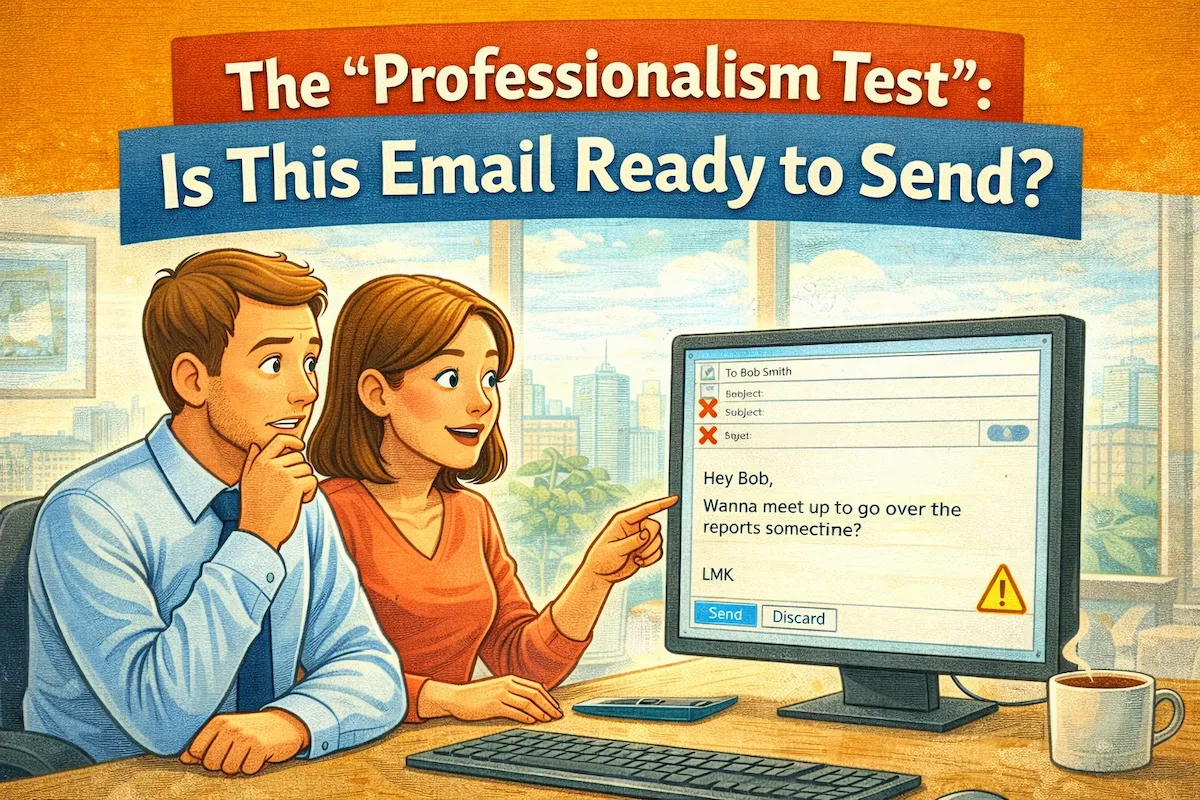
This Email Etiquette usage guide introduces a simple professionalism test you can run before sending any work email. Learn five quick self-audit questions to check clarity, tone, emotional language, formality, and endings so your emails sound confident and professional.
Almost everyone has sent an email they later regretted. Maybe it sounded too harsh. Maybe it was too vague. Or maybe it was technically correct — but felt slightly “off” in tone. In professional settings, these small missteps can have outsized consequences.
Email etiquette is not about perfect grammar or fancy words. It’s about professionalism, clarity, and emotional awareness. A well-written email shows respect for the reader’s time and position. A poorly written one can damage trust, even if the message itself is reasonable.
That’s where the Professionalism Test comes in. Before you hit “Send,” you should pause and run your email through a short self-audit. In this usage guide, you’ll learn five essential questions that help you decide whether your email is truly ready to go.
Why Emails Need a Professionalism Check
Unlike spoken conversation, emails lack tone of voice, facial expression, and immediate feedback. This means readers interpret your words based only on language — and their own assumptions.
A sentence that sounds neutral in your head may feel cold or demanding to someone else. The professionalism test helps prevent these unintended signals.
The Professionalism Test in One Sentence
If this email were forwarded to your manager, would you still feel comfortable?
If the answer is “maybe,” it’s time for a closer review.
Question 1: Is My Purpose Clear?
The first test is clarity.
Ask yourself:
- Why am I sending this email?
- What action do I want from the reader?
- Is that action obvious?
Unclear: Just following up on this. Clear: I’m following up to confirm whether the report will be ready by Friday.
Professional emails respect time by being direct.
Question 2: Is My Tone Polite but Confident?
Tone is the most common source of email problems.
Emails should avoid sounding:
- Demanding
- Passive-aggressive
- Overly apologetic
Too harsh: I need this today. Balanced: Could you please let me know if this will be ready today?
Politeness does not weaken authority — it strengthens it.
Question 3: Have I Removed Emotional Language?
Emotional language often slips in when emails are written quickly.
Watch for:
- Frustration (“as I said before”)
- Blame (“you failed to”)
- Defensiveness (“just to be clear”)
Emotional: This delay is very disappointing. Neutral: This delay impacts our timeline.
Neutral language keeps discussions professional and productive.
Question 4: Is My Level of Formality Appropriate?
Not every email needs to sound formal — but it should match the context.
Consider:
- Your relationship with the recipient
- The topic’s seriousness
- Company culture
Casual: Hey, can you send that over? Professional: Could you please send that over when you have a moment?
When in doubt, slightly more formal is usually safer.
Question 5: Does My Email End Clearly and Politely?
Endings matter more than people realize.
A good closing:
- Signals next steps
- Shows appreciation
- Feels complete
Thank you for your time. Please let me know if you have any questions.
Avoid endings that feel abrupt or unfinished.
Common Email Red Flags
Before sending, scan for:
- All caps (can feel aggressive)
- Too many exclamation points
- One-line emails for complex issues
- Missing greetings or closings
These small details strongly affect perception.
The “Read It Out Loud” Test
One of the simplest professionalism checks:
Read your email out loud before sending.
If it sounds awkward, rushed, or uncomfortable, it probably needs revision.
Professional Does Not Mean Cold
Many people worry that professional emails sound robotic.
Professional English can still be:
- Warm
- Respectful
- Human
I appreciate your help with this.
Small human touches improve tone without reducing professionalism.
Practice Test
Please answer the following questions. To see the correct answer, please click the arrow icon.
Which question checks for clarity of purpose?
Answer: Is my purpose clear? Explanation: It ensures the reader knows why the email exists.
Why should emotional language be removed?
Answer: It can escalate conflict. Explanation: Neutral language keeps emails professional.
What does the “read it out loud” test reveal?
Answer: Tone and flow issues. Explanation: Spoken language exposes awkward phrasing.
Is politeness a sign of weakness in emails?
Answer: No. Explanation: Politeness strengthens authority and trust.
Why This Self-Audit Matters
Running this professionalism test:
- Reduces misunderstandings
- Builds professional credibility
- Improves long-term communication
The goal isn’t perfection — it’s intention.
Final Thoughts: Pause Before You Send
The most professional emails aren’t written faster — they’re written more thoughtfully.
Taking an extra minute to review tone, clarity, and structure can prevent days of confusion or discomfort.
Before you hit “Send,” run the professionalism test. Your future self — and your reader — will thank you.