Synonyms vs. Antonyms: 5 Pro Tips to Never Swap Them Again
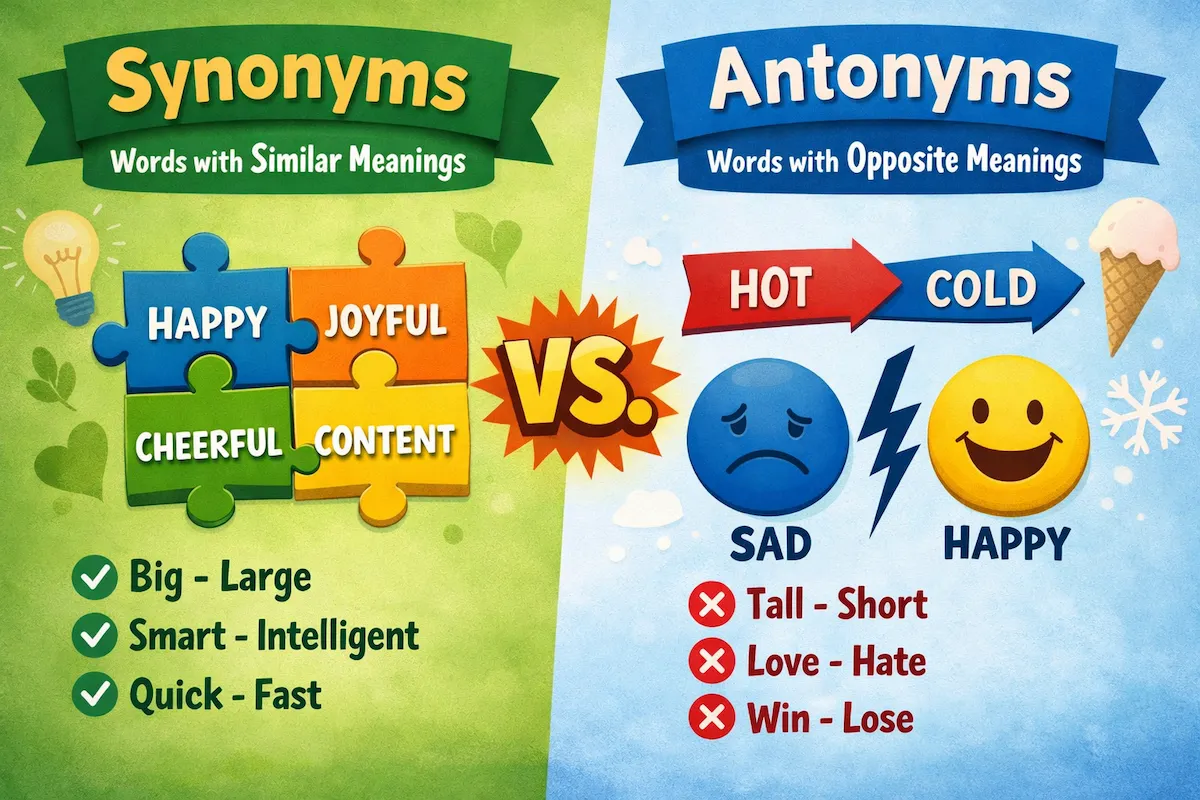
This education guide explains synonyms vs antonyms with clear definitions, examples, and five pro tips. Learn how to identify word relationships, avoid common exam traps, and confidently tell similar meanings apart from opposite ones.
Synonyms and antonyms are among the very first vocabulary concepts most English learners encounter. At first glance, they seem simple: one means “the same,” the other means “the opposite.” Yet in real reading, writing, and exams, many learners still mix them up — sometimes without realizing it.
This confusion can lead to wrong answers, unclear writing, and awkward sentences that say the exact opposite of what you intended.
In this education guide, we’ll break down synonyms vs. antonyms in a clear, practical way and share five pro tips that will help you instantly tell them apart — and never swap them again.
What Are Synonyms?
Synonyms are words that have the same or nearly the same meaning.
Big → large Happy → joyful Fast → quick
Synonyms help writers avoid repetition and add variety to language, but they rarely mean exactly the same thing in every context.
What Are Antonyms?
Antonyms are words that have opposite meanings.
Hot → cold Success → failure Early → late
Antonyms help us express contrast, comparison, and clear differences.
Why Learners Confuse Synonyms and Antonyms
The confusion often happens because:
- Both appear together in vocabulary lessons
- Tests mix them in similar-looking questions
- Learners memorize lists without context
- Some words have multiple meanings
Understanding function is more important than memorization.
Pro Tip #1: Ask “Does It Replace or Reverse?”
The fastest mental check is this question:
Can this word replace the original without changing meaning — or does it reverse the meaning?
Replacement → synonym Reversal → antonym
Pro Tip #2: Use the Sentence Swap Test
Place the new word into the original sentence.
The exam was difficult. The exam was easy.
If the message flips, you’re dealing with an antonym.
Pro Tip #3: Watch for Gradation, Not Opposition
Many synonyms differ in degree, not direction.
Cold → cool → chilly → freezing
These are synonyms on a scale, not opposites.
Pro Tip #4: Identify the Core Meaning
Strip a word down to its basic idea.
Cheap vs. expensive Both relate to cost → antonyms
Shared core meaning with opposite direction = antonyms.
Pro Tip #5: Check the Function, Not Just the Definition
Dictionaries often show multiple meanings.
A word may be a synonym in one context and not in another.
Synonyms Are Not Always Interchangeable
Synonyms can differ in:
- Formality
- Emotion
- Register
- Collocation
Childlike ≠ childish
Antonyms Can Be Gradable or Absolute
Some antonyms allow degrees:
Hot ↔ cold
Others are absolute:
Alive ↔ dead
Common Exam Traps
- Words that look similar but differ in tone
- Context-based antonyms
- False opposites
How Teachers Expect You to Think
Education systems test understanding, not memorization.
They expect you to analyze context and meaning relationships.
Synonyms Expand, Antonyms Contrast
Remember this simple rule:
- Synonyms expand meaning
- Antonyms contrast meaning
Practice Test
Please answer the following questions. To see the correct answer, please click the arrow icon.
Is “happy” a synonym or antonym of “sad”?
Answer: Antonym Explanation: The meanings are opposite.
Are “quick” and “fast” synonyms or antonyms?
Answer: Synonyms Explanation: They share a similar meaning.
Is “cheap” a synonym of “expensive”?
Answer: No Explanation: They are opposites, so they are antonyms.
Can synonyms always replace each other perfectly?
Answer: No Explanation: Tone and context may differ.
Which pair shows gradable antonyms?
Answer: Hot and cold Explanation: Temperature exists on a scale.
Final Thoughts: Think Relationships, Not Lists
Synonyms and antonyms are not just vocabulary labels — they describe relationships between meanings.
By focusing on replacement versus reversal, degree versus direction, and context over memorization, you’ll stop confusing these two concepts and start using them with confidence in reading, writing, and exams.