5 Ways to Ask for a Deadline Extension Without Sounding Unprofessional
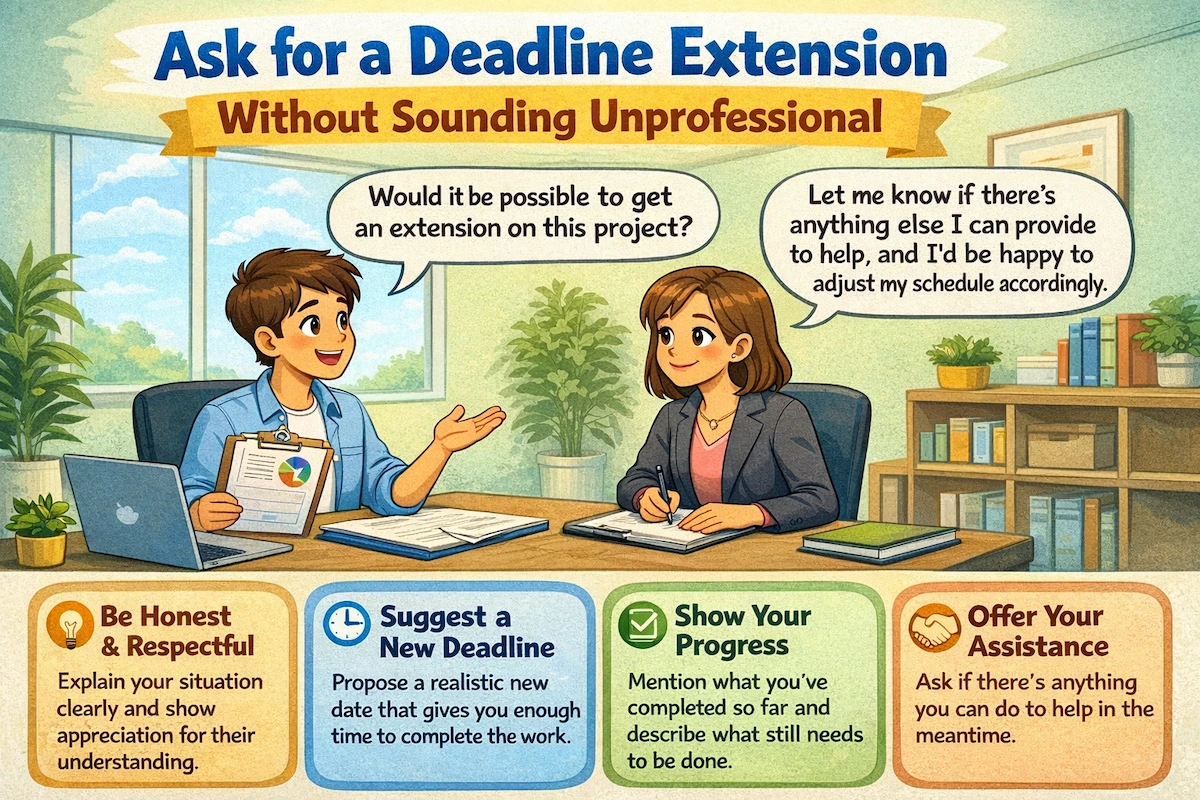
This corporate-politeness usage guide explains how to request a deadline extension professionally. Learn five respectful phrasing strategies, what to avoid, and how to ask for more time while protecting trust and maintaining a strong professional reputation.
Asking for a deadline extension is one of the most delicate moments in professional communication. You’re essentially saying, “I can’t meet the original agreement,” which can easily sound irresponsible if phrased poorly — even when the reason is completely valid.
The good news is that needing more time is normal in modern workplaces. Projects change, priorities shift, and unexpected issues appear. What truly matters is not that you ask for an extension, but how you ask for it.
In this usage guide, you’ll learn five professional ways to request a deadline extension without sounding careless, defensive, or unprepared. Each approach focuses on responsibility, clarity, and respect — the core principles of corporate politeness.
Why Asking for More Time Feels So Risky
Many professionals hesitate to ask for deadline extensions because they worry about how they’ll be perceived.
Common fears include:
- Looking unorganized
- Appearing incapable
- Damaging trust
- Being judged as unreliable
These fears often lead people to stay silent — which is usually worse than asking early and professionally.
The Golden Rule of Deadline Extensions
Before looking at specific phrases, remember this principle:
A professional extension request focuses on the work — not excuses.
Your goal is to show ownership, not to shift blame or over-explain.
Way #1: “I’d like to request a short extension to ensure quality.”
This phrasing works well when you genuinely need more time to maintain standards.
I’d like to request a short extension to ensure the final deliverable meets the expected quality.
Why this works:
- It shows commitment to quality
- It avoids emotional language
- It frames the extension as responsible
Managers rarely argue with quality-focused reasoning.
Way #2: “Given the updated scope, may I suggest a revised deadline?”
This approach is ideal when project requirements have changed.
Given the updated scope, may I suggest a revised deadline so we can account for the additional tasks?
Why this works:
- It acknowledges change
- It sounds collaborative
- It avoids personal blame
The focus stays on logistics, not performance.
Way #3: “I’m making good progress, but I need a bit more time to finalize.”
This phrasing reassures the reader that work is already underway.
I’m making good progress, but I need a bit more time to finalize the remaining details.
Why this works:
- It reduces anxiety
- It shows momentum
- It sounds calm and controlled
It signals that the extension is about finishing — not starting.
Way #4: “Would it be possible to extend the deadline to [date]?”
Sometimes clarity is the most polite choice.
Would it be possible to extend the deadline to Friday, May 10?
Why this works:
- It asks, not demands
- It provides a clear alternative
- It respects authority
Specific dates feel more professional than vague timelines.
Way #5: “I want to align expectations before the deadline.”
This method opens a discussion instead of making a direct request.
I wanted to align expectations before the deadline, as additional time may help ensure a stronger outcome.
Why this works:
- It sounds proactive
- It invites dialogue
- It avoids saying “I can’t”
This is especially effective with senior stakeholders.
What to Avoid When Asking for an Extension
Even good intentions can fail with poor phrasing.
Avoid:
- Over-apologizing
- Blaming others
- Emotional language
- Last-minute surprises
❌ I’m really sorry, everything went wrong, can I get more time?
Email Tone Matters More Than You Think
Written requests lack facial expressions and voice tone. This makes word choice critical.
Compare:
I need more time. I’d like to request a brief extension.
The second sounds intentional and professional.
How Early Is “Early Enough”?
As a general rule:
- Ask as soon as risk appears
- Don’t wait until the deadline day
- Signal issues early
Early requests feel responsible. Late ones feel reactive.
Practice Test
Please answer the following questions. To see the correct answer, please click the arrow icon.
Which sentence sounds most professional?
Answer: “Would it be possible to extend the deadline to next Tuesday?” Explanation: It is polite, specific, and respectful.
Is apologizing multiple times helpful when asking for an extension?
Answer: No. Explanation: Excessive apologies can sound insecure or defensive.
Should you give a new suggested date when asking for more time?
Answer: Yes. Explanation: A specific proposal shows planning and accountability.
Is it better to ask early or close to the deadline?
Answer: Early. Explanation: Early requests demonstrate foresight and responsibility.
Why Professional Extensions Build Trust
Counterintuitively, asking for an extension the right way can increase trust.
It shows:
- Self-awareness
- Commitment to outcomes
- Respect for expectations
Silence or missed deadlines do the opposite.
Final Thoughts: Professionalism Is in the Framing
Needing more time doesn’t define your professionalism — your communication does.
By choosing calm, respectful language and focusing on outcomes, you can request deadline extensions without damaging your reputation.
In modern workplaces, clear and polite communication is just as important as meeting deadlines themselves.