"Say that again?" vs. "Pardon me?" – Asking for Repetition
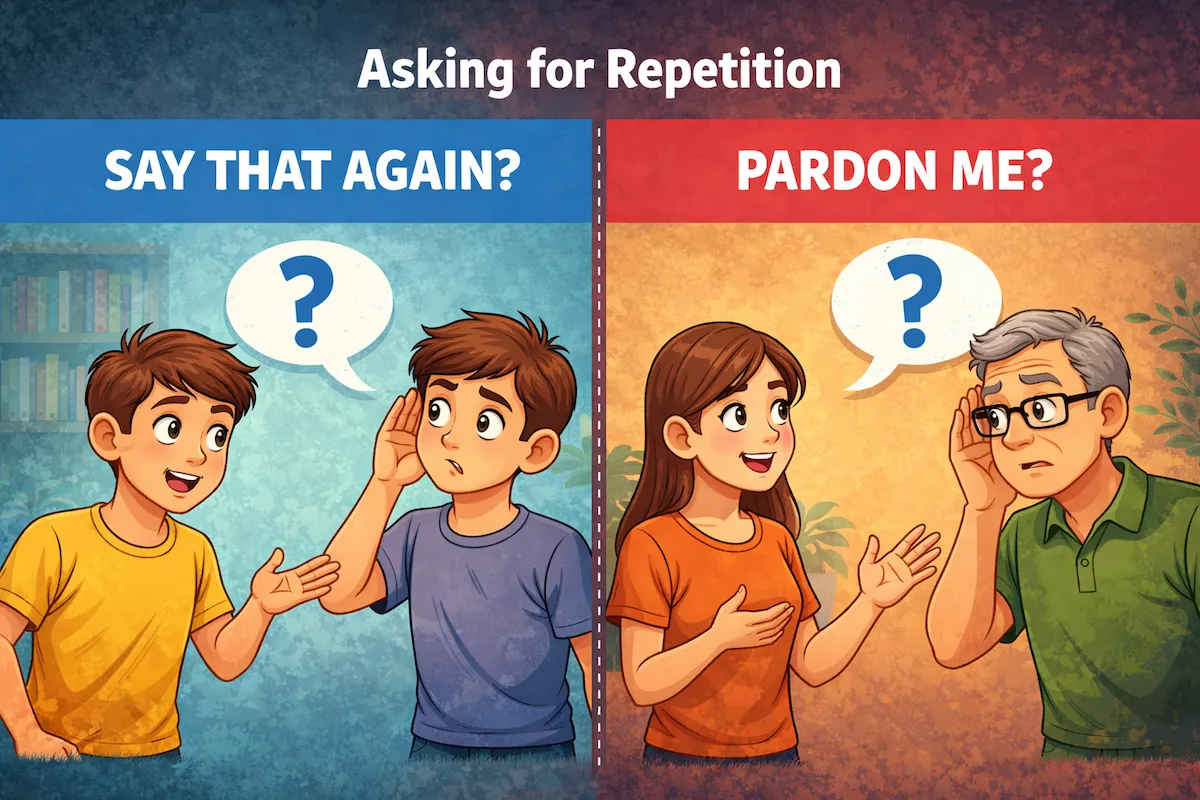
This synonyms-in-context guide explains how to ask someone to repeat themselves using phrases like “Say that again?” and “Pardon me?”. Learn how tone, formality, and context affect politeness so you never sound annoyed or rude in conversation.
Everyone has experienced that awkward moment in a conversation when you didn’t quite catch what the other person said. Maybe the room was noisy, the speaker talked too fast, or your mind briefly wandered. In that moment, you need to ask for repetition — politely, naturally, and without sounding rude or impatient.
English offers many ways to do this, but two of the most common are “Say that again?” and “Pardon me?”. While both are correct, they are not interchangeable in every situation. Each carries its own tone, level of formality, and social implication.
In this synonyms-in-context guide, you’ll learn how “Say that again?” and “Pardon me?” differ, when each sounds appropriate, and how to ask someone to repeat themselves smoothly in casual, professional, and formal settings.
Why Asking for Repetition Is a Social Skill
Asking someone to repeat themselves is not just a language function — it’s a social interaction. The wrong wording can make you sound:
- Annoyed
- Dismissive
- Uninterested
- Confrontational
The right wording, however, shows attentiveness and respect.
Understanding “Say That Again?”
“Say that again?” is a direct and informal way to ask for repetition.
Say that again? I didn’t hear you.
It is commonly used in everyday conversation among friends, family, and close colleagues.
Sentence Patterns with “Say That Again?”
This phrase often appears:
- On its own
- With a brief explanation
Say that again? Sorry, there was a lot of noise.
Tone of “Say That Again?”
The tone depends heavily on:
- Intonation
- Facial expression
- Context
Spoken neutrally, it sounds friendly. Spoken sharply, it can sound annoyed.
When “Say That Again?” Can Sound Rude
In formal or professional situations, “Say that again?” may sound too blunt.
❌ Say that again? (to a client)
While not grammatically wrong, it lacks softness.
Understanding “Pardon Me?”
“Pardon me?” is a more polite and formal way to ask for repetition.
Pardon me? Could you repeat that?
It carries an apologetic tone, even when no apology is needed.
Grammar Role of “Pardon Me?”
Originally, pardon means “forgive.” In this context, it functions as a polite request for clarification.
The phrase implies: “Please forgive me for not hearing you.”
When “Pardon Me?” Sounds Best
Use “Pardon me?” in:
- Professional meetings
- Customer service situations
- Formal conversations
- Conversations with strangers
Side-by-Side Comparison
Say that again? → casual, direct Pardon me? → polite, formal
Neither is wrong — context decides.
Other Polite Alternatives Worth Knowing
Native speakers often soften their request with longer phrases:
- Could you say that again?
- Sorry, I didn’t catch that.
- Would you mind repeating that?
These options work well when you want to sound extra considerate.
Why “What?” Is Risky
Simply saying “What?” is grammatically fine but socially risky.
It often sounds abrupt or rude, especially in adult conversation.
Repetition Requests in Phone Calls
On the phone, asking for repetition is especially common.
Sorry, could you say that again? The line is breaking up.
Adding a reason helps soften the request.
Repetition Requests in Meetings
In meetings, clarity matters.
Pardon me, could you repeat the last point?
This sounds professional and respectful.
Repetition Requests with Friends
Among friends, directness is normal.
Say that again? I missed it.
Intonation Makes All the Difference
Rising intonation signals confusion or politeness.
Flat or falling intonation may sound annoyed.
Common Learner Mistakes
- Using “What?” in formal contexts
- Using “Say that again?” with authority figures
- Forgetting to soften the request
Practice Test
Please answer the following questions. To see the correct answer, please click the arrow icon.
Which phrase sounds more polite in a business meeting?
Answer: Pardon me? Explanation: It carries a formal and respectful tone.
Which phrase is more natural among close friends?
Answer: Say that again? Explanation: It is casual and direct.
Is “What?” rude in all situations?
Answer: No. Explanation: It’s acceptable informally, but risky in polite contexts.
Why does intonation matter?
Answer: It changes the perceived attitude. Explanation: Tone can make a phrase sound polite or annoyed.
Final Thoughts: Repeat with Respect
“Say that again?” and “Pardon me?” both help you recover lost information — but they send different social signals.
Choosing the right phrase shows awareness, politeness, and confidence in English conversation. With practice, asking for repetition will feel natural, smooth, and stress-free.