"House" vs. "Home" – The Difference Between Structure and Feeling
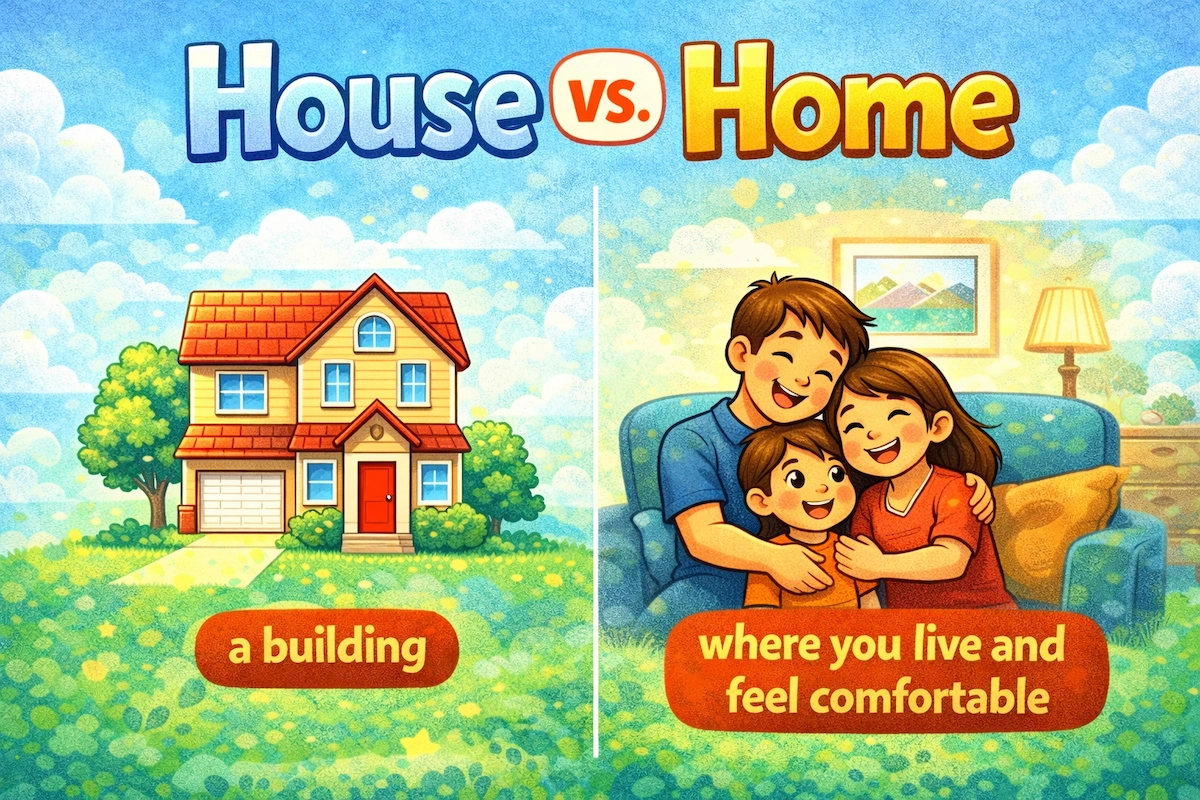
This Synonyms in Context usage guide explains the difference between “house” and “home.” Learn how one refers to a physical building while the other expresses emotional connection, explore common sentence patterns, and avoid frequent learner mistakes so your English sounds natural and meaningful.
Few word pairs confuse English learners as much as house and home. At first glance, they seem interchangeable. Both refer to places where people live. Yet native speakers instinctively know that these two words are not the same — and using the wrong one can subtly change the meaning, tone, or emotional impact of a sentence.
The difference between house and home is not just grammatical. It is deeply connected to how English separates physical structures from human experience. One word describes walls and roofs; the other describes belonging, comfort, and identity.
In this usage guide, we’ll explore how house and home function differently in real English, examine common sentence patterns, and help you choose the right word based on meaning, not translation.
What Does “House” Mean?
House refers to a physical building. It is a concrete noun that describes a structure made of materials like wood, brick, or concrete.
They bought a house near the beach.
In this sentence, house refers to the building itself — its size, location, and structure.
A house can exist without people. It can be empty, abandoned, or for sale.
Common Contexts for “House”
House is commonly used in contexts involving:
- Real estate
- Architecture
- Construction
- Physical description
The house has three bedrooms and a large garden.
The focus is on measurable, visible features.
What “House” Does Not Express
House does not express emotional attachment by default.
This is just a house, not a home.
This sentence clearly separates physical structure from emotional meaning.
What Does “Home” Mean?
Home refers to a place where someone feels belonging, comfort, and emotional connection.
After years abroad, she finally returned home.
Notice that home here does not describe a building. It describes a feeling of return.
A home can be an apartment, a house, a room, or even a country — as long as it carries emotional meaning.
Home as an Abstract Concept
Unlike house, home can function as an abstract noun.
Home is where you feel safe.
This sentence talks about an idea, not a location.
House vs. Home: Core Difference
The simplest way to remember the distinction:
- House → physical structure
- Home → emotional connection
One answers the question “What kind of building?” The other answers “Where do I belong?”
Using “House” in Sentence Patterns
House often appears with articles and descriptive adjectives.
They live in a modern house.
The house was built in the 1950s.
These patterns emphasize structure and design.
Using “Home” in Sentence Patterns
Home often appears without an article, especially when referring to one’s own place.
I’m going home now.
Saying “going to the home” would sound unnatural in most contexts.
Why “Go Home” Is Not “Go to House”
English treats home as a destination tied to identity.
Let’s go home.
This sentence emphasizes return and comfort, not the physical building.
In contrast:
Let’s go to the house.
This sounds like a neutral visit to a location.
House as a Countable Noun
House is countable.
There are many houses on this street.
You can count houses, list them, and compare them.
Is “Home” Countable?
Home can be countable in some contexts, but it often functions as uncountable or abstract.
They provide homes for displaced families.
Here, homes refers to living spaces with emotional significance.
Emotional Language with “Home”
Home frequently appears in emotional or reflective language.
This place finally feels like home.
Using house here would sound cold or incorrect.
Common Learner Mistake #1
Using house when emotional meaning is intended.
Incorrect: I miss my house. Better: I miss my home.
The second sentence expresses emotional attachment.
Common Learner Mistake #2
Using home when describing physical features.
Incorrect: The home has four bathrooms. Better: The house has four bathrooms.
Physical descriptions belong to house.
House and Home in Idioms
English idioms often preserve the emotional distinction.
Home sweet home Make yourself at home
These expressions would not work with house.
Cultural Importance of “Home”
The concept of home is deeply tied to identity, family, and belonging.
This is why home appears frequently in literature, songs, and speeches.
Choosing the Right Word in Real Life
Ask yourself:
Am I talking about walls and space — or feelings and belonging?
Structure → house Feeling → home
Why This Distinction Matters
Using the right word makes your English sound natural and emotionally accurate.
Native speakers instantly notice when these words are mixed incorrectly.
Final Thoughts: A Building Can Be a House, but a Feeling Is a Home
House and home describe where we live — but from different angles.
One is concrete and measurable. The other is personal and emotional.
Mastering this difference allows you to communicate not just information, but meaning.