Weather vs. Whether: Don't Let the Storm Ruin Your Choices!
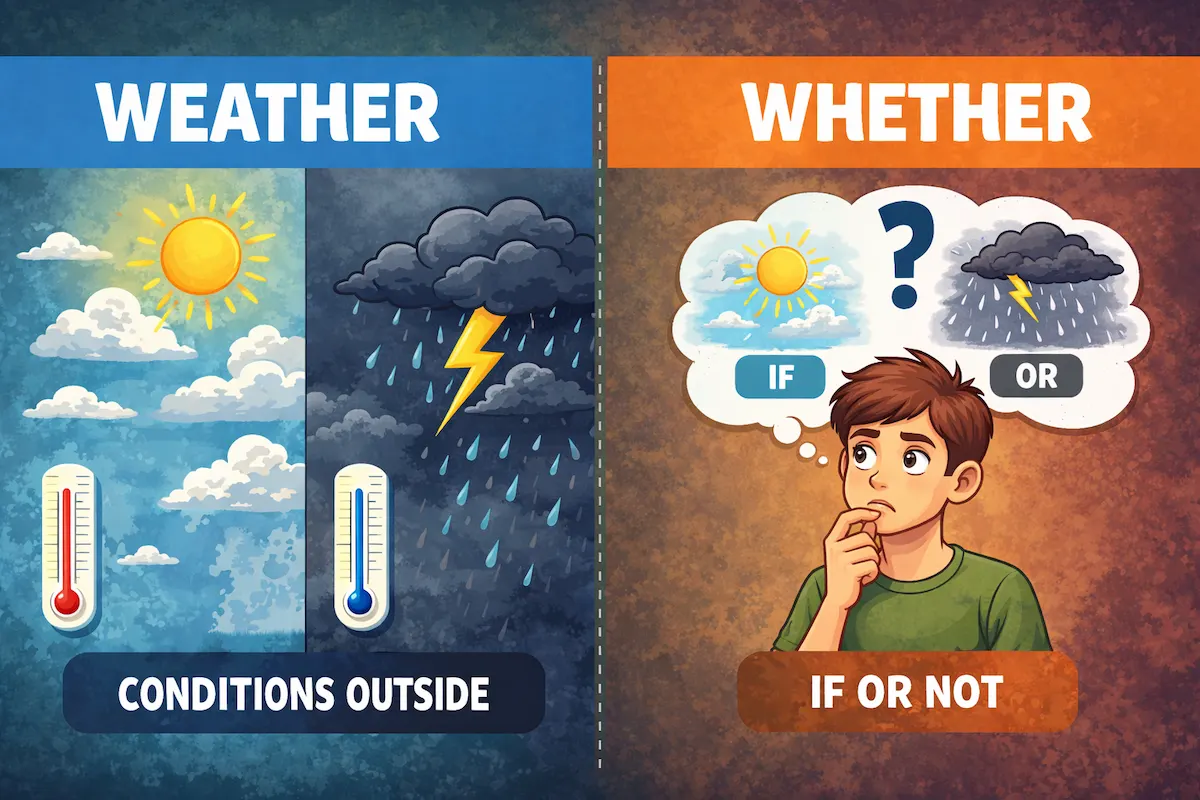
This confusing-words guide explains how to use weather and whether correctly. Learn when a sentence is about atmospheric conditions and when it expresses a choice or uncertainty, plus simple tests to avoid this common homophone mistake.
Few English word pairs confuse learners as consistently as weather and whether. They sound almost identical when spoken, yet their meanings live in completely different worlds. One belongs to the sky; the other belongs to decisions, doubts, and choices.
Because they are homophones, writers often mix them up — especially in fast typing, emails, and informal writing. Unfortunately, choosing the wrong one can instantly change the meaning of your sentence or make it look careless.
In this confusing-words guide, you’ll learn how to clearly separate weather from whether, understand their grammatical roles, and avoid one of the most common sound-based mistakes in English writing.
Why Weather and Whether Get Confused
The main reason for confusion is pronunciation. In most accents, weather and whether sound the same or extremely similar.
When two words sound alike but have different meanings and spellings, they are called homophones. English has many of them, and this pair is among the trickiest.
What Does “Weather” Mean?
Weather refers to atmospheric conditions such as temperature, rain, wind, snow, and sunshine.
The weather is sunny today.
It answers questions like:
- Is it raining?
- Is it cold or hot?
- What’s the forecast?
Grammar Role of “Weather”
Weather is primarily a noun.
Bad weather can delay flights.
It can also appear in compound nouns and set expressions.
Common Collocations with “Weather”
- Weather forecast
- Weather conditions
- Severe weather
- Weather report
The weather forecast predicts heavy rain.
Weather as a Verb (Less Common)
Weather can also be a verb meaning “to survive” or “to endure.”
The company managed to weather the crisis.
This meaning is metaphorical and unrelated to rain or temperature.
What Does “Whether” Mean?
Whether introduces alternatives, choices, or uncertainty.
I don’t know whether to stay or leave.
It often appears when someone is deciding between two possibilities.
Grammar Role of “Whether”
Whether is a conjunction.
It connects clauses and introduces indirect questions.
She asked whether the meeting was canceled.
Common Patterns with “Whether”
- whether + clause
- whether … or …
- whether or not
Let me know whether you’re coming or not.
Weather vs Whether: Core Difference
Weather → sky and atmosphere Whether → choice and uncertainty
If your sentence is about rain, sun, or temperature, weather is correct. If it’s about decisions, whether is the right choice.
A Simple Replacement Test
Try replacing the word with if.
If the sentence still works → use whether.
I’m not sure if he will join us. → whether
You can’t replace weather with if.
Common Mistakes in Writing
- Using “weather” when talking about choices
- Using “whether” when describing rain or temperature
- Relying on spellcheck to catch the error
Why Spellcheck Often Misses This Error
Both weather and whether are real words, so spellcheck rarely flags the mistake.
Only context can reveal the error — and context checking is your job as a writer.
Weather in Everyday Language
Conversations about weather are common small talk topics.
The weather has been unpredictable lately.
This word is concrete and descriptive.
Whether in Professional and Academic Writing
Whether appears frequently in reports, emails, and formal discussion.
We need to determine whether the proposal meets our criteria.
Weather vs Whether in Questions
❌ Do you know weather he arrived? ✅ Do you know whether he arrived?
Questions about facts or outcomes require whether.
Idiomatic Expressions with “Weather”
- Under the weather
- Fair-weather friend
- Weather the storm
She’s feeling under the weather today.
There Are No Idioms with “Whether”
Whether is purely functional. It exists to structure meaning, not create imagery.
Memory Trick That Always Works
Remember:
- Weather → contains “sun,” “rain,” “wind” in meaning
- Whether → contains “if” in function
Sky vs choice — that’s the core contrast.
Practice Test
Please answer the following questions. To see the correct answer, please click the arrow icon.
Choose the correct word: “I don’t know ___ it will rain tomorrow.”
Answer: whether Explanation: The sentence expresses uncertainty.
Choose the correct word: “The ___ was cold and windy.”
Answer: weather Explanation: It refers to atmospheric conditions.
Is this sentence correct? “She asked weather the shop was open.”
Answer: No. Explanation: The sentence involves a question, so “whether” is needed.
Which word can be replaced with “if”?
Answer: whether Explanation: “Whether” introduces conditional alternatives.
Final Thoughts: Sky or Choice?
Weather talks about the world outside your window. Whether talks about decisions inside your mind.
Once you lock in that distinction, the confusion disappears — and your writing becomes clearer, sharper, and more confident.