Ingenious vs. Ingenuous: Are You Brilliant or Just Naive?
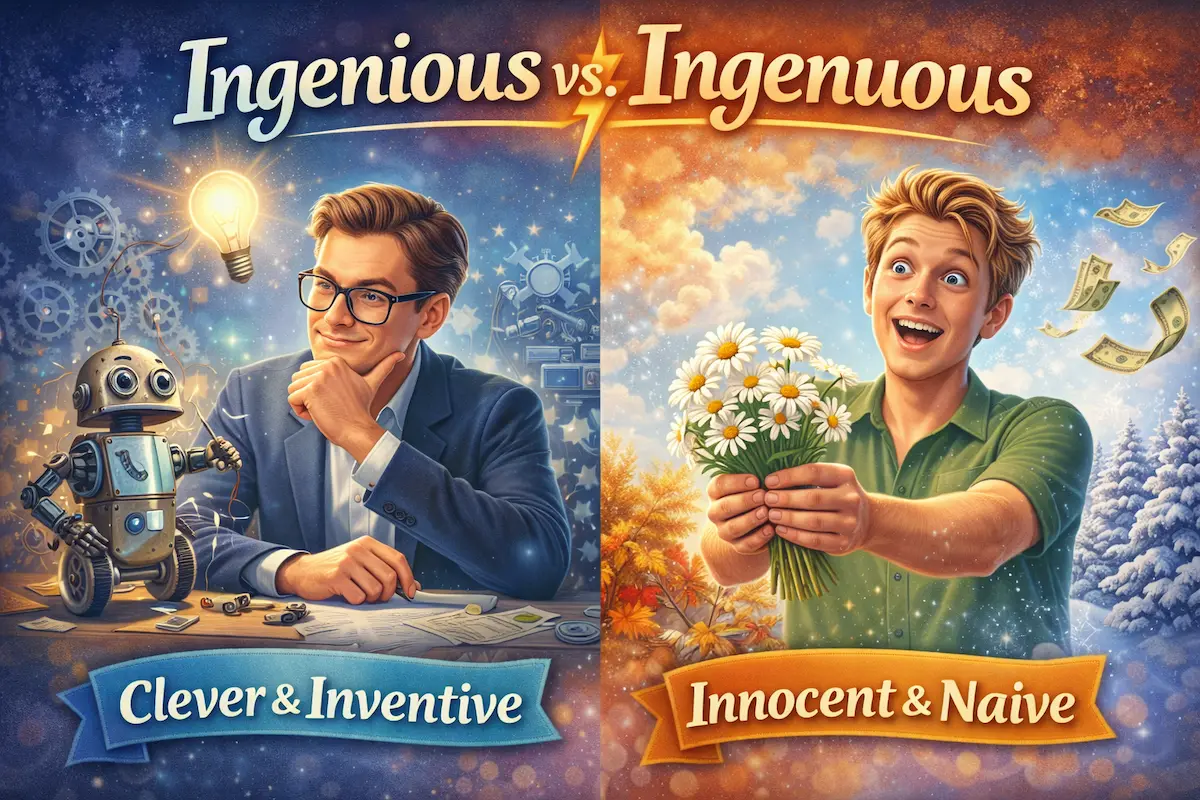
This confusing-words guide explains the difference between ingenious and ingenuous. Learn why ingenious means clever and inventive, while ingenuous means innocent or naive, and discover how using the wrong word can completely change your message in professional and social contexts.
English has many word pairs that look almost identical but mean very different things. One of the most dangerous pairs — especially in professional or social settings — is ingenious and ingenuous.
At first glance, these words seem interchangeable. They share similar spelling, pronunciation, and even a vaguely positive tone. But using the wrong one can completely change your message — and sometimes turn a compliment into an unintended insult.
In this usage guide, we’ll break down the real difference between ingenious and ingenuous, explore their meanings, contexts, and connotations, and show you exactly when to use each word with confidence.
Why This Pair Is So Confusing
These two words confuse learners — and even native speakers — for three main reasons:
- They look almost the same
- They sound similar when spoken quickly
- They both feel “positive” at first glance
However, their meanings sit on opposite ends of the intelligence spectrum.
What Does “Ingenious” Mean?
Ingenious means clever, inventive, or creatively intelligent.
She came up with an ingenious solution to the problem.
This word praises mental ability — especially problem-solving and innovation.
Key Characteristics of “Ingenious”
- Highly intelligent
- Creative or inventive
- Problem-solving oriented
- Often associated with design or ideas
Calling someone ingenious is always a compliment.
Common Contexts for “Ingenious”
You’ll often see ingenious used with:
- Solutions
- Ideas
- Devices
- Plans
The engineer designed an ingenious mechanism.
What Does “Ingenuous” Mean?
Ingenuous means innocent, naive, or overly trusting.
His ingenuous comments revealed how little he understood the situation.
While not always negative, this word suggests a lack of worldly experience.
Key Characteristics of “Ingenuous”
- Innocent
- Trusting
- Open and honest
- Sometimes naive
Unlike “ingenious,” this word is risky as a compliment.
Ingenuous Is Not the Same as “Genuine”
Many learners confuse ingenuous with genuine.
Genuine → sincere Ingenuous → innocent or naive
Using ingenuous when you mean genuine can sound patronizing.
Why “Ingenuous” Can Sound Insulting
Calling someone ingenuous can imply:
- They are easily fooled
- They lack experience
- They don’t understand complex situations
That was an ingenuous assumption.
This sentence suggests poor judgment, not intelligence.
Side-by-Side Comparison
Ingenious → clever solution Ingenuous → naive reaction
One praises the mind; the other describes innocence.
Common Learner Mistake
Incorrect: She’s an ingenuous engineer. Correct: She’s an ingenious engineer.
The incorrect sentence accidentally suggests she’s naive.
Pronunciation Tip
Although similar, there is a subtle difference:
ingenious → in-JEEN-yus ingenuous → in-JEN-yoo-us
Listening carefully helps reinforce meaning.
Etymology Insight
Both words come from Latin ingenium, meaning natural ability.
Over time, English split the meaning:
Ingenious → developed intelligence Ingenuous → undeveloped innocence
Professional Context Warning
In business or academic writing, avoid ingenuous unless you truly mean innocent or naive.
Most praise-related contexts require ingenious.
Choosing the Right Word Quickly
Ask yourself:
Am I praising intelligence? → ingenious Am I describing innocence? → ingenuous
Practice Test
Please answer the following questions. To see the correct answer, please click the arrow icon.
Which word means clever and inventive?
Answer: ingenious Explanation: It praises intelligence and creativity.
Which word can suggest someone is naive?
Answer: ingenuous Explanation: It describes innocence or lack of experience.
Which sentence is correct: “an ingenious plan” or “an ingenuous plan”?
Answer: an ingenious plan Explanation: Plans require intelligence, not innocence.
Why should you be careful using “ingenuous” as a compliment?
Answer: It can sound patronizing. Explanation: It may imply naivety rather than praise.
Why Native Speakers Notice This Difference
Native speakers may forgive small grammar errors, but confusing these two words stands out immediately.
Precision here signals advanced vocabulary control.
Final Thoughts: One Letter, Huge Difference
Ingenious celebrates intelligence. Ingenuous describes innocence.
Mastering this pair helps you avoid awkward misunderstandings — and ensures your compliments land exactly as intended.