"As Per My Last Email" – 5 Polite Ways to Remind Someone
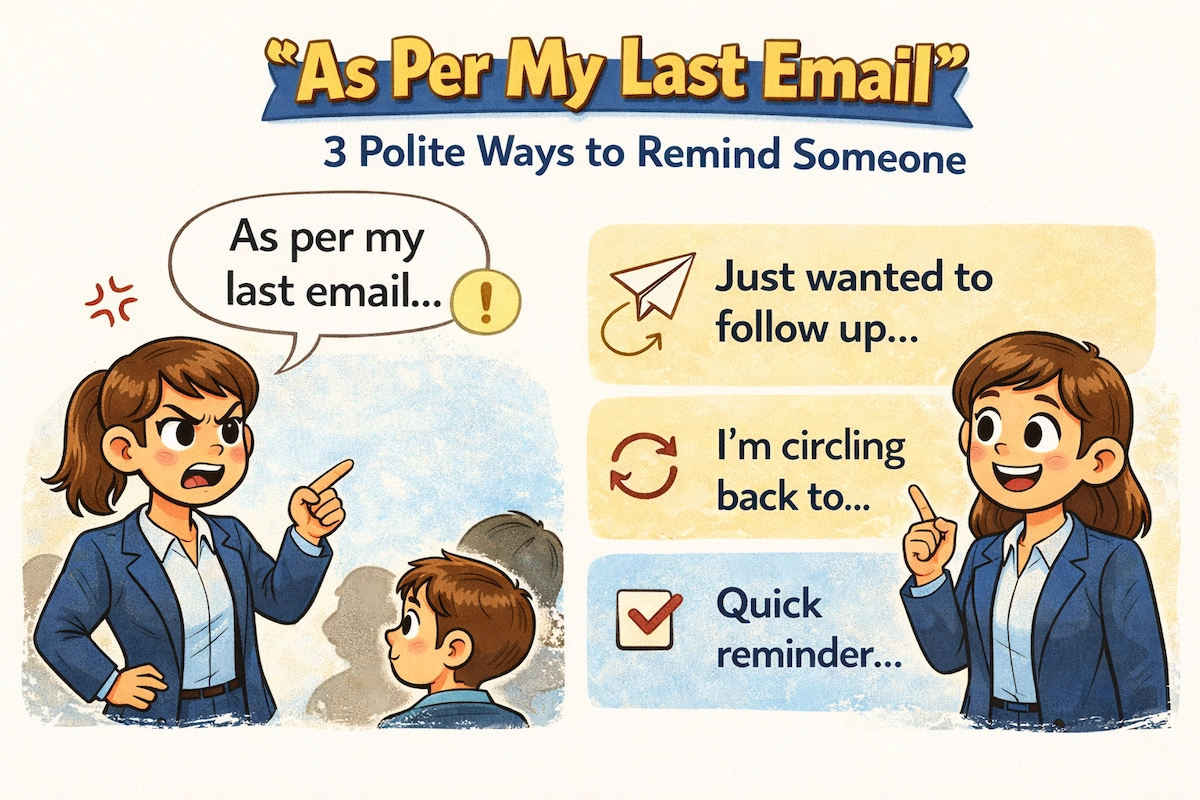
This Corporate Politeness usage guide explains why “As per my last email” often sounds passive-aggressive and offers five polite alternatives for professional follow-ups. Learn how to remind colleagues about pending tasks while maintaining respect, clarity, and strong working relationships.
Few phrases in corporate English carry as much hidden tension as “As per my last email”. On paper, it looks neutral and factual. In reality, many people hear it as frustrated, impatient, or quietly angry — even when that’s not what the sender intended.
In modern workplaces, following up on unanswered emails is unavoidable. Projects move fast, inboxes overflow, and people forget. The challenge is not whether to remind someone, but how to do it without sounding passive-aggressive or damaging professional relationships.
In this usage guide, we’ll break down why “As per my last email” often backfires and introduce five polite, professional alternatives you can use to remind colleagues about pending tasks while keeping the tone respectful and collaborative.
Why “As Per My Last Email” Sounds Passive-Aggressive
The phrase itself is not rude grammatically. The problem is its implication.
When someone reads “As per my last email,” they often hear:
- You should have read my message
- This is not the first time I’m asking
- I’m annoyed that this isn’t done yet
Even if none of this is true, the phrase carries a tone of blame — especially in written communication where facial expressions and voice are missing.
Why Follow-Ups Are So Sensitive
Follow-up emails sit at the intersection of time pressure and social hierarchy.
You may be writing to:
- A colleague at the same level
- A senior manager
- A client or external partner
Each situation requires politeness, clarity, and emotional intelligence. A poorly worded reminder can sound like criticism instead of coordination.
What Makes a Polite Reminder?
Effective follow-ups usually:
- Acknowledge the other person’s time
- Assume positive intent
- Focus on the task, not the delay
- Sound collaborative, not corrective
The five alternatives below are built around these principles.
Polite Alternative #1: “Just following up on my previous message…”
This is one of the safest and most widely accepted follow-up phrases in professional English.
Just following up on my previous message regarding the updated timeline.
The phrase “just following up” sounds neutral and procedural, not emotional.
It implies routine, not frustration.
Why This Works
It removes blame and frames the reminder as part of an ongoing process.
This phrasing works well with colleagues, managers, and clients alike.
Polite Alternative #2: “I wanted to check in regarding…”
“Check in” is a soft, human phrase that signals awareness rather than urgency.
I wanted to check in regarding the documents we discussed last week.
This phrasing suggests curiosity, not pressure.
It’s especially useful when the deadline is flexible or when writing to someone senior.
Polite Alternative #3: “Just a quick reminder about…”
This phrase acknowledges the reminder directly while minimizing its emotional weight.
Just a quick reminder about the feedback requested below.
The word “quick” reassures the reader that you’re not demanding a long response.
Use this when you need to be clear but still polite.
When to Be Careful with This Phrase
Avoid overusing “quick reminder” in high-pressure situations — it can still feel urgent if repeated too often.
Polite Alternative #4: “In case it was missed, I wanted to share…”
This phrasing assumes the email was overlooked, not ignored.
In case it was missed, I wanted to share the updated file below.
This removes any suggestion of fault.
It works well when forwarding an earlier message.
Polite Alternative #5: “Could you let me know when you have a chance?”
This phrase shifts the focus from the delay to availability.
Could you let me know when you have a chance to review the proposal?
It respects the other person’s schedule while still requesting action.
This is particularly effective with senior colleagues or external partners.
How to Combine These Phrases Naturally
Polite reminders often use more than one softening element.
Just following up on my previous message — could you let me know when you have a chance to review it?
The tone feels cooperative, not corrective.
What to Avoid in Follow-Up Emails
Certain patterns tend to escalate tension:
- As per my last email…
- Please see below (repeated aggressively)
- I already mentioned this
- No response yet
These phrases draw attention to the delay rather than the task.
Formal vs Semi-Formal Follow-Ups
Compare the tone difference:
Semi-formal: Just checking in on the status of this. Formal: I wanted to follow up regarding the status of this request.
Both are polite — the choice depends on your relationship and context.
Why Tone Matters More Than Speed
A polite reminder may take slightly longer to write, but it protects trust and professionalism.
In corporate environments, how you communicate often matters as much as what you communicate.
Building a Polite Follow-Up Habit
Before sending a reminder, ask yourself:
Does this sound like collaboration — or correction?
If it sounds corrective, soften the language.
Final Thoughts: Polite Reminders Get Better Results
Following up doesn’t have to feel uncomfortable or confrontational.
By replacing “As per my last email” with more thoughtful phrasing, you reduce tension, maintain professionalism, and often get faster responses.
Politeness isn’t weakness — it’s a strategic communication skill.