Advice vs. Advise: How to Choose the Right One Every Time
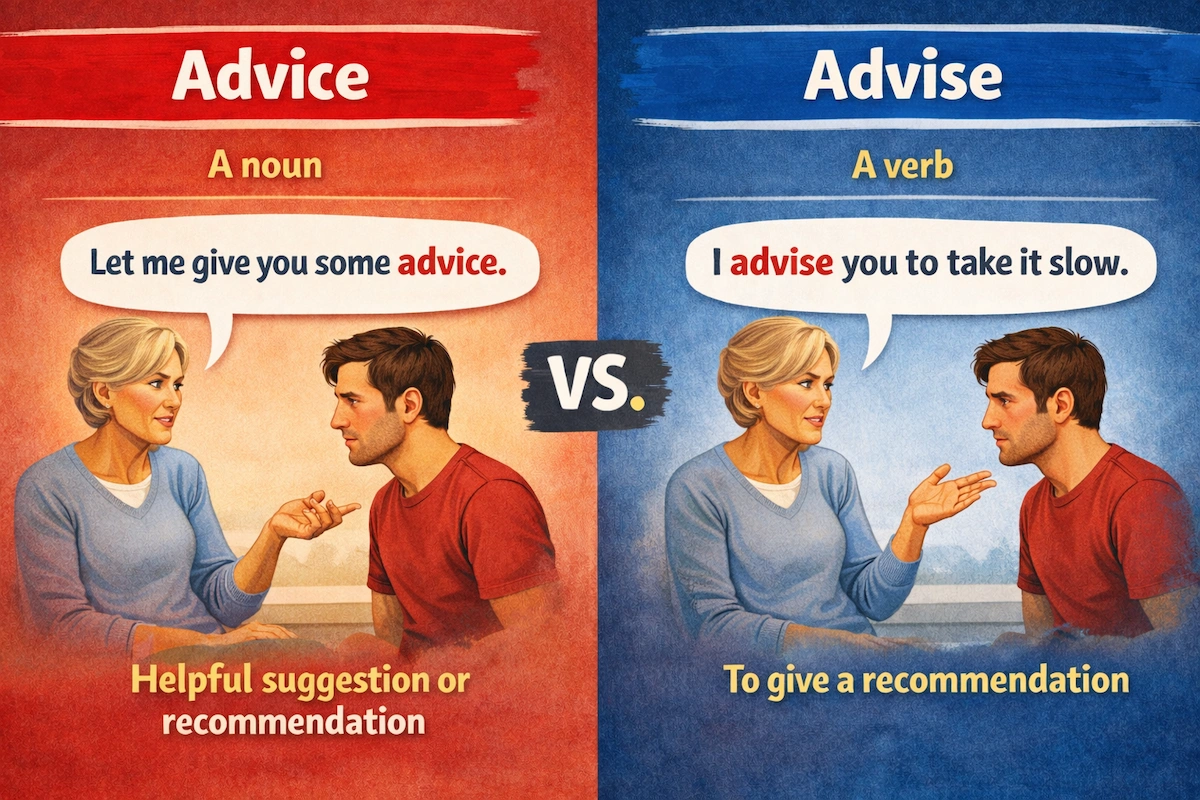
This confusing-words usage guide explains how to choose between “advice” and “advise.” Learn why one is a noun and the other a verb, how pronunciation helps, common learner mistakes, and a simple rule that makes the correct choice obvious in writing and speech.
Few word pairs cause as much quiet frustration for English learners as advice and advise. They look almost the same, they sound similar, and they often appear in the same situations — giving recommendations, offering help, or sharing experience.
Yet despite their similarity, these two words play completely different grammatical roles. One is a noun, and the other is a verb. Using the wrong one doesn’t just sound awkward — it can instantly signal a grammar mistake in professional, academic, or formal writing.
In this usage guide, you’ll learn the clear difference between advice and advise, a simple rule you can apply every time, and practical examples that make the distinction feel natural instead of technical.
Why Advice and Advise Are So Often Confused
This confusion happens for several predictable reasons:
- The spelling difference is only one letter
- The pronunciation difference is subtle
- They share the same meaning idea
- Many languages use one word for both forms
Because both words relate to giving guidance, learners often assume they are interchangeable. They are not.
The Core Difference in One Line
Here is the rule you should remember:
Advice = a thing (noun) Advise = an action (verb)
If you remember this, you will avoid most mistakes instantly.
“Advice”: A Noun
Advice is a noun. It refers to a suggestion, recommendation, or guidance that someone gives.
She gave me some helpful advice.
Notice that advice names a thing — something you can receive, give, or ask for.
Important Grammar Rule: Advice Is Uncountable
One key detail many learners miss is that advice is an uncountable noun.
This means:
- You cannot say “an advice”
- You cannot say “advices”
Incorrect: She gave me an advice. Correct: She gave me some advice.
This rule applies in both British and American English.
Common Collocations with “Advice”
Native speakers often use advice with:
- Give advice
- Ask for advice
- Follow advice
- Take advice
I asked my manager for advice about the project.
“Advise”: A Verb
Advise is a verb. It describes the act of giving advice.
I advise you to double-check the report.
Unlike advice, advise expresses an action.
Grammar Behavior of “Advise”
Because advise is a verb, it:
- Changes tense (advised, advising)
- Needs a subject
- Often takes an object
The lawyer advised her client to remain silent.
Pronunciation Difference (Very Important)
While the spellings are similar, the pronunciation helps distinguish them:
- Advice ends with an /s/ sound
- Advise ends with a /z/ sound
This difference is subtle but consistent in standard English.
A Simple Replacement Test
When you’re unsure which word to use, try this:
Can I replace the word with “suggestion”?
✔ Yes → use advice ❌ No → you probably need advise
Common Learner Mistake #1
Incorrect: I need your advise. Correct: I need your advice.
“Need” requires a noun, not a verb.
Common Learner Mistake #2
Incorrect: She advice me to wait. Correct: She advised me to wait.
This sentence needs a verb — not a noun.
Formal vs Informal Contexts
Both words appear in formal and informal English, but they are especially important in professional contexts.
Please seek legal advice before signing the contract.
We advise all employees to follow company policy.
Using the wrong form in these situations can weaken credibility.
Business and Workplace Usage
In workplace English:
- Managers give advice
- Policies advise employees
- Consultants offer advice
- Experts advise clients
Keeping the noun–verb distinction clear makes communication sharper.
Practice Test
Please answer the following questions. To see the correct answer, please click the arrow icon.
I strongly _____ you to speak with HR before making a decision.
Answer: Advise. Explanation: The sentence needs a verb describing an action.
She gave me some excellent _____ about managing my time.
Answer: Advice. Explanation: “Some” must be followed by a noun.
My doctor _____ me to get more rest.
Answer: Advised. Explanation: The verb form is required, and the tense is past.
Can you give me any _____ on this issue?
Answer: Advice. Explanation: The sentence asks for a thing, not an action.
Why This Is a High-Impact Grammar Fix
Advice vs advise is a small distinction with a big effect.
Fixing this mistake:
- Improves grammatical accuracy
- Boosts professional confidence
- Prevents common writing errors
And it only requires remembering one simple rule.
Final Thoughts: Noun or Verb?
Advice is something you give. Advise is something you do.
Once you focus on the role the word plays in the sentence, the choice becomes obvious — every time.