"Will" vs. "Going To" – The Secret to Planning Your Future
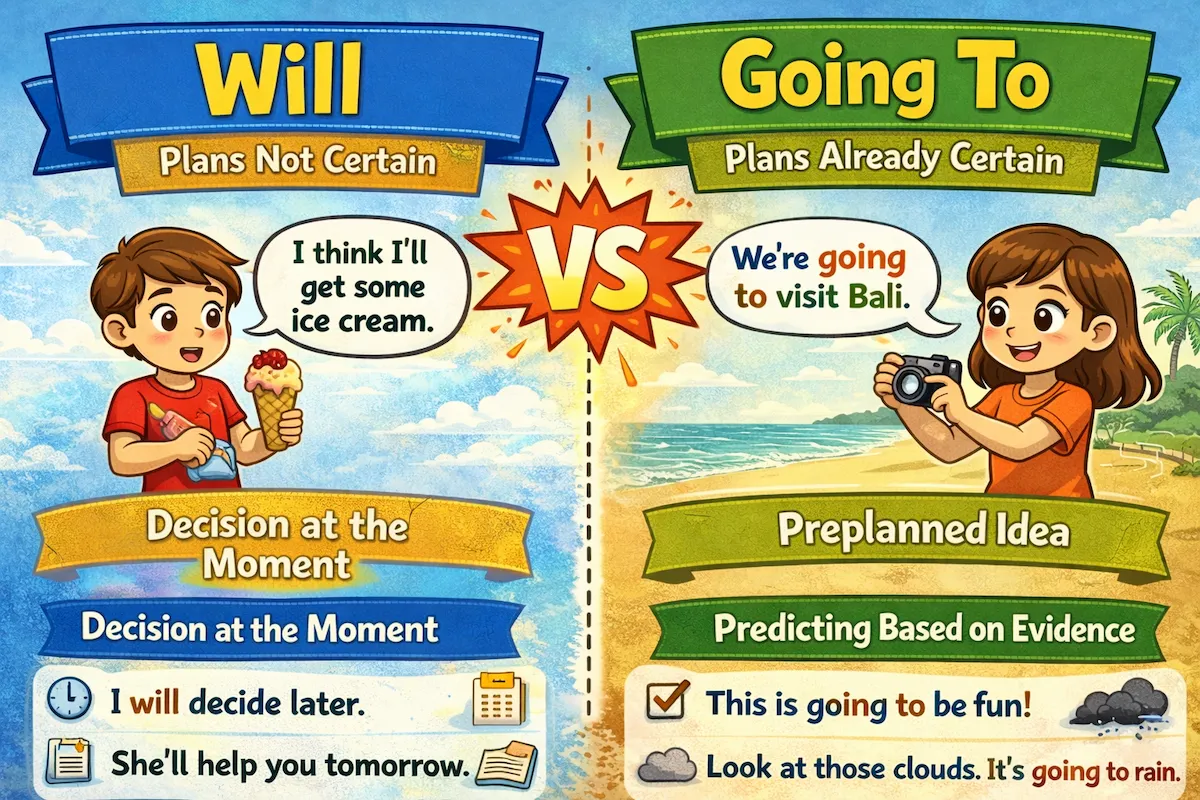
This guide explains how to use “will” and “going to” correctly by focusing on intention and timing. Learn when a future action is spontaneous, planned, or based on evidence, with clear examples and practice questions to master English future tenses naturally.
If you’ve ever said “I will call you later” and then wondered whether “I’m going to call you later” would sound more natural, you’re dealing with one of the most important — and confusing — choices in English grammar.
Both will and going to talk about the future. Both are correct. And yet, they are not interchangeable. Native speakers choose between them instinctively, based on intention, timing, and context.
In this guide, we’ll uncover the real difference between will and going to, explain how native speakers decide which one to use, and give you clear patterns you can apply in daily conversation, planning, and formal communication.
The Big Idea: Decision Time Matters
The core difference between will and going to is when the decision was made.
- Will → decision made now (at the moment of speaking)
- Going to → decision made before now (a plan)
If you remember nothing else from this article, remember this rule.
Using “Will” for Spontaneous Decisions
We use will when we decide to do something as we are speaking. There was no plan — the idea appears suddenly.
Phone battery is dead. I’ll borrow a charger.
The speaker did not plan to borrow a charger earlier. The decision happens in the moment.
Oh, you’re busy? I’ll come back later.
“Will” for Offers and Promises
Another major use of will is for offers, promises, and voluntary actions.
I’ll help you with that report.
Don’t worry. I’ll handle it.
In these cases, will shows willingness, not planning.
Using “Going To” for Planned Actions
Going to is used when the decision was made before the moment of speaking. The plan already exists.
I’m going to start a new job next month.
The decision was made earlier, possibly weeks ago.
We’re going to visit Japan this summer.
“Going To” Shows Intention
When you use going to, you signal intention and preparation.
It often implies that steps have already been taken.
She’s going to learn Spanish. She already signed up for classes.
Predictions: Will vs. Going To
Both forms can be used for predictions, but the logic differs.
- Will → prediction based on opinion or belief
- Going to → prediction based on evidence
I think it will rain tomorrow.
Look at those clouds — it’s going to rain.
Common Mistake: Overusing “Will”
Many learners use will for all future situations. This sounds unnatural to native speakers.
❌ Tomorrow I will meet my boss at 10. ✅ Tomorrow I’m going to meet my boss at 10.
The meeting is planned, so going to is more natural.
Formal vs. Informal Contexts
In formal writing (contracts, announcements, policies), will is often preferred.
The company will provide training to all new employees.
This use of will expresses commitment rather than spontaneity.
Daily Conversation Patterns
In spoken English, especially casual conversation:
- Going to → plans and personal intentions
- Will → reactions, decisions, offers
I’m tired. I think I’m going to sleep early tonight.
You forgot your wallet? I’ll pay.
Questions with Will vs. Going To
Questions also reflect intention.
Will you help me?
This is a request.
Are you going to help me?
This assumes a plan already exists.
Negative Forms and Meaning
Negative forms follow the same logic.
I won’t stay long.
Decision made now.
I’m not going to stay long.
Plan decided earlier.
Native Speaker Intuition
Native speakers don’t think about grammar rules consciously. They think about intention.
Ask yourself:
Did I decide this just now, or did I already plan it?
Practice Test
Please answer the following questions. To see the correct answer, please click the arrow icon.
You see someone struggling with bags. What do you say?
Answer: I’ll help you. Explanation: This is a spontaneous offer.
You decided yesterday to start exercising. How do you say it?
Answer: I’m going to start exercising. Explanation: The decision was made earlier.
You see dark clouds. What’s correct?
Answer: It’s going to rain. Explanation: The prediction is based on evidence.
Which is better for formal promises?
Answer: Will. Explanation: It expresses commitment.
Why does “will” sound wrong for fixed plans?
Answer: It suggests a spontaneous decision. Explanation: Planned actions need “going to.”
Final Thoughts: Plan or React?
The future in English isn’t just about time — it’s about intention.
Use going to when you plan. Use will when you react.
Mastering this distinction instantly makes your English sound more natural, confident, and native-like.