"Strength" vs. "Strongly": From Nouns to Powerful Adverbs
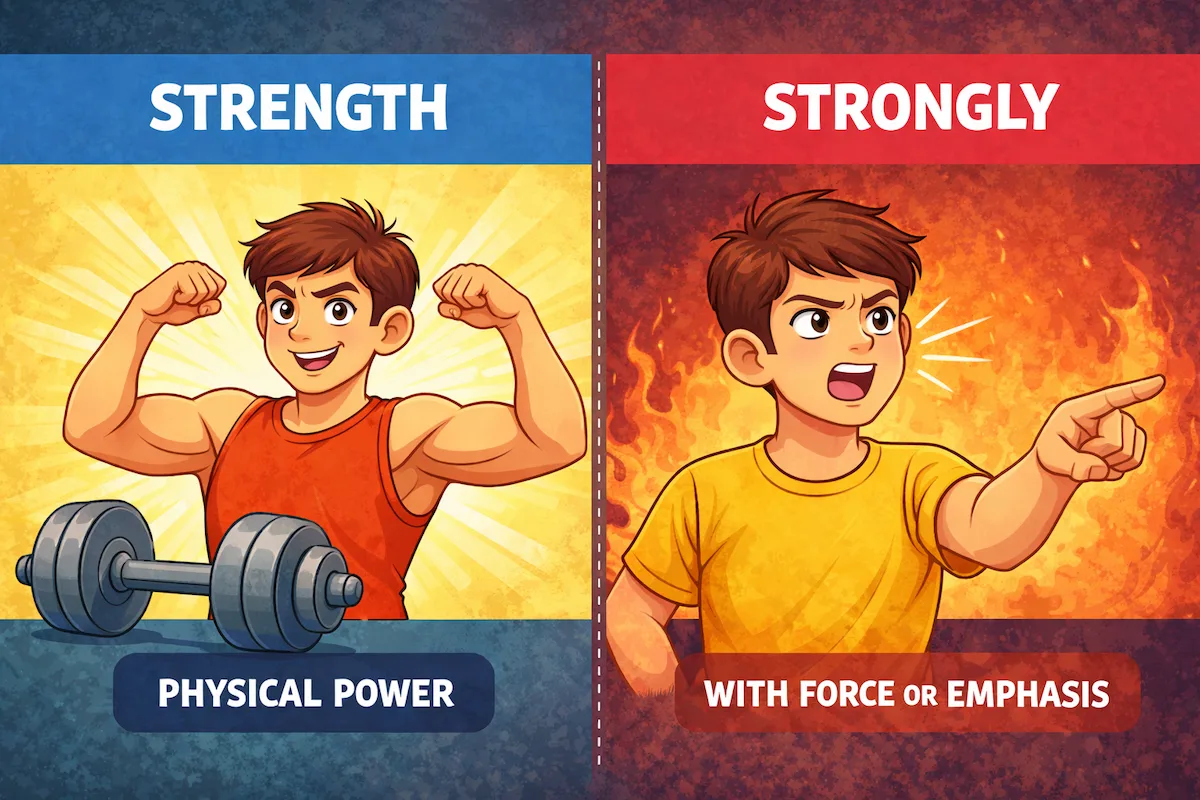
This sentence-patterns guide explains how strength works as a noun and strongly functions as an adverb. Learn how to move from naming a quality to emphasizing an action, avoid common mistakes like “strengthly,” and write clearer, more powerful English.
English often builds meaning by shifting word forms. A single root word can appear as a noun, adjective, or adverb — and each form changes how a sentence works. A clear example of this transformation is the pair strength and strongly.
At first glance, both words relate to power, intensity, or force. But using them interchangeably is a mistake. Strength and strongly serve completely different grammatical purposes, and choosing the wrong one can weaken clarity instead of reinforcing it.
In this sentence-patterns guide, you’ll learn how strength functions as a noun, how strongly operates as an adverb, and how moving from nouns to adverbs allows you to emphasize actions with precision and confidence.
Why Word Form Matters More Than Meaning
Many learners focus on meaning alone: “Both words are about being strong, so they must be similar.” But grammar works differently.
Word form determines:
- Where the word can appear in a sentence
- What it can modify
- How formal or abstract the sentence sounds
Understanding word form helps you build sentences that sound intentional, not accidental.
Understanding “Strength” as a Noun
Strength is a noun. It refers to a quality, ability, or capacity.
Physical strength takes time to build.
Here, strength is the subject of the sentence. It names an abstract concept.
Common Meanings of “Strength”
Strength can describe:
- Physical power
- Mental resilience
- Emotional stability
- A positive quality or advantage
Her greatest strength is her ability to stay calm under pressure.
Sentence Patterns with “Strength”
Because it is a noun, strength fits into noun-based patterns:
- Strength + verb
- Adjective + strength
- Strength of + noun
Teamwork is a key strength of the organization.
Strength Is Static, Not Active
Nouns like strength describe states or qualities. They don’t describe actions directly.
He showed great strength during the crisis.
The focus is on what he has, not what he does.
Understanding “Strongly” as an Adverb
Strongly is an adverb. It modifies verbs, adjectives, or other adverbs.
I strongly disagree.
The adverb intensifies the verb disagree.
Sentence Patterns with “Strongly”
Typical adverbial patterns include:
- Strongly + verb
- Verb + strongly
- Strongly + adjective
She strongly believes in the project.
Strongly Emphasizes Action
Unlike strength, strongly highlights how an action is performed.
The committee strongly supports the proposal.
The emphasis is on intensity, not on a static quality.
Strength vs Strongly: Core Contrast
Strength → what you have Strongly → how you act or feel
Confusing these roles leads to awkward or incorrect sentences.
Why “Strongly” Sounds More Formal
Adverbs like strongly are common in:
- Academic writing
- Professional emails
- Formal opinions
We strongly recommend reviewing the policy.
Why “Strength” Feels More Abstract
Nouns tend to feel more conceptual and reflective.
Leadership strength develops over time.
This pattern is common in analysis and evaluation.
Common Learner Mistakes
- Using “strengthly” (this word does not exist)
- Using “strength” to modify verbs
- Overusing “strongly” in casual conversation
Why “Strengthly” Is Always Wrong
English does not form adverbs from nouns directly.
❌ I strengthly agree. ✅ I strongly agree.
Switching Between Forms Naturally
Skilled writers often use both forms in the same paragraph.
Her strength lies in communication, and she strongly believes in transparency.
Choosing the Right Form Quickly
Ask yourself:
Am I naming a quality? → strength Am I emphasizing an action? → strongly
Practice Test
Please answer the following questions. To see the correct answer, please click the arrow icon.
Choose the correct word: “She ___ supports the plan.”
Answer: strongly Explanation: An adverb is needed to modify the verb “supports.”
Choose the correct word: “Honesty is his greatest ___.”
Answer: strength Explanation: A noun is required as the subject complement.
Is this sentence correct? “They strength believe in teamwork.”
Answer: No. Explanation: The adverb form “strongly” is required.
Which form sounds more formal in recommendations?
Answer: strongly Explanation: Adverbial emphasis is common in formal writing.
Final Thoughts: From Concept to Emphasis
Strength names power as a concept. Strongly expresses power through action and attitude.
Mastering this shift from noun to adverb allows you to control tone, clarity, and emphasis — a key skill for advanced English fluency.