"Live" vs. "Alive": Predicative vs. Attributive Word Forms
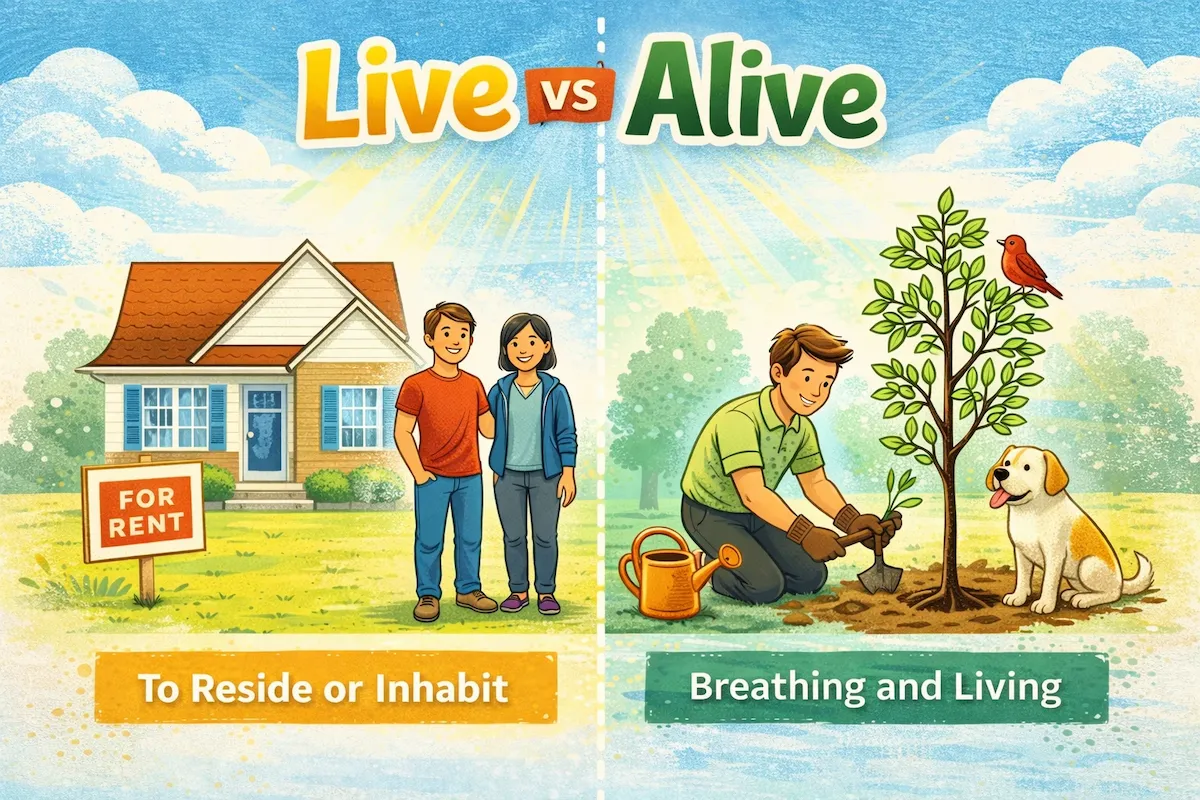
This sentence-patterns usage guide explains the difference between “live” and “alive.” Learn how attributive and predicative adjectives work, why word position matters, and how to avoid common learner mistakes when describing living things in English.
English learners often assume that words with similar meanings can be used in the same way. Unfortunately, that assumption leads to some very noticeable mistakes — and live vs. alive is one of the best examples.
Both words relate to the idea of being living or not dead. Yet native speakers instinctively know that “a live animal” sounds natural, while “an alive animal” sounds wrong — even though the meaning seems similar.
The reason has nothing to do with vocabulary and everything to do with sentence patterns, specifically the difference between attributive and predicative adjectives.
In this usage guide, you’ll learn exactly why live and alive behave differently, how adjective position works in English, and how to avoid one of the most common adjective placement mistakes.
The Core Difference in One Sentence
Here is the rule that explains almost everything:
Live is usually attributive (before a noun). Alive is usually predicative (after a verb).
Understanding this distinction will instantly improve your sentence accuracy.
What Is an Attributive Adjective?
An attributive adjective appears before a noun and directly describes it.
a live animal a live broadcast live music
In all of these examples, live comes directly before the noun.
Attributive adjectives are tightly connected to the noun they modify.
Why “Live” Works Before a Noun
When live is used as an adjective, it usually means:
- Not recorded
- Not dead
- Happening in real time
We watched a live concert. The scientists studied a live specimen.
In these cases, “live” functions naturally as a descriptive label.
What Is a Predicative Adjective?
A predicative adjective appears after a linking verb, such as:
- be
- seem
- appear
- feel
The animal is alive. She seems alive again.
The adjective describes the subject’s state, not the noun directly.
Why “Alive” Does Not Work Before a Noun
Alive is almost always predicative.
It describes a condition or state that is confirmed or observed, not a defining label.
Incorrect: an alive animal Correct: the animal is alive
Native speakers reject “an alive animal” because alive resists attributive placement.
Live vs Alive: Side-by-Side Comparison
a live fish → correct the fish is alive → correct an alive fish → incorrect
The meaning is similar, but the sentence pattern is different.
Meaning Difference: Subtle but Important
While both words relate to life, their emphasis differs slightly.
- Live → functional, descriptive
- Alive → state or condition
They released live animals into the wild. The animals are alive and healthy.
Why Learners Make This Mistake
This error happens because many languages allow adjectives to appear anywhere without restriction.
English, however, restricts certain adjectives to specific positions.
Alive, asleep, aware, and afraid behave similarly.
Alive Is Part of a Special Group
“Alive” belongs to a group of adjectives that are:
- State-based
- Often emotional or physical
- Mostly predicative
The child is asleep. The team is aware of the issue.
Saying “an asleep child” sounds unnatural for the same reason.
Live as an Adjective vs Live as a Verb
Another source of confusion is that live can also be a verb.
They live in Canada. We watched a live event.
Context and position make the meaning clear.
Formal vs Informal Usage
Both forms appear in formal and informal English.
The difference is grammatical, not stylistic.
The patient is alive. Doctors examined live tissue samples.
Common Learner Mistake #1
Incorrect: They found an alive bird. Correct: They found a live bird.
The adjective appears before the noun, so “live” is required.
Common Learner Mistake #2
Incorrect: The animal is live. Correct: The animal is alive.
After “is,” we need a predicative adjective.
A Simple Position Test
Ask yourself:
Am I placing the adjective before a noun or after a verb?
Before noun → live After verb → alive
Practice Test
Please answer the following questions. To see the correct answer, please click the arrow icon.
Which is correct: a ___ animal was rescued.
Answer: live Explanation: The adjective appears before the noun.
Which is correct: the animal is ___.
Answer: alive Explanation: “Alive” works after a linking verb.
Why is “an alive animal” incorrect?
Answer: Because “alive” is primarily predicative. Explanation: It describes a state, not a defining attribute.
Which sentence is natural?
Answer: We watched a live broadcast. Explanation: “Live” works attributively.
Why This Pattern Matters
Understanding adjective position:
- Prevents unnatural phrasing
- Improves fluency
- Signals advanced grammar awareness
Native speakers may not explain the rule — but they hear the mistake instantly.
Final Thoughts: Meaning Isn’t Enough
“Live” and “alive” show that English grammar is about more than definitions.
Word form, position, and sentence pattern all work together to create natural-sounding English.
Mastering this distinction helps you move from understandable English to fluent, confident English.