Zero Conditional for Logical If-Then Statements in Programming
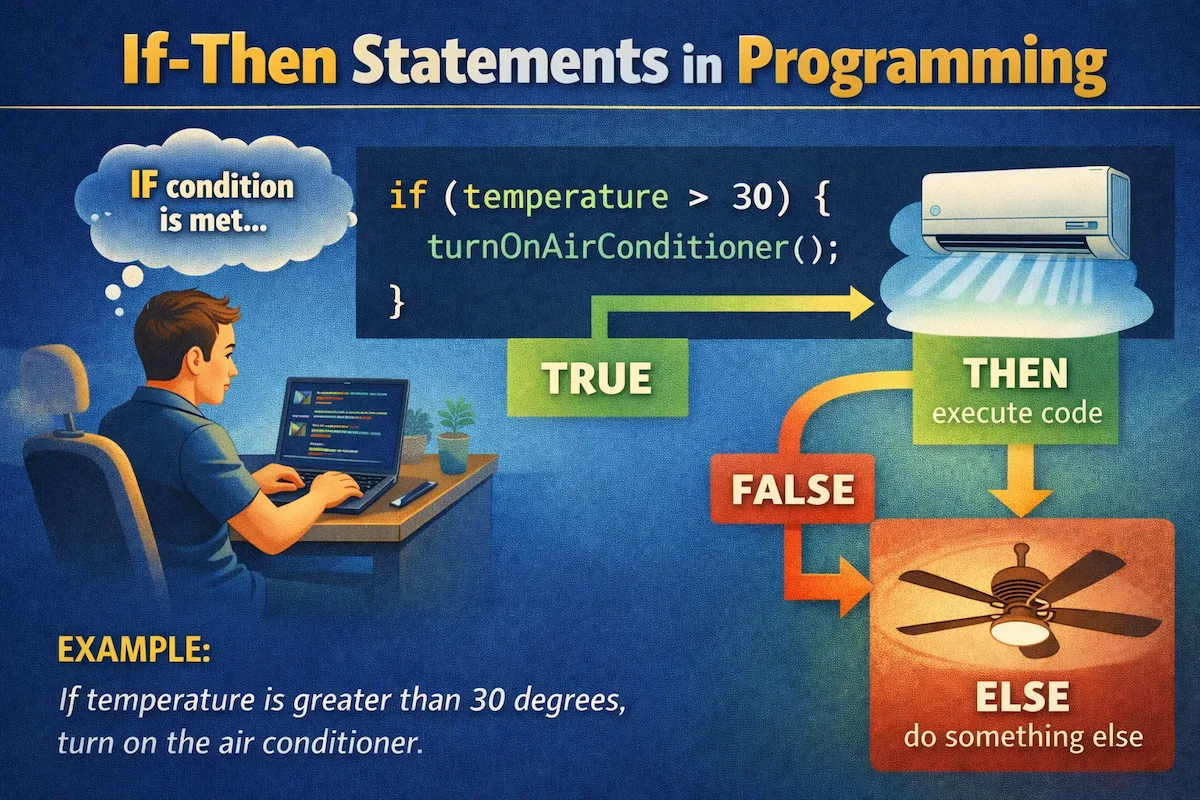
This tenses-in-action guide explains how the zero conditional works in programming and logical writing. Learn why present simple is used in both clauses, how zero conditional mirrors computer logic, and how to write clear if-then rules for software, systems, and technical documentation.
If you work with technology, programming, or logical systems, you already think in conditional patterns — even if you don’t realize it. Every time you say something like “If the user clicks the button, the page reloads”, you’re using a structure that looks exactly like a line of code.
In English grammar, this structure is called the zero conditional. It’s one of the simplest conditionals, but also one of the most powerful — especially in technical writing, documentation, and explanations involving cause and effect.
In this usage guide, we’ll explore how the zero conditional works, why it fits perfectly with programming logic, and how you can use it to write clear, precise “if-then” statements for technology, software, and logical reasoning.
What Is the Zero Conditional?
The zero conditional is used to talk about things that are always true.
If + present simple, present simple
If you heat ice, it melts.
The key idea is certainty. The result always happens when the condition is met.
Why It’s Called “Zero” Conditional
It’s called “zero” because there is no future or hypothetical distance. The statement is factual, logical, and repeatable.
This makes it ideal for describing:
- Scientific facts
- General truths
- System behavior
- Program logic
The Parallel Between English and Programming
Compare these two statements:
If the temperature drops below zero, the system shuts down.
if (temperature < 0) { shutdown(); }
Grammatically and logically, they do the same thing. This is why programmers often find the zero conditional intuitive.
Structure of the Zero Conditional
The standard pattern looks like this:
If / When + present simple, present simple
Both clauses use the present simple tense because the statement describes a consistent rule.
“If” vs. “When” in Zero Conditional
In zero conditional sentences, if and when are often interchangeable.
If you press this key, the program exits. When you press this key, the program exits.
Both imply the same predictable outcome.
Zero Conditional in Software Documentation
Technical manuals rely heavily on the zero conditional.
If the file is missing, the application displays an error message.
This sentence describes system behavior, not a future possibility.
Why Not Use the Future Tense?
Learners often write:
Incorrect: If the user clicks the button, the page will reload.
While this isn’t always wrong, in technical logic the zero conditional is preferred because it expresses rules, not predictions.
Preferred: If the user clicks the button, the page reloads.
Zero Conditional vs First Conditional
Compare:
Zero conditional: If you enter invalid data, the system rejects it. First conditional: If you enter invalid data, the system will reject it.
The first sentence sounds like a design rule. The second sounds like a future event.
Why Engineers Prefer Zero Conditional
Engineers and developers think in deterministic logic.
A rule should be:
- Always true
- Predictable
- Repeatable
The zero conditional matches this mindset perfectly.
Common Zero Conditional Examples in Tech
If the server is down, users cannot log in. If memory usage exceeds the limit, the process stops. If the password is incorrect, access is denied.
These sentences describe system rules.
Word Order Flexibility
You can reverse the clauses:
The system shuts down if the temperature rises too high.
The meaning stays the same.
Negative Zero Conditional
Negatives follow the same pattern.
If the user does not agree, the process stops.
This mirrors negative conditions in code.
Zero Conditional in Logical Writing
Outside programming, the zero conditional appears in instructions and rules.
If you mix red and blue, you get purple.
The logic is universal.
Using Zero Conditional for Teaching
Teachers use it to explain systems and processes.
If a student misses the deadline, they lose points.
The rule applies consistently.
Common Learner Mistakes
Incorrect: If you will click the button, the program starts. Correct: If you click the button, the program starts.
The future tense does not belong in zero conditional structures.
Memory Trick
Think like a computer:
Condition true → result happens
No guessing, no future prediction — just logic.
Practice Test
Please answer the following questions. To see the correct answer, please click the arrow icon.
Which tense is used in both clauses of the zero conditional?
Answer: Present simple. Explanation: Zero conditional describes general truths.
Which sentence describes a system rule?
Answer: If the password is incorrect, access is denied. Explanation: It shows a consistent cause-effect relationship.
Can “when” replace “if” in zero conditional sentences?
Answer: Yes. Explanation: Both imply certainty in this structure.
Why is zero conditional preferred in technical writing?
Answer: Because it expresses fixed logic. Explanation: It describes rules, not future possibilities.
Why This Matters in Tech Communication
Clear conditionals reduce misunderstanding.
When users, developers, or stakeholders read your instructions, they should immediately understand what happens — and when.
Final Thoughts: Think Like Code, Write Like English
The zero conditional sits at the intersection of language and logic.
If you already think in “if-then” structures, mastering this tense will feel natural — and it will make your technical English clearer, sharper, and more professional.