How to Use "Question Tags" to Keep Any Conversation Going
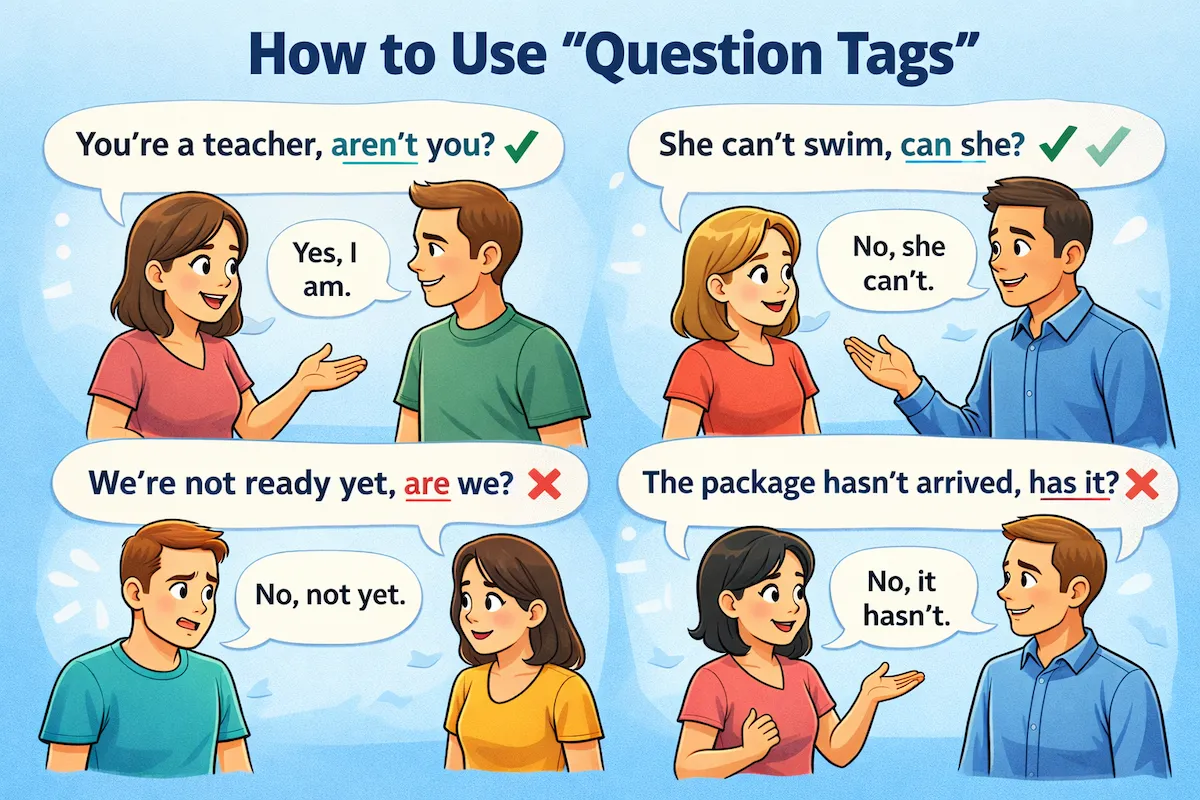
This sentence-patterns guide explains how to use question tags like “isn’t it?” to keep English conversations going. Learn tag structure, intonation, and real-life examples to confirm information, invite responses, and sound more fluent in everyday small talk.
One of the biggest challenges in English conversation isn’t grammar or vocabulary — it’s keeping the conversation alive. You may know how to answer questions, but what happens after that awkward pause?
This is where question tags quietly do their magic. Short, flexible, and incredibly natural, question tags help you confirm information, invite responses, and gently keep people engaged without sounding pushy or unnatural.
In this usage guide, you’ll learn how to use question tags correctly, naturally, and confidently — not just as a grammar rule, but as a powerful conversational tool for small talk, socializing, and everyday English.
What Is a Question Tag?
A question tag is a short question added to the end of a statement.
It’s cold today, isn’t it?
The main sentence gives information. The tag invites confirmation or response.
Why Question Tags Keep Conversations Going
Without a question tag, a statement can feel closed.
It’s cold today.
With a question tag, it becomes an invitation.
It’s cold today, isn’t it?
That small change turns a comment into a conversation starter.
The Basic Pattern of Question Tags
The most common structure follows a simple rule:
Positive statement + negative tag Negative statement + positive tag
You’re busy, aren’t you? You aren’t busy, are you?
Matching the Auxiliary Verb
The verb in the tag must match the main verb in the sentence.
She’s coming later, isn’t she? They finished already, didn’t they?
This is where many learners hesitate — but with practice, it becomes automatic.
Using Question Tags in Small Talk
Question tags are especially common in casual conversation.
Nice place, isn’t it? Long day, wasn’t it?
These phrases feel friendly and non-invasive.
Confirming Information Politely
Instead of directly questioning someone, a tag softens the confirmation.
You work in marketing, don’t you?
This sounds more relaxed than:
Do you work in marketing?
Keeping the Other Person Talking
One powerful use of question tags is encouraging longer responses.
You’ve been here before, haven’t you?
This invites a story, not just a yes or no.
Rising vs Falling Intonation
Intonation changes meaning.
- Rising intonation → genuine question
- Falling intonation → expecting agreement
You’re new here, aren’t you? ↗ That was a great meeting, wasn’t it? ↘
Common Question Tags in Daily English
- isn’t it?
- aren’t you?
- don’t they?
- didn’t we?
- won’t you?
Mastering these covers most real-life situations.
Question Tags with “I am”
“I am” has a special tag.
I’m late, aren’t I?
Not: “am I not?”
Negative Statements and Positive Tags
You don’t like coffee, do you? She isn’t joining us, is she?
These often sound more neutral and careful.
Question Tags in Polite Suggestions
Tags soften suggestions and opinions.
We could leave a bit earlier, couldn’t we?
This feels collaborative rather than directive.
What to Avoid with Question Tags
- Using the wrong auxiliary verb
- Overusing tags in formal writing
- Forcing tags where a direct question is better
Written vs Spoken English
Question tags are far more common in spoken English than in formal writing.
In emails or reports, they may sound too casual.
Practice Test
Please answer the following questions. To see the correct answer, please click the arrow icon.
Which tag correctly completes this sentence: “She’s finished, ___?”
Answer: isn’t she? Explanation: The auxiliary verb matches “is.”
What does rising intonation usually signal?
Answer: A real question. Explanation: It shows uncertainty or curiosity.
Which sentence sounds more conversational?
Answer: It’s busy today, isn’t it? Explanation: The tag invites response.
Is “I’m early, am I not?” correct?
Answer: No. Explanation: “Aren’t I?” is the correct tag.
Why Question Tags Signal Fluency
Fluent speakers use question tags instinctively. They show rhythm, confidence, and social awareness.
Using them naturally makes your English sound less rehearsed and more human.
Final Thoughts: Small Pattern, Big Impact
Question tags are not just grammar — they’re conversation glue.
Master a few core patterns, and you’ll notice conversations flowing more smoothly, responses becoming longer, and interactions feeling more natural.