"Goal" vs. "Objective" vs. "Target" – Precision in Planning
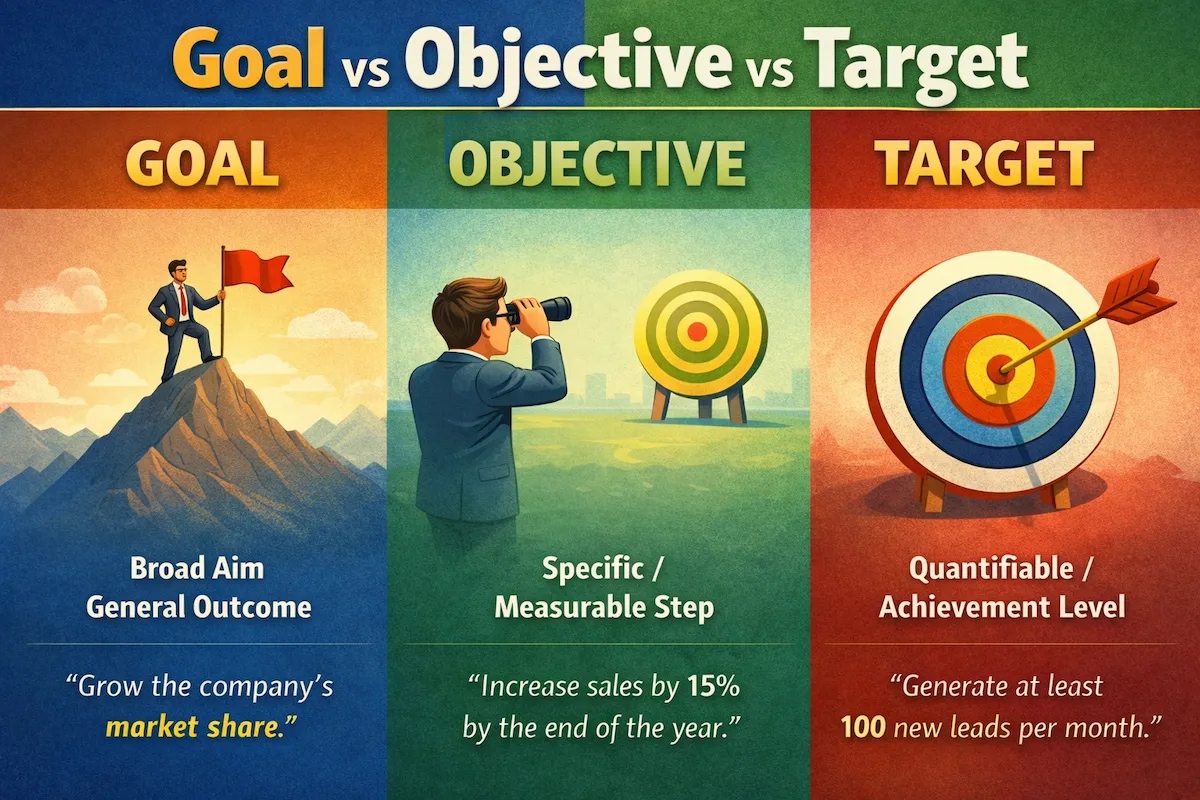
This synonyms-in-context guide explains the difference between goal, objective, and target. Learn how goals express long-term vision, objectives define actionable steps, and targets specify measurable numbers in business, planning, and professional communication.
In everyday conversation, people often use goal, objective, and target as if they mean exactly the same thing. You might hear sentences like “Our goal is to hit this target” or “The objective is our goal this year,” and nobody seems confused.
But in professional, academic, and business contexts, these three words carry distinct meanings. Choosing the wrong one doesn’t just sound slightly off — it can create confusion about priorities, timelines, and expectations.
In this usage guide, we’ll explore the subtle but important differences between goal, objective, and target. You’ll learn how each word functions in planning, strategy, and performance discussions — and how to use them with precision and confidence.
The Big Picture: Why Precision Matters
In planning and project management, language shapes thinking. When a manager says “This is our goal,” people expect something broad and aspirational. When they hear “This is the target,” they expect a number, a deadline, or a concrete outcome.
Mixing these terms can blur responsibility and make success harder to measure.
What Is a Goal?
A goal is a broad, long-term intention. It describes where you want to go, not exactly how or when you’ll get there.
Our goal is to become a market leader in sustainable packaging.
Goals are often inspirational. They provide direction and motivation rather than measurable detail.
Key Characteristics of a Goal
- Long-term
- Broad and strategic
- Vision-oriented
- Not always measurable
A goal answers the question: Where do we want to be?
What Is an Objective?
An objective is more specific than a goal. It breaks a big vision into actionable steps.
One objective this year is to expand into three new regional markets.
Objectives turn abstract ambition into concrete direction.
How Objectives Support Goals
Think of objectives as milestones on the path to a goal.
Goal: Improve customer satisfaction. Objective: Reduce average response time to under 24 hours.
Objectives answer the question: What needs to happen to reach the goal?
Key Characteristics of an Objective
- Short- to medium-term
- Clear and specific
- Often measurable
- Action-focused
What Is a Target?
A target is the most precise of the three. It refers to a specific, measurable outcome — often a number, date, or percentage.
Our sales target for Q3 is $2 million.
Targets are concrete and leave little room for interpretation.
Targets Are About Measurement
Targets answer the question: Exactly how much, how many, or by when?
Increase website traffic by 15%. Hire 10 new engineers by December.
Unlike goals, targets are either met or not met.
Comparing the Three Side by Side
Goal → Improve company performance. Objective → Increase customer retention. Target → Reach a 90% retention rate by Q4.
Each term narrows the focus.
Why “Target” Sounds Stronger
In business language, target often carries pressure and accountability.
We missed our target.
This sentence implies clear measurement and responsibility.
Goal vs Objective in Everyday English
Outside business, people often use goal where professionals might say objective.
My goal is to learn Spanish this year.
In formal planning, this would likely be broken into objectives.
Objective in Academic and Technical Writing
In academic writing, objective is preferred over goal.
The objective of this study is to analyze consumer behavior.
It sounds precise and methodical.
Target in Marketing and Sales
Target is especially common in sales, marketing, and performance metrics.
This campaign targets young professionals.
Here, target can also function as a verb.
Common Learner Mistakes
Incorrect: Our goal is $5 million in revenue this year. Better: Our revenue target is $5 million this year.
Numbers usually belong with target.
Memory Framework
Vision → Goal Plan → Objective Number → Target
This simple framework helps you choose the right word quickly.
Practice Test
Please answer the following questions. To see the correct answer, please click the arrow icon.
Which word best fits: “Our long-term ___ is to expand globally.”
Answer: goal Explanation: It describes a broad, long-term vision.
Which word fits: “Our ___ is to reduce costs by improving efficiency.”
Answer: objective Explanation: It defines a specific action that supports a goal.
Which word fits: “Our sales ___ is 10,000 units this quarter.”
Answer: target Explanation: It refers to a precise, measurable number.
Which term is most common in academic writing?
Answer: objective Explanation: It sounds formal and analytical.
Why Native Speakers Care About These Distinctions
Native speakers may understand you even if you mix these words — but precision signals professionalism.
Using the correct term shows you understand planning logic, not just vocabulary.
Final Thoughts: Precision Builds Credibility
Goals inspire. Objectives guide. Targets measure.
Mastering these distinctions helps your English sound clearer, smarter, and more professional — especially in business and strategic discussions.